
A father has blood group A and mother has blood group B. What will be the possible blood groups of the progeny?
Answer & explanation
Correct answer: option 2
The correct answer is Option (2) → A, B, AB and O
ABO blood groups are controlled by gene I with three alleles, IA, IB and i. IA and IB are dominant over i and co-dominant with each other. A father of group A can be IAi, and a mother of group B can be IBi. The question asks what is possible, so take both as heterozygous:
| IB (mother) | i (mother) | |
| IA (father) | IAIB = AB | IAi = A |
| i (father) | IBi = B | ii = O |
All four blood groups can appear among the children.
Option (1) AB — Incorrect. AB arises only when both parents pass on IA and IB. It is one possible group, but not the only one.
Option (2) A, B, AB and O — Correct. With heterozygous parents, the children can be A, B, AB or O, as the square shows.
Option (3) Only O — Incorrect. Group O needs i from both parents. It is possible, but the other three groups are possible as well.
Option (4) Only A and B. — Incorrect. A and B are possible, but AB and O are left out, so “only A and B” is wrong.
NCERT Extract:
Co-dominance – “… The gene (I) has three alleles IA, IB and i. The alleles IA and IB produce a slightly different form of the sugar while allele i does not produce any sugar. Because humans are diploid organisms, each person possesses any two of the three I gene alleles. IA and IB are completely dominant over i, in other words when IA and i are present only IA expresses (because i does not produce any sugar), and when IB and i are present IB expresses. But when IA and IB are present together they both express their own types of sugars: this is because of co-dominance.”
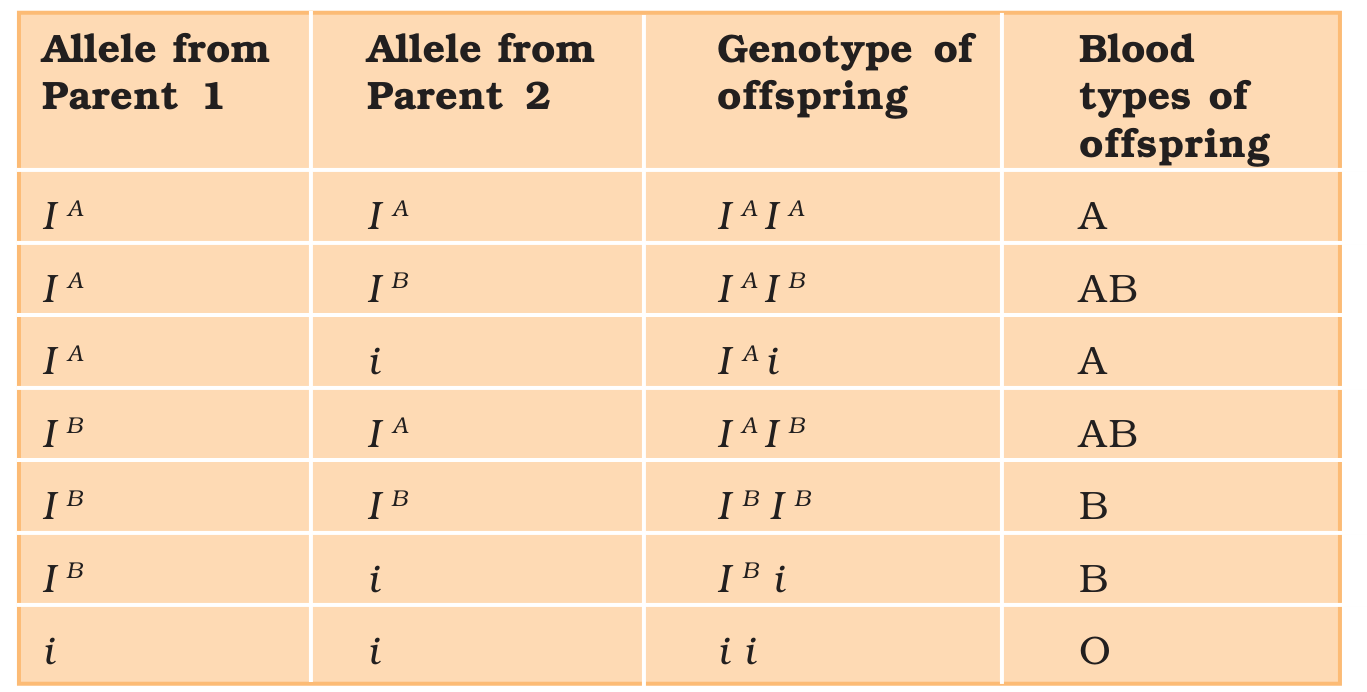
Table 4.2: Table Showing the Genetic Basis of Blood Groups in Human Population