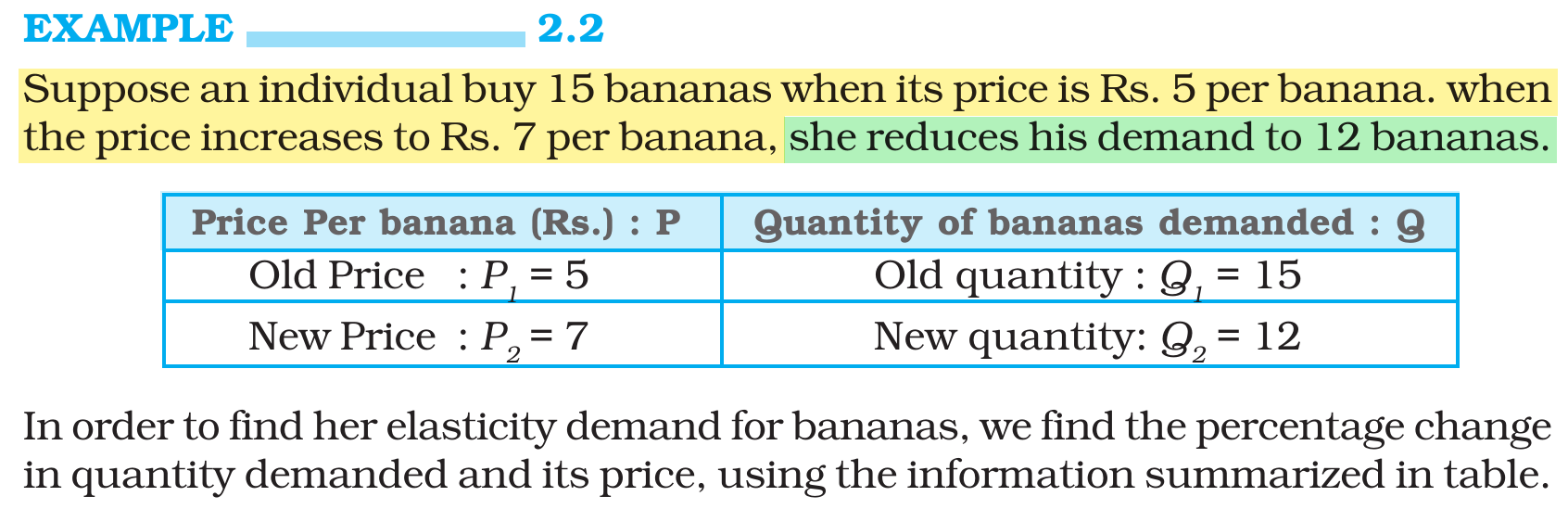
Suppose an Individual buys 15 units of good when its price is ₹5 per unit. What will happen to his demand when price of the good increases to ₹7 per unit and elasticity of demand for the good is 0.5?
Answer & explanation
Correct answer: option 3
The correct answer is Option (3) → Reduce his demand
Given:
Old price = ₹5, new price = ₹7
Quantity at ₹5 = 15 units
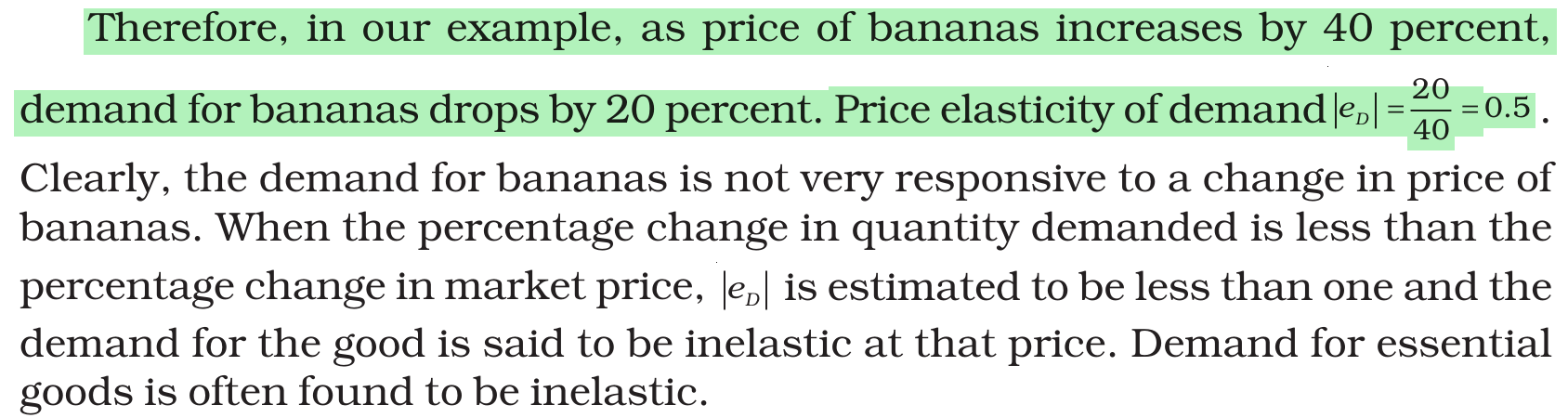
Price elasticity of demand (eD) = 0.5
By the law of demand, he buys less when the price rises. Price elasticity of demand (eD) is the percentage change in demand divided by the percentage change in price:
Change in price = (7 − 5)/5 × 100 = 40 per cent
Change in demand = 0.5 × 40 = 20 per cent
Fall in quantity = 20 per cent of 15 = 3 units
New quantity = 15 − 3 = 12 units
His demand falls from 15 to 12 units.
Note: NTA built this question on the NCERT book’s own worked example on the demand for bananas. It kept the same prices and the same starting quantity, but wrote ‘units of good’ in place of bananas. It asked only which way demand moves. It left out the new quantity of 12 that the book works out.
NCERT (2026-27): Introductory Microeconomics — Chapter 2: Theory of Consumer Behaviour
|