Choose the statements that describe the Panchayati Raj System.
A. It means governance by five individuals
B. The structure is like a pyramid
C. Election to Panchayati Raj bodies is conducted every 5 years
D. It is for all the states having population of over 40 lakhs.
Choose the correct answer from the options given below:
Answer & explanation
Correct answer: option 1
The correct answer is Option (1) → A, B and C only
A. It means governance by five individuals Correct. Panchayati Raj translates literally to ‘Governance by five individuals’. The idea is to have a functioning and vibrant democracy at the village or grassroot level.
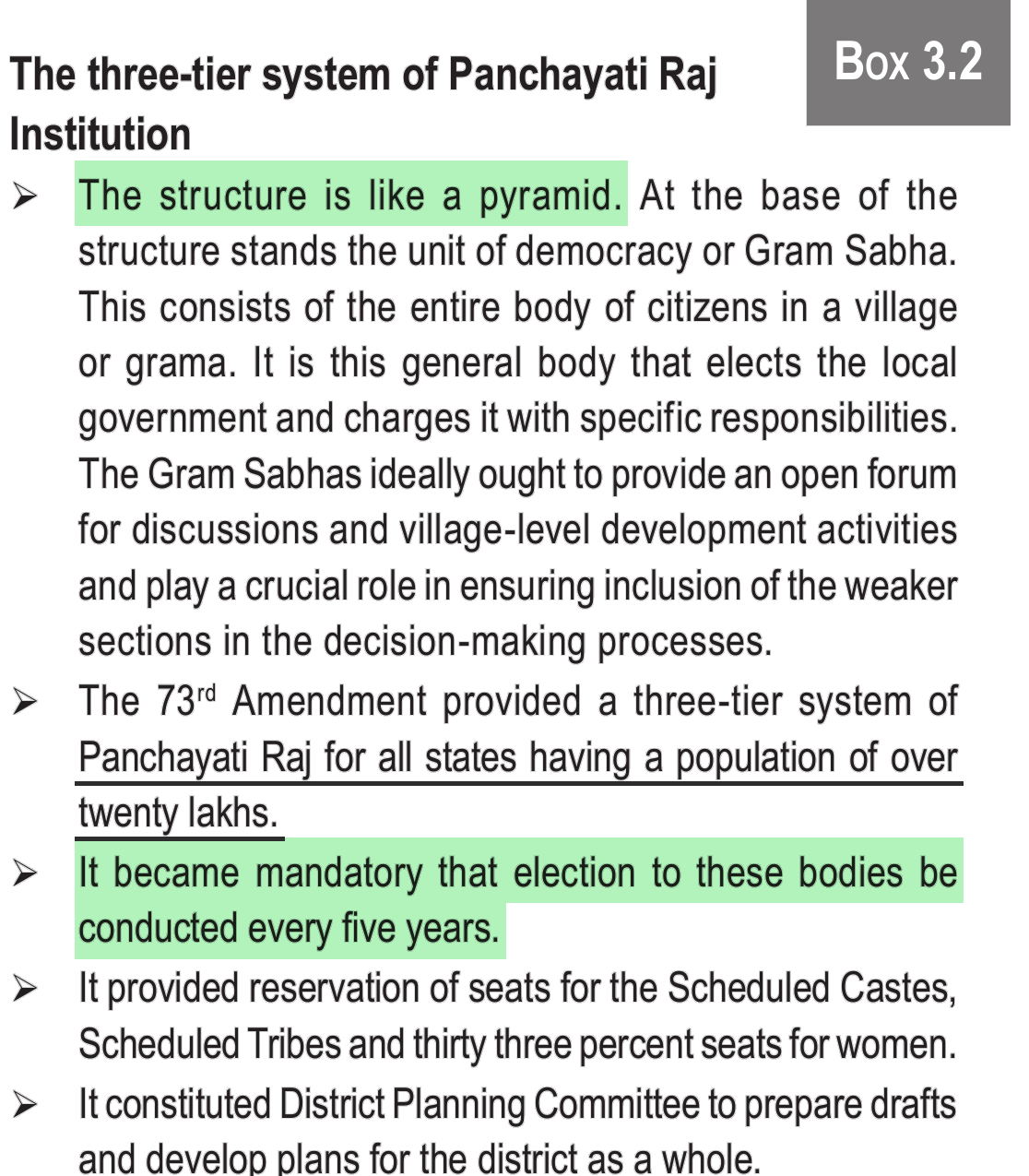
B. The structure is like a pyramid Correct. The three-tier system is like a pyramid. At its base stands the Gram Sabha, the entire body of citizens of a village, which elects the local government and charges it with its responsibilities.
C. Election to Panchayati Raj bodies is conducted every 5 years Correct. The 73rd Amendment made it mandatory that election to these bodies be conducted every five years.
D. It is for all the states having population of over 40 lakhs. Incorrect. The 73rd Amendment provided the three-tier system of Panchayati Raj for all states having a population of over twenty lakhs, not forty lakhs. A single figure, forty in place of twenty, made the statement false, so check every number as carefully as the words.
Note: The chapter ‘The Story of Indian Democracy’ of the pre-rationalised NCERT, which NTA followed in 2023, has been renamed ‘The Constitution and Social Change’ in the NCERT book (2025-26). Its section on Panchayati Raj, with the box on the three-tier system, is still there.
NCERT (2025-26): “Ideals of Panchayati Raj … Panchayati Raj translates literally to ‘Governance by five individuals’. The idea is to ensure at the village or grass root level a functioning and vibrant democracy. While the idea of grassroot democracy is not an alien import to our country, in a society where there are sharp inequalities, democratic participation is hindered on grounds of gender, caste and class. Furthermore, as you shall see in the newspaper reports later in the chapter, traditionally there have been caste panchayats in villages. But they have usually represented dominant groups. Furthermore, they often held conservative views and often have, and continue to take decisions that go against both democratic norms and procedures.…”
Box 3.2 (NCERT 2025-26) |