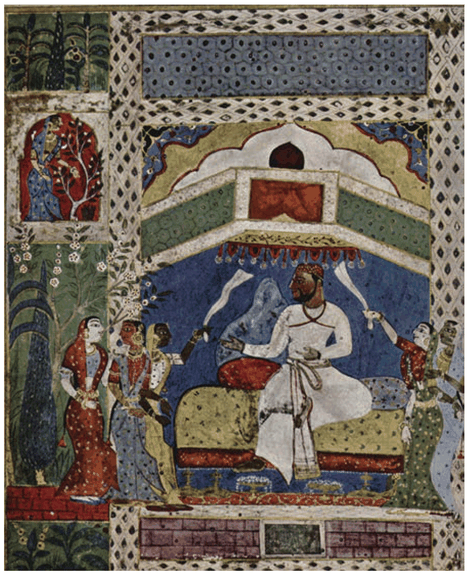
Court painting grew in several Deccani kingdoms in the sixteenth century. Given below are two statements: one is labelled as Assertion (A) and the other is labelled as Reason (R).
Assertion (A): The kingdoms of Bijapur, Golconda and Ahmadnagar developed highly sophisticated and distinct schools of court painting.
Reason (R): The painting Tarif-i-Hussain Shahi: King sitting on the Throne belongs to the Bijapur school.
In the light of the above statements, choose the most appropriate answer from the options given below:
Answer & explanation
Correct answer: option 3
The correct answer is Option (3) → (A) is true but (R) is false.
Assertion (A): The kingdoms of Bijapur, Golconda and Ahmadnagar developed highly sophisticated and distinct schools of court painting. — True. Each of these three kingdoms had its own distinct school of court painting.
Reason (R): The painting Tarif-i-Hussain Shahi: King sitting on the Throne belongs to the Bijapur school. — False. This painting comes from Ahmadnagar and is dated 1565–1569. It does not belong to Bijapur.
NCERT (2026-27): “The Deccani Schools of Painting …The kingdoms of Bijapur, Golconda and Ahmadnagar developed highly sophisticated and distinct school of court painting. Its unique sensuality and intense colours have strong affinity to regional aesthetics. The school preferred dense composition and attempted to create an aura of romance, which invariably expressed itself in an idiom that was eloquently natural and vivid.”
“Tarif–i–Hussain Shahi: King sitting on the Throne, Ahmadnagar, 1565–1569, Bharata Itihasa Samshodaka Mandala, Poona” |