
A man plans to jump and climb the stairs. The path (as shown in the figure) he moves for the first jump is given by \(y = y(x) = x + \sqrt{2x - 3x^2}\) where ‘x’ (in meters) is the horizontal distance moved and ‘y’ (in meters) is the corresponding height. Assuming that his initial point is at origin.
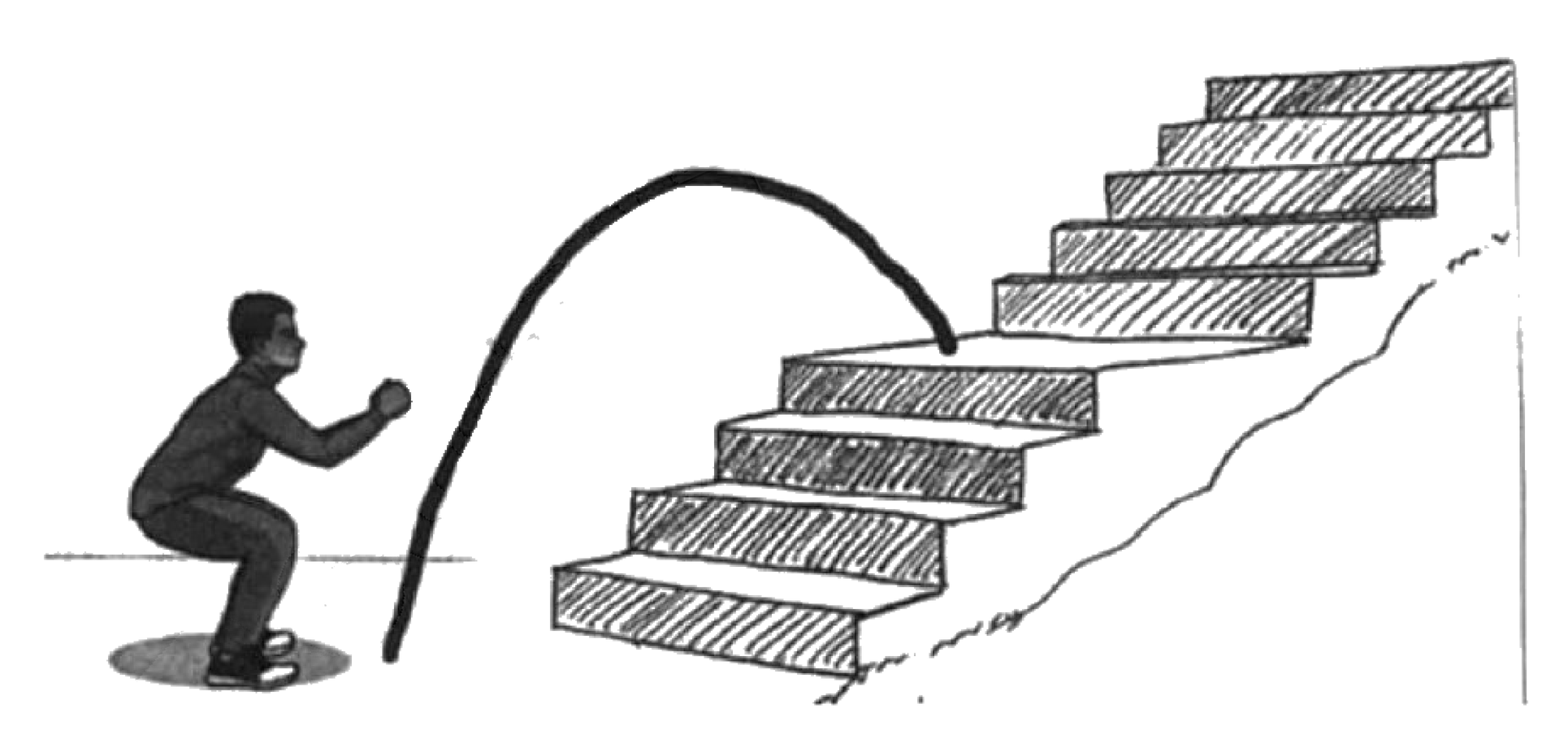
Based on the above information answer the Questions
y(x) is strictly increasing in the interval
Answer & explanation
Correct answer: option 3
The correct answer is Option (3) → \(\left(0, \displaystyle\frac{1}{2}\right)\)
The path is defined for \(0 \le x \le \frac{2}{3}\), and
\( \displaystyle \frac{dy}{dx} = 1 + \frac{1 - 3x}{\sqrt{2x - 3x^2}} \)
y is strictly increasing where dy/dx > 0.
For \(0 \lt x \le \frac{1}{3}\), \(1 - 3x \ge 0\), so dy/dx > 0.
For \(\frac{1}{3} \lt x \lt \frac{2}{3}\), dy/dx > 0 means \(\sqrt{2x - 3x^2} \gt 3x - 1\), where both sides are positive. Squaring:
\(2x - 3x^2 \gt 9x^2 - 6x + 1\)
\(12x^2 - 8x + 1 \lt 0\)
\((6x - 1)(2x - 1) \lt 0\)
\( \displaystyle \frac{1}{6} \lt x \lt \frac{1}{2} \)
Together with \(x \gt \frac{1}{3}\), this gives \(\frac{1}{3} \lt x \lt \frac{1}{2}\).
So dy/dx > 0 on \(\left(0, \frac{1}{2}\right)\) and dy/dx < 0 on \(\left(\frac{1}{2}, \frac{2}{3}\right)\): y(x) is strictly increasing on \(\left(0, \frac{1}{2}\right)\). The intervals in Options (1), (2) and (4) all contain part of \(\left(\frac{1}{2}, \frac{2}{3}\right)\), where y decreases.