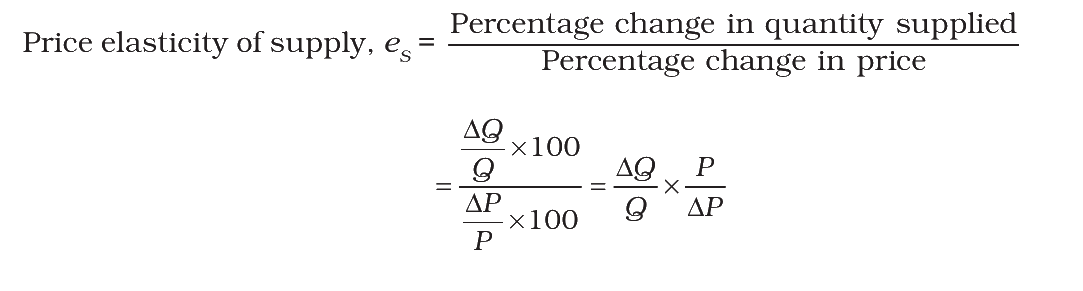
When the price of a good rises from Rs 20 to Rs 24 per kg, a firm raises the quantity it supplies from 400 kg to 520 kg. If the quantities were measured in grams instead of kilograms, the price elasticity of supply would be:
Answer & explanation
Correct answer: option 4
The correct answer is Option (4) → 1.5
Given:
Price: Rs 20 to Rs 24 per kg
Quantity supplied: 400 kg to 520 kg
Price elasticity of supply = percentage change in quantity supplied ÷ percentage change in price.
Percentage change in quantity = 120 / 400 × 100 = 30%
Percentage change in price = 4 / 20 × 100 = 20%
eS = 30 / 20 = 1.5
In grams, the quantities become 4,00,000 and 5,20,000. The change is still 30%, so eS stays 1.5. Elasticity uses percentage changes, so it does not depend on the units.
Option (3) 0.67 — this comes from dividing the other way round (20 / 30).
NCERT (2026-27): “4.7 Price Elasticity of Supply The price elasticity of supply of a good measures the responsiveness of quantity supplied to changes in the price of the good. More specifically, the price elasticity of supply, denoted by eS, is defined as follows”
“4.7 Price Elasticity of Supply … Like the price elasticity of demand, the price elasticity of supply is also independent of units.” |