
CUETMOCK
  • Pricing
  • Mentors
Log inStart freeStart free mocks→

First test, then trust

Try a free CUET mock test.

Join 5,00,000+ students who rehearsed exam day on the exact NTA screen before sitting CUET. On the web and on Android.

Start free mocks →Get the Android app
CUETMOCK

India's #1 CUET Mock Test Platform. Original NCERT-based questions on the exact NTA exam screen — trusted by 5,00,000+ students since CUET 2022.

Get it onGoogle PlayScan to download the CUETMOCK app

Mock tests

  • CUET mock test series
  • Browse all papers
  • Commerce mocks
  • Humanities (Arts) mocks
  • Science mocks
  • Languages & GAT mocks
  • Free practice questions
  • Pricing

Resources

  • CUET exam guide
  • CUET syllabus
  • Universities accepting CUET
  • Expert blogs
  • News & notifications
  • Webinars & counselling
  • CUET score calculator
  • How we estimate your rank
  • FAQs

Company

  • About us
  • Our leadership & team
  • Our toppers
  • Mentors
  • For schools
  • Contact us
  • Terms
  • Privacy
  • Refund policy

Talk to us

+91 7696 6630 56info@cuetmock.comWhatsApp us

Our other platforms

  • JEE Mock — For IIT-JEE aspirants
  • NEET Mock — For NEET aspirants

Newsletter

Exam updates, study material and offers — no spam.

© 2026 NYC Ventures Pvt. Ltd.

701-702, Royal Business Park, Zirakpur, Punjab - 140603

  • Terms of use
  • Privacy policy
  • Refund policy
  • Contact us

iCUETMOCK is an independent preparation platform, not affiliated with the National Testing Agency (NTA). Always check exam details on the official NTA website.

  • Home
  • Mock tests
  • CUET guide
  • Pricing
  • Log in
Home/Practice questions/Biology
BiologyOrganisms and Populations

Members of a population are arranged as per their age group. Select t…

Members of a population are arranged as per their age group. Select the expanding population from the following situations.

Answer & explanation+

Correct answer: option 3

The correct answer is Option (3) → Pre-reproductive age > Reproductive age > Post reproductive age

An age pyramid is drawn from the per cent of individuals in each age group: pre-reproductive at the base, reproductive in the middle and post-reproductive at the top. Its shape shows whether a population is growing, stable or declining.

Option (1) Reproductive age > Post reproductive age > Pre-reproductive age — Incorrect. Here the young are the fewest. Fewer individuals will enter the reproductive age, so the population will shrink.

Option (2) Post reproductive age > Pre-reproductive age > Reproductive age — Incorrect. Here the old are the most numerous and the reproductive group is the smallest. Such a population cannot grow.

Option (3) Pre-reproductive age > Reproductive age > Post reproductive age — Correct. The pyramid has a broad base of young individuals. When they grow up, more individuals will reproduce, so the population is expanding.

Option (4) Post reproductive age < Pre-reproductive age = Reproductive age — Incorrect. When the young are about equal to the reproductive group, each generation only replaces the one before. That is the shape of a stable population.

NCERT Extract:
Population Attributes – “… A population at any given time is composed of individuals of different ages. If the age distribution (per cent individuals of a given age or age group) is plotted for the population, the resulting structure is called an age pyramid (Figure 11.1). For human population, the age pyramids generally show age distribution of males and females in a diagram. The shape of the pyramids reflects the growth status of the population - (a) whether it is growing, (b) stable or (c) declining.”
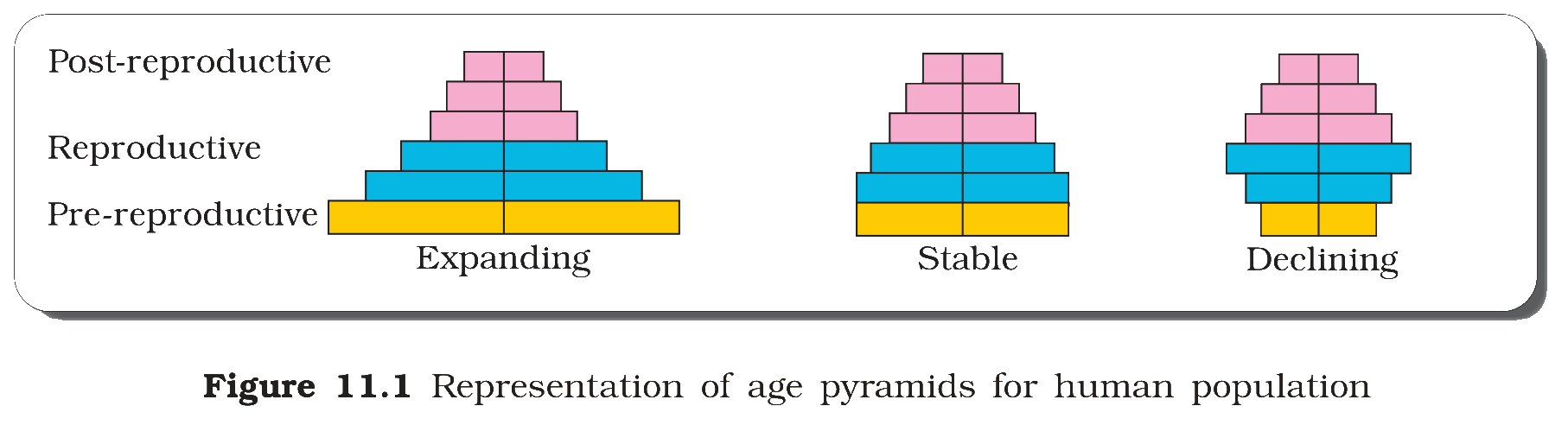
Textbook figure

Advertisement

Practise more on Organisms and Populations

Chapter-wise mocks on the real NTA exam screen, with solutions and your rank. Your first mocks are free.

Start free mocks →

Advertisement

Next questions

  1. In the given cell,Ni(s) + 2Ag+ (aq) → Ni2+(aq) + 2Ag(s)which of the given species is the reducing agent?Chemistry · Physical: Electro Chemistry
  2. The value of MPC lies between:Economics · Macro Economics: Determination of Income and Employment
  3. Propagating electromagnetic waves transport __________.Physics · Electromagnetic Waves
  4. Which of the following is/are correct?A. ∫ e^x≤ft[displaystyle1/((x-2))-displaystyle1/((x-2)^2)]dx=(e^x)/((x-2))+C , where C is an arbitrar…Applied Maths. Section A · Indefinite Integration (Section A)
  5. Al-Biruni’s book ‘Kitab-ul-Hind’, was written in which language?History · Medieval India: Through the Eyes of Travellers
  6. Match the tools of promotion in List-I with the examples in List-II:List-IList-II(A) Advertising(I) A company sends newsletters and annual…Business Studies · Marketing
  7. Which of the following is NOT a relative by blood?English · Odd One Out
  8. Arrange the following in a sequence, explaining: Theory of Multiple Intelligences, Triarchic theory, Guilford's Structure of Intellect theo…Psychology · Variations in Psychological Attributes
  9. A thief is spotted by a policeman from a distance of 100 m. When the policeman starts the chase, the thief also starts running. If the spee…General Aptitude Test · Numerical Ability
  10. A rod of length L is held vertically on a smooth horizontal surface. The top end of the rod is given a gentle push. At a certain instant of…Physics · System of Particle and Rotational Motion