
A rod AB moves with uniform velocity v in a uniform magnetic field as shown in the figure. Identify the correct statement(s) among the following.
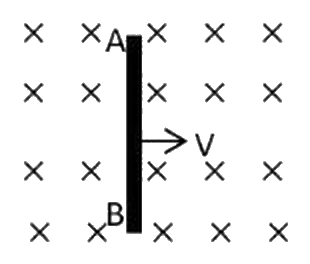
(A) Rod becomes electrically charged.
(B) End A becomes positively charged.
(C) End B becomes positively charged.
(D) Rod becomes hot due to joule’s heating.
Choose the correct answer from the options given below:
Answer & explanation
Correct answer: option 1
The correct answer is Option (1) → (B) only
A conductor moving across a magnetic field has its free charges pushed by the magnetic force \( \vec{F} = q\,\vec{v}\times\vec{B} \). The velocity is to the right and the field is into the page, so \( \vec{v}\times\vec{B} \) points upward. The free electrons are pushed the opposite way, towards B, so end B becomes negative and end A is left positive. The separated charges build up an electric field that balances the magnetic force, and then the charges stop moving.
(A) Rod becomes electrically charged. — Incorrect. The charge only moves from one end to the other; the rod as a whole stays neutral, with equal and opposite charges at its ends.
(B) End A becomes positively charged. — Correct. Electrons are pushed towards B, leaving A positive.
(C) End B becomes positively charged. — Incorrect. B gains the electrons, so it is negative.
(D) Rod becomes hot due to joule’s heating. — Incorrect. The rod is not part of a closed circuit, so no steady current flows after the charges have separated, and there is no heating.
Only statement (B) is correct, which is Option (1).
Note: “Rod becomes electrically charged” has been read as the rod acquiring a net charge, which it does not, so (A) is taken as incorrect. If it is read as the two ends becoming charged, (A) would also be true, and then (A) and (B) would both be correct, which is not among the options.
NCERT (2026-27):
Motional Electromotive Force – “… It is also possible to explain the motional emf expression in Eq. (6.5) by invoking the Lorentz force acting on the free charge carriers of conductor PQ. … The Lorentz force on this charge is qvB in magnitude, and its direction is towards Q.”