Select the correct option in regard to the hydrolysis of the cane sugar.
Answer & explanation
Correct answer: option 1
The correct answer is Option (1) → It is an example of pseudo first order reaction.
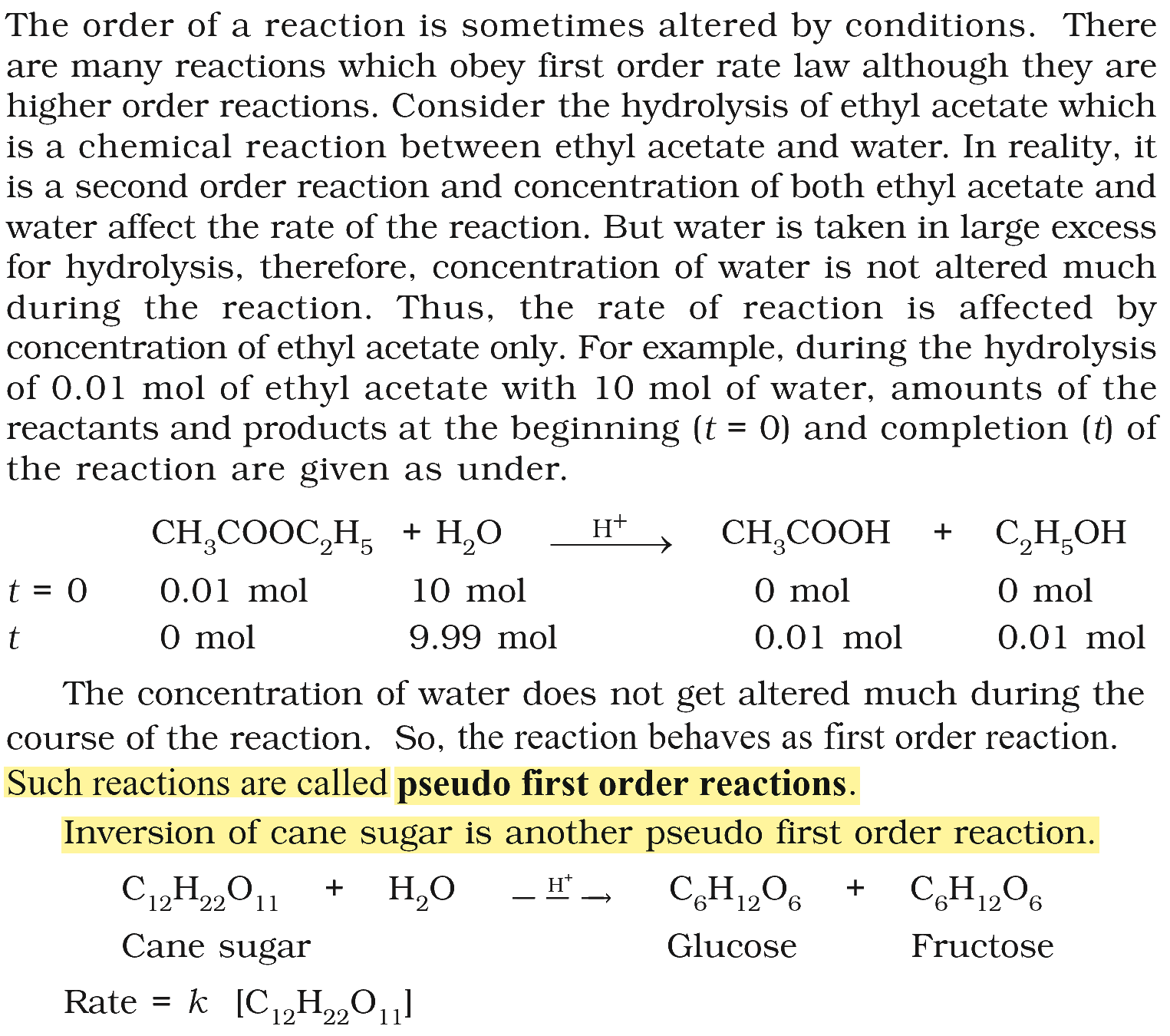
The order of a reaction comes from the experimental rate law, while the molecularity is the number of molecules taking part in an elementary step. In the acid hydrolysis of cane sugar, sucrose and water both react, but water is present in large excess, so its concentration hardly changes and is taken into the rate constant:
\( \displaystyle \text{Rate}=k^{\prime}[\ce{C12H22O11}][\ce{H2O}]=k[\ce{C12H22O11}] \)
So the reaction is bimolecular but follows first order kinetics: it is a pseudo first order reaction.
Why the other options are incorrect
Option (2) It is a unimolecular reaction. — Incorrect. Sucrose and water both take part, so the molecularity is 2 (bimolecular).
Option (3) The rate constant unit is mol L−1 s−1. — Incorrect. That is the unit for a zero order reaction; a first order rate constant has the unit s−1.
Option (4) The rate of reaction is affected by the concentration of the water only. — Incorrect. The rate depends on the concentration of sucrose; the water concentration stays practically constant.
NCERT (2026-27 edition):
Half-Life of a Reaction – …