Inner transition Elements
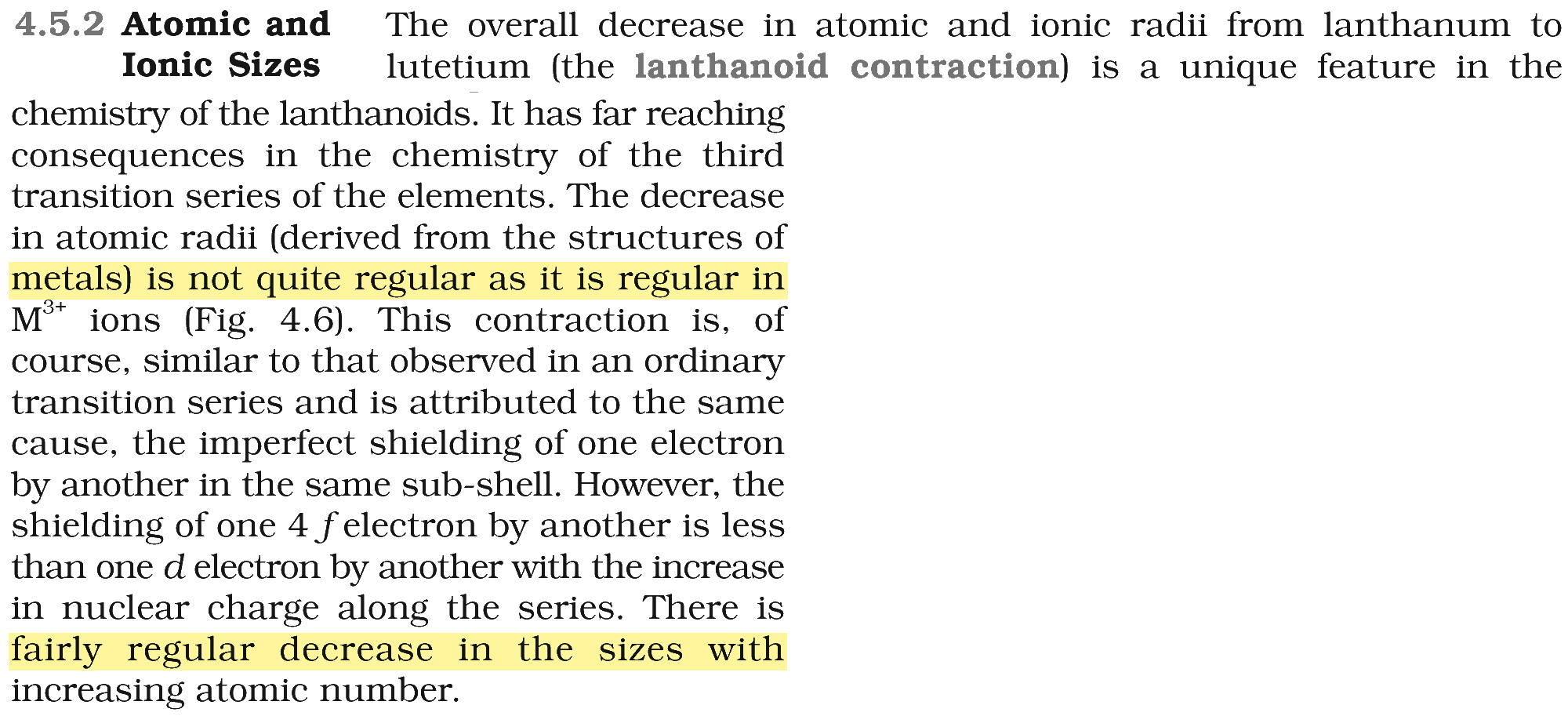
The lanthanoid contraction is a feature of f block elements in which overall decrease in atomic radii from lanthanum to lutetium is observed. The decrease in atomic radii is not quite regular as it is regular in M3+ ions. This is because of imperfect shielding of one electron by another in the same subshell. The shielding of one 4f electron by another is less than one d electron by another with the increase in nuclear charge along the series. In the lanthanoid La(II) and Ln(III) are predominant species. Occasionally +2 and +4 ions in solution or in solid compounds are obtained. The formation of CeIV is favored by its noble gas configuration but it acts like a strong oxidising agent reverting to the common +3 state. The E0 value for CeIV/CeIII is +1.74 V which refer that it can oxidise water. The Pr, Nd, Tb and Dy show +4 state in oxides only. Eu2+ is a strong reducing agent changing to the common +3 state. Actinoids include 14 elements from Th to Lr. There is gradual decrease in size of atoms or M3+ ions in series and referred as actinoid contraction. The contraction is greater from element to element in this series resulting from poor shielding by 5f electrons.
Select the Correct statement from the following:
Answer & explanation
Correct answer: option 2
The correct answer is Option (2) → Ionic radii of trivalent lanthanoid ions decreases regularly with increasing atomic number.
Across the lanthanoid series, each element adds one proton and one 4f electron. The 4f electrons shield each other poorly, so the pull of the nucleus on the outer electrons increases steadily. For the M3+ ions the decrease in size is smooth and regular (from 106 pm for \( \ce{La^{3+}} \) to 86 pm for \( \ce{Yb^{3+}} \), the last ionic radius given in the book’s table). This is the lanthanoid contraction.
So the correct statement is that the ionic radii of trivalent lanthanoid ions decrease regularly with increasing atomic number.
Why the other options are incorrect
Option (1) Paramagnetism of trivalent lanthanide ions decreases regularly with increasing atomic number — Incorrect. Paramagnetism depends on unpaired 4f electrons. La (Z = 57) is [Xe]5d16s2; losing the two 6s electrons and the 5d electron gives \( \ce{La^{3+}} \): 4f0 (0 unpaired). Gd (Z = 64) is [Xe]4f75d16s2; losing the same three electrons gives \( \ce{Gd^{3+}} \): 4f7 (7 unpaired). Lu (Z = 71) is [Xe]4f145d16s2; losing the same three electrons gives \( \ce{Lu^{3+}} \): 4f14 (0 unpaired). The number rises to a maximum and then falls, so it is not a regular decrease.
Option (3) Stable oxidation state of lanthanoids decreases regularly with increasing atomic number — Incorrect. The stable state is +3 for all the lanthanoids; it does not decrease.
Option (4) Number of 4f electrons of trivalent lanthanoid ions decreases regularly with increasing atomic number — Incorrect. It increases, from 0 in \( \ce{La^{3+}} \) to 14 in \( \ce{Lu^{3+}} \).
NCERT (2026-27 edition):
Atomic and Ionic Sizes