Read the passage and answer the questions:
Environmental Concerns in Global Politics
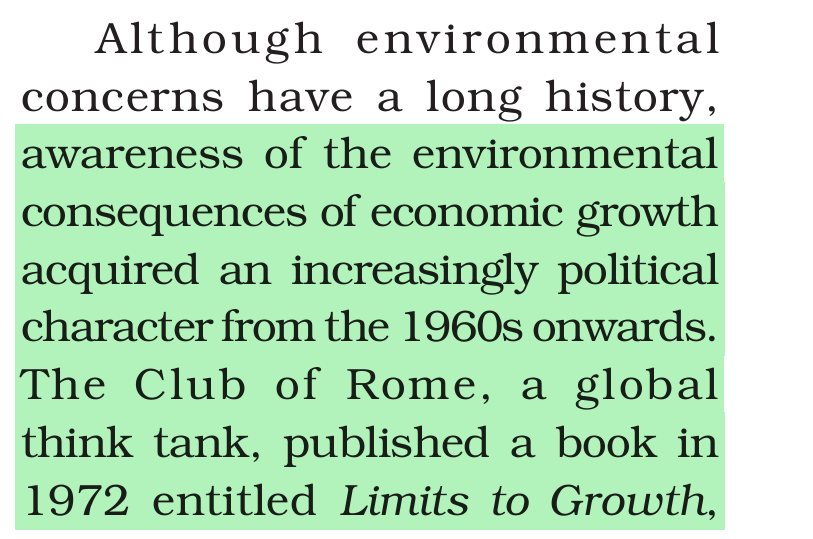
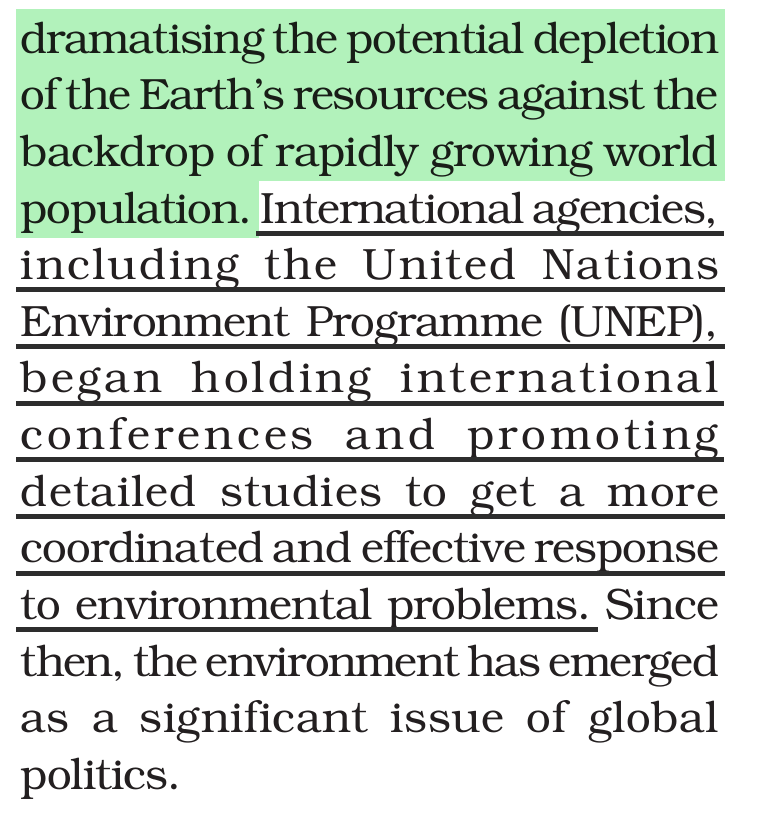
Although environmental concerns have a long history, awareness of the environmental consequences of economic growth acquired an increasingly political character from the 1960s onwards. The Club of Rome, a global think tank, published a book in 1972 entitled Limits to Growth, dramatising the potential depletion of the Earth’s resources against the backdrop of rapidly growing world population. International agencies, including the United Nations Environment Programme (UNEP), began holding international conferences and promoting detailed studies to get a more coordinated and effective response to environmental problems. Since then, the environment has emerged as a significant issue of global politics. The growing focus on environmental issues within the arena of global politics was firmly consolidated at the United Nations Conference on Environment and Development held in Rio de Janeiro, Brazil, in June 1992. This was also called the Earth Summit. The summit was attended by 170 states, thousands of NGOs and many multinational corporations. Five years earlier, the 1987 Brundtland Report, Our Common Future, had warned that traditional patterns of economic growth were not sustainable in the long term, especially in view of the demands of the South for further industrial development. What was obvious at the Rio Summit was that the rich and developed countries of the First World, generally referred to as the ‘global North’ were pursuing a different environmental agenda than the poor and developing countries of the Third World, called the ‘global South’. Whereas the Northern states were concerned with ozone depletion and global warming, the Southern states were anxious to address the relationship between economic development and environmental management. The Rio Summit produced conventions dealing with climate change, biodiversity, forestry, and recommended a list of development practices called ‘Agenda 21’. But it left unresolved considerable differences and difficulties. There was a consensus on combining economic growth with ecological responsibility. This approach to development is commonly known as ‘sustainable development’. The problem however was how exactly this was to be achieved. Some critics have pointed out that Agenda 21 was biased in favour of economic growth rather than ensuring ecological conservation.
Which one of the following statements does not pertain to the emergence of environmental concerns in global politics?
Answer & explanation
Correct answer: option 2
The correct answer is Option (2) → The book Silent Spring, dramatised the potential depletion of the Earth’s resources in the context of rapidly growing world population.
Option (1) The Club of Rome is a global think tank. Pertains (Incorrect).
Option (2) The book Silent Spring, dramatised the potential depletion of the Earth’s resources in the context of rapidly growing world population. Does not pertain (Correct). The work that did this was Limits to Growth, published by the Club of Rome in 1972. Silent Spring is a different work.
Option (3) UNEP held international conferences to focus on environmental issues within the arena of global politics. Pertains (Incorrect).
Option (4) UNEP promoted detailed studies to get a more coordinated and effective response to environmental problems. Pertains (Incorrect).
Note: Silent Spring (1962) is a book by Rachel Carson on the harm done by chemical pesticides to living things; it does not deal with the depletion of resources against a growing world population.
NCERT: Contemporary World Politics — Chapter 6: Environment and Natural Resources (2025-26)
|