
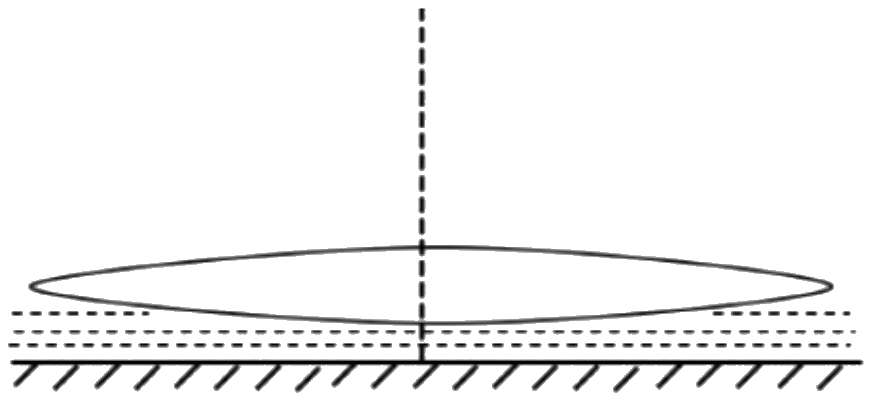
An equiconvex lens with radii of curvature \( R \) each, is put over a liquid layer (refractive index \( \mu \)) poured on top of a plane mirror. A small needle with its tip on the principal axis of the lens is moved along the axis until its inverted real image coincides with the needle itself. The distance of the needle from the lens is measured to be ‘\( x \)’. On removing the liquid layer and repeating the experiment the distance is found to be ‘\( y \)’. The value of ‘\( x \)’ can be expressed as:
Answer & explanation
Correct answer: option 2
The correct answer is Option (2) → \( x = \displaystyle\frac{yR}{R - \mu y + y} \)
The needle coincides with its own inverted image when the rays leaving the lens system strike the mirror normally and retrace their path, that is, when the needle is at the focus of the lens system just above the mirror. So \( y \) is the focal length of the glass lens alone and \( x \) is the focal length of the glass lens combined with the liquid.
The liquid between the lens and the mirror forms a plano-concave liquid lens: one face is the lower surface of the lens (radius \( R \)), the other is flat. By the lens maker’s formula:
\( \displaystyle \frac{1}{f_{l}} = (\mu - 1)\left(-\frac{1}{R} - \frac{1}{\infty}\right) = -\frac{\mu - 1}{R} \)
Lenses in contact (\( f_{g} = y \)):
\( \displaystyle \frac{1}{x} = \frac{1}{y} + \frac{1}{f_{l}} = \frac{1}{y} - \frac{\mu - 1}{R} \)
\( \displaystyle \frac{1}{x} = \frac{R - (\mu - 1)y}{yR} \)
\( \displaystyle x = \frac{yR}{R - \mu y + y} \)
Shortcut: Check the limiting case \( \mu = 1 \) (the liquid is no different from air): the answer must reduce to \( x = y \). Only Option (2) does; Options (1), (3) and (4) do not even have the dimensions of length.