What is the IUPAC name of the organic compound (X) formed in the following reaction
\( \displaystyle \ce{CH3COCH3} \xrightarrow[\text{(ii) }\ce{H2O, H^+}]{\text{(i) }\ce{C2H5MgBr}\text{, Dry ether}} \text{(X)} \)
Answer & explanation
Correct answer: option 3
The correct answer is Option (3) → 2-methylbutan-2-ol
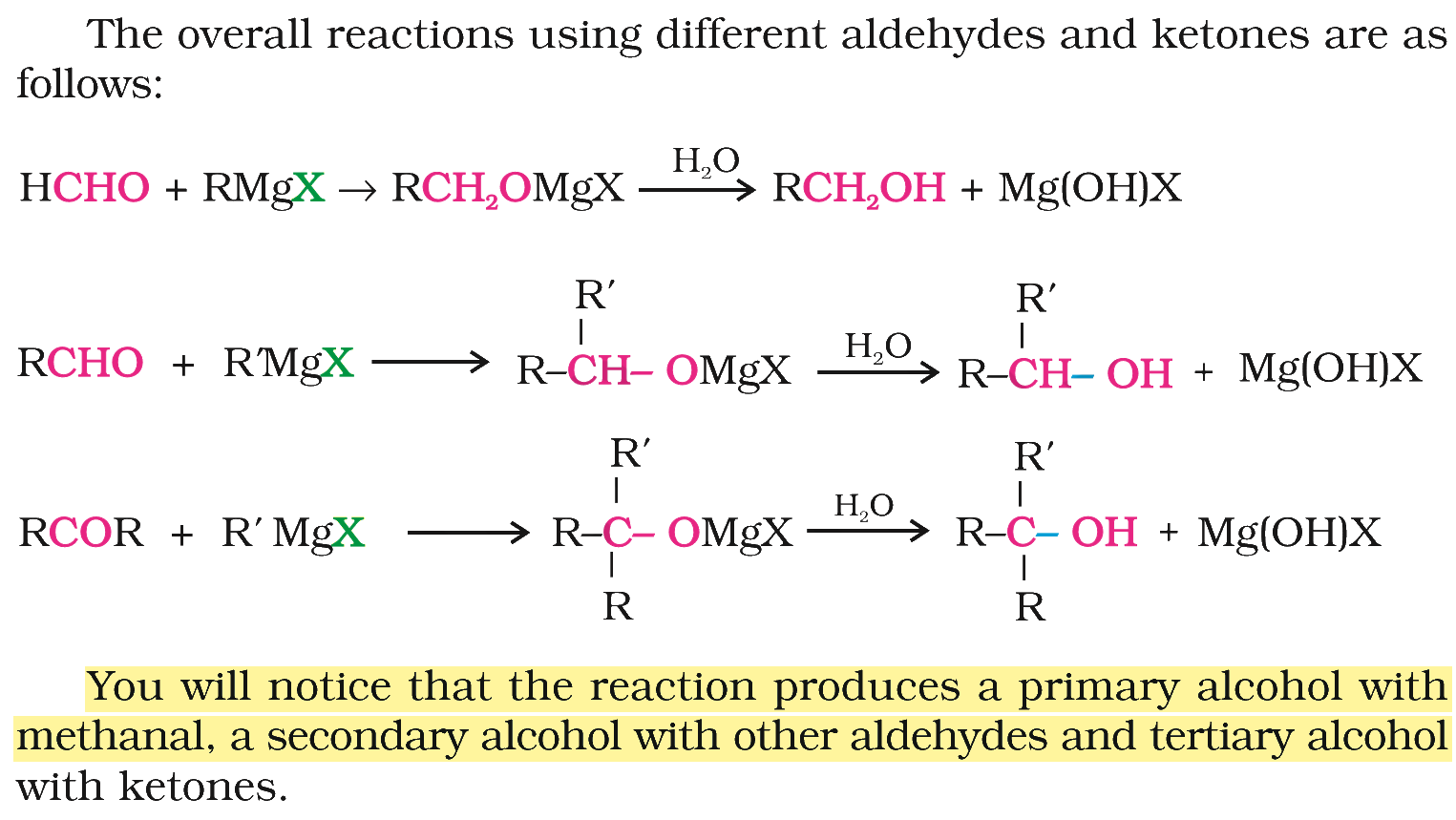
A Grignard reagent (RMgX) adds to the >C=O group of aldehydes and ketones: the alkyl group R goes to the carbonyl carbon and MgX to the oxygen, and hydrolysis of the adduct gives an alcohol.
Propanone (\( \ce{CH3COCH3} \)) is a ketone, so ethylmagnesium bromide gives a tertiary alcohol:
\( \displaystyle \ce{CH3COCH3 + C2H5MgBr} \xrightarrow{\text{dry ether}} \ce{(CH3)2C(OMgBr)C2H5} \)
\( \displaystyle \ce{(CH3)2C(OMgBr)C2H5} \xrightarrow{\ce{H2O, H^+}} \ce{(CH3)2C(OH)CH2CH3 + Mg(OH)Br} \)
To name the product, take the longest chain containing the C–OH carbon: \( \ce{CH3-C(OH)(CH3)-CH2-CH3} \) has four carbons (butane), with the –OH and a methyl group both on C-2.
So (X) is 2-methylbutan-2-ol.
Why the other options are incorrect
Option (1) 2-methylpropan-2-ol — Incorrect. This forms from propanone with CH3MgBr; the ethyl group here adds one more carbon.
Option (2) Pentan-2-ol — Incorrect. A secondary alcohol, \( \ce{CH3CH(OH)CH2CH2CH3} \); it comes from an aldehyde (ethanal with propylmagnesium bromide), not a ketone.
Option (4) Pentan-3-ol — Incorrect. Also secondary, \( \ce{CH3CH2CH(OH)CH2CH3} \); it comes from propanal with \( \ce{C2H5MgBr} \).
NCERT (2026-27 edition):
Preparation of Alcohols – …