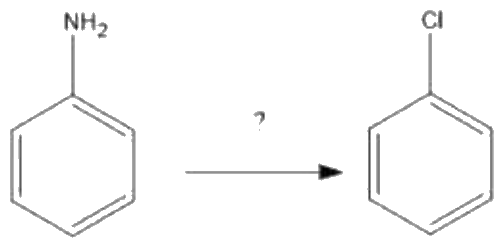
Which of the following reagents will bring out the following transformation ?
(A) NaNO2/HCl and Cu/HCl
(B) NaNO2/NaOH and Cu/HCl
(C) NaNO2/HCl and Cu2Cl2/HCl
(D) NaNO2/NaOH and Cu2Cl2/HCl
Choose the correct answer from the options given below:
Answer & explanation
Correct answer: option 1
The correct answer is Option (1) → (A) and (C) only
Replacing –\( \ce{NH2} \) on a benzene ring by –Cl takes two steps.
1. Diazotisation. A primary aromatic amine reacts with nitrous acid at 273–278 K to give a diazonium salt. Nitrous acid is unstable, so it is made in the mixture itself from NaNO2 and HCl. In NaOH no nitrous acid can form, so no diazonium salt is obtained.
\( \displaystyle \ce{C6H5NH2 + NaNO2 + 2HCl} \xrightarrow{\text{273-278 K}} \ce{C6H5N2^+Cl^- + NaCl + 2H2O} \)
2. Replacement of the diazonium group by Cl. This can be done in two ways:
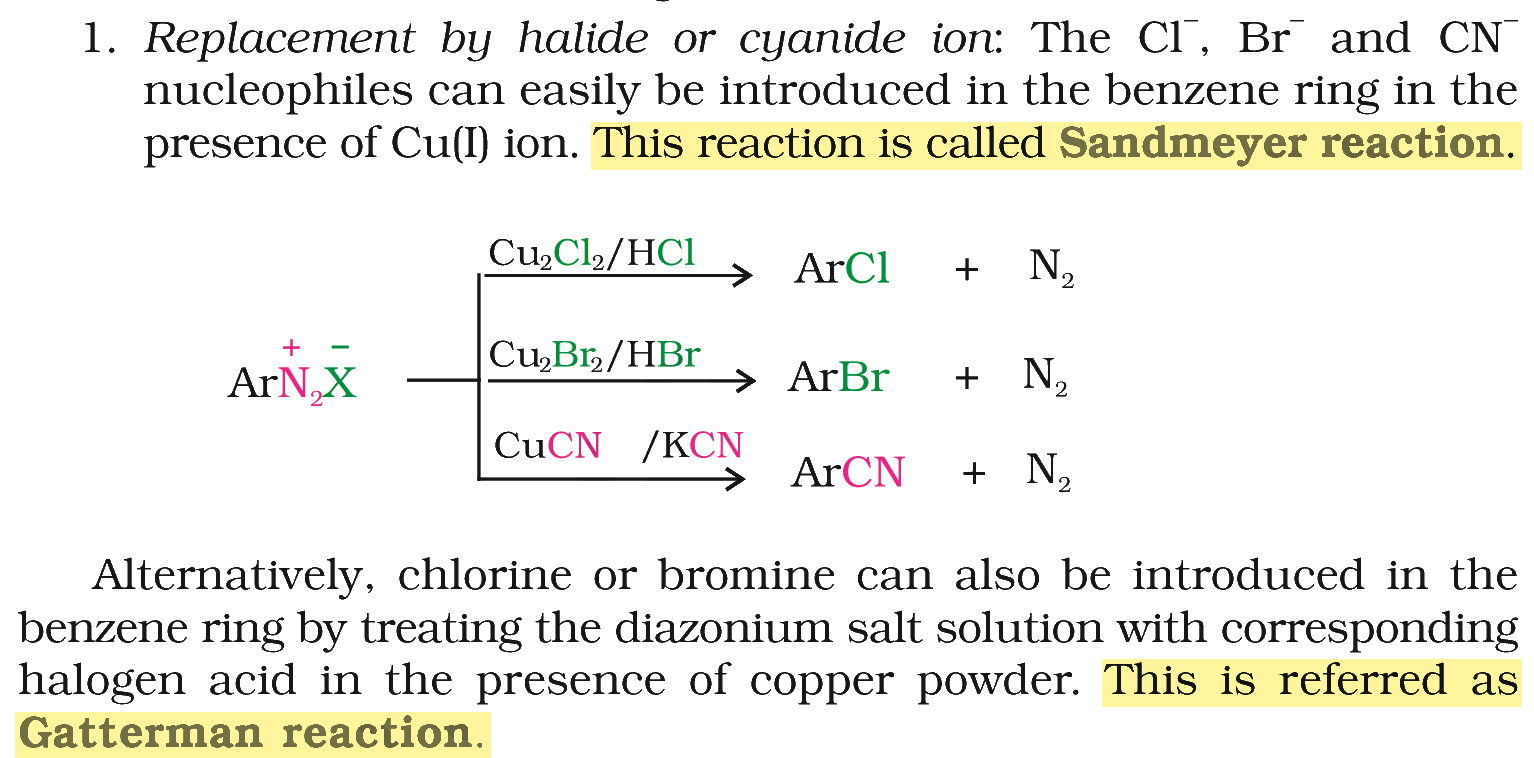
Sandmeyer reaction: \( \ce{Cu2Cl2} \)/HCl
\( \displaystyle \ce{C6H5N2^+Cl^-} \xrightarrow{\ce{Cu2Cl2/HCl}} \ce{C6H5Cl + N2} \)
Gattermann reaction: copper powder with HCl
\( \displaystyle \ce{C6H5N2^+Cl^-} \xrightarrow{\ce{Cu/HCl}} \ce{C6H5Cl + N2} \)
Judging each set of reagents:
(A) NaNO2/HCl and Cu/HCl — Correct. Diazotisation followed by the Gattermann reaction.
(B) NaNO2/NaOH and Cu/HCl — Incorrect. \( \ce{NaNO2} \) in NaOH gives no nitrous acid, so the diazonium salt is never formed.
(C) NaNO2/HCl and Cu2Cl2/HCl — Correct. Diazotisation followed by the Sandmeyer reaction.
(D) NaNO2/NaOH and Cu2Cl2/HCl — Incorrect. The first step fails for the same reason as in (B).
NCERT (2026-27 edition):
Method of Preparation of Diazonium Salts – “Benzenediazonium chloride is prepared by the reaction of aniline with nitrous acid at 273-278K. Nitrous acid is produced in the reaction mixture by the reaction of sodium nitrite with hydrochloric acid. The conversion of primary aromatic amines into diazonium salts is known as diazotisation.”
Replacement by Halide or Cyanide Ion