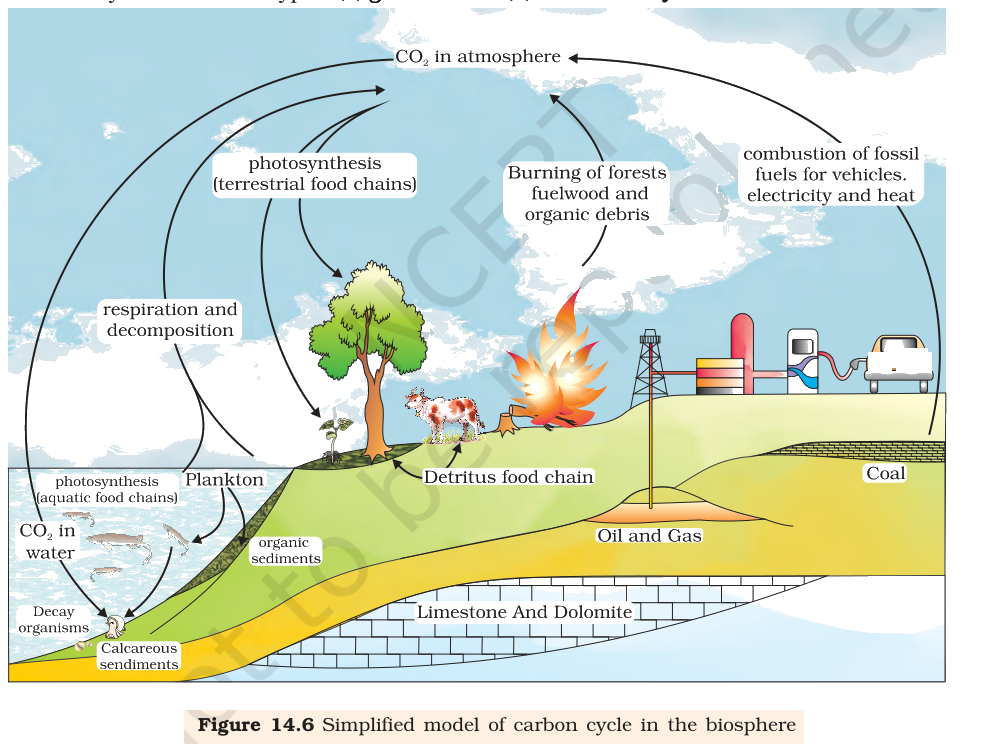
Fossil fuel also represent a reservoir of carbon. Carbon cycling occurs through atmosphere, ocean and through living and dead organisms. According to one estimate, 4 × 10¹³ kg of carbon is fixed annually in the biosphere through photosynthesis. A considerable amount of carbon returns to the atmosphere as CO2 through respiratory activities of the producers and consumers. Decomposers also contribute substantially to CO2 pool by their processing of waste materials and dead organic matter of land or oceans. Some amount of the fixed carbon is lost to sediments and removed from circulation. Burning of wood, forest fire and combustion of organic matter, fossil fuel, volcanic activity are additional sources for releasing CO2 in the atmosphere.
Identify the statement which is NOT correct for carbon cycle.
Answer & explanation
Correct answer: option 4
The correct answer is Option (4) → The environmental reservoir regulate the amount of CO2 in the ocean.
Option (1) There is respiratory release of carbon in the atmosphere. — Correct for the carbon cycle. A considerable amount of carbon returns to the atmosphere as CO2 through the respiration of producers and consumers. So respiratory release of carbon is a true part of the cycle.
Option (2) The gaseous reservoir of carbon is atmosphere. — Correct for the carbon cycle. The carbon cycle is a gaseous cycle with its reservoir in the atmosphere.
Option (3) Carbon dioxide is a major constituent of green house gases. — Correct for the carbon cycle. Carbon dioxide is a major greenhouse gas. Burning of wood and fossil fuels adds more CO2 to the atmosphere, which links the carbon cycle to global warming.
Option (4) The environmental reservoir regulate the amount of CO2 in the ocean. — Not correct for the carbon cycle. It is the other way round: the oceanic reservoir regulates the CO2 in the atmosphere.
Note 1: This passage is taken from NCERT as it is.
Note 2: This question is from the topic “Ecosystem – Carbon Cycle” in Chapter 14, Ecosystem, of the pre-rationalised NCERT book. This portion is not in the present NCERT book, where the chapter is now Chapter 12, Ecosystem. The extract below is from the pre-rationalised edition.
NCERT Extract (Pre-rationalised edition, Chapter 14, Ecosystem):
Ecosystem – Carbon Cycle – “… When you study the composition of living organisms, carbon constitutes 49 per cent of dry weight of organisms and is next only to water. If we look at the total quantity of global carbon, we find that 71 per cent carbon is found dissolved in oceans. This oceanic reservoir regulates the amount of carbon dioxide in the atmosphere (Figure 14.6).”