
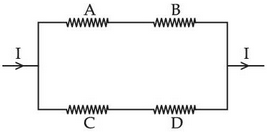
There are four resistances, \( A = 20\,\Omega \), \( B = 30\,\Omega \), \( C = 40\,\Omega \) and \( D = 50\,\Omega \), connected as per the arrangement shown. The heat produced per second in them, in the descending order will be:
Answer & explanation
Correct answer: option 2
The correct answer is Option (2) → \( B \gt A \gt D \gt C \)
The heat produced per second in a resistor is the power \( P = I^{2}R \) (Joule heating). A and B are in series in one branch, C and D in series in the other, and the two branches are in parallel, so both have the same potential difference \( V \).
\( R_{AB} = 20 + 30 = 50\,\Omega \)
\( R_{CD} = 40 + 50 = 90\,\Omega \)
\( \displaystyle I_{1} = \frac{V}{50}, \qquad I_{2} = \frac{V}{90} \)
\( \displaystyle P_{A} = \frac{V^{2}}{2500} \times 20 = 0.0080\,V^{2}, \qquad P_{B} = \frac{V^{2}}{2500} \times 30 = 0.0120\,V^{2} \)
\( \displaystyle P_{C} = \frac{V^{2}}{8100} \times 40 = 0.0049\,V^{2}, \qquad P_{D} = \frac{V^{2}}{8100} \times 50 = 0.0062\,V^{2} \)
\( P_{B} \gt P_{A} \gt P_{D} \gt P_{C} \)
Within one branch the current is the same, so the larger resistor heats more (B over A, D over C). The upper branch carries the larger current, which puts both A and B above D and C.