
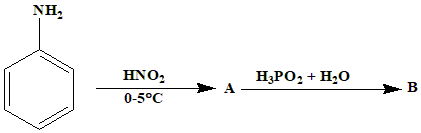
Compound B in the above reaction is:
Answer & explanation
Correct answer: option 4
The correct answer is Option (4) → Benzene
First, aniline is diazotised: nitrous acid (from \( \ce{NaNO2} \) and HCl) at 273–278 K converts the –\( \ce{NH2} \) group into a diazonium group; the low temperature keeps the unstable salt from decomposing:
\( \displaystyle \ce{C6H5NH2 + NaNO2 + 2HCl} \xrightarrow{\text{273-278 K}} \ce{C6H5N2+Cl- + NaCl + 2H2O} \)
So A is benzenediazonium chloride. Next, hypophosphorous acid (phosphinic acid), H3PO2, a mild reducing agent, replaces the diazonium group by hydrogen and is itself oxidised to phosphorous acid:
\( \displaystyle \ce{C6H5N2+Cl- + H3PO2 + H2O -> C6H6 + N2 + H3PO3 + HCl} \)
So B is benzene.
Why the other options are incorrect
Option (1) Phenol — Incorrect. Phenol is formed when the diazonium salt is warmed with water; \( \ce{H3PO2} \) reduces it instead:
\( \displaystyle \ce{C6H5N2+Cl- + H2O} \xrightarrow{\text{warm}} \ce{C6H5OH + N2 + HCl} \)
Option (2) Benzoic acid — Incorrect. This would need a –COOH group; it is obtained from the diazonium salt only indirectly (via benzonitrile with CuCN, then hydrolysis).
Option (3) Azodye — Incorrect. Azo dyes are formed by coupling the diazonium salt with phenol or aniline, in which the –N=N– group is kept; here the nitrogen is lost as \( \ce{N2} \).
NCERT (2026-27 edition):
Replacement by H
