
Match List I with List II.
| List I | List II |
| A. \([CH_3(CH_2)_{15}-N(CH_3)_3]^+Br^-\) | I. Dishwashing powder |
| B. \(CH_3-(CH_2)_{11}-C_6H_4-SO_3^-Na^+\) | II. Laundry soap powder |
| C. \(C_{17}H_{35}COO^-Na^+ + Na_2CO_3\) + Rosin | III. Hair conditioner |
| D. \(CH_3(CH_2)_{16}COO(CH_2CH_2O)_nCH_2CH_2OH\) | IV. Toothpaste |
Choose the correct answer from the options given below:
Answer & explanation
Correct answer: option 2
The correct answer is Option (2) → A-III, B-IV, C-II, D-I
Detergents are classed by the charge on the part of the molecule that carries the long hydrocarbon chain: cationic, anionic or non-ionic. Soaps are sodium salts of long chain fatty acids.
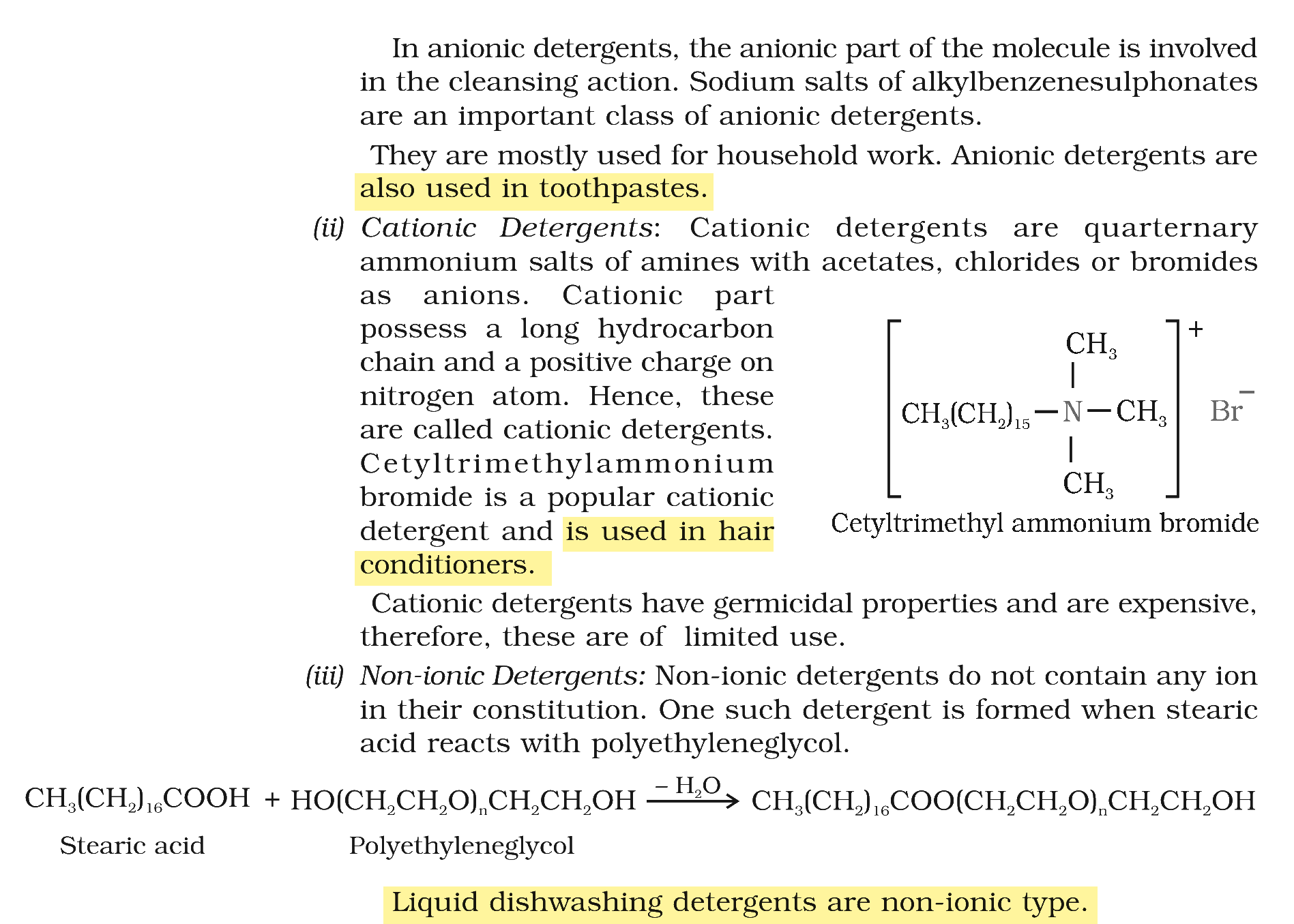
(A) \( \ce{[CH3(CH2)15-N(CH3)3]^{+}Br^{-}} \) — This matches (III) Hair conditioner. It is cetyltrimethylammonium bromide, a cationic detergent: the long chain is in the positive ion.
(B) \( \ce{CH3-(CH2)11-C6H4-SO3^{-}Na^{+}} \) — This matches (IV) Toothpaste. Sodium dodecylbenzenesulphonate is an anionic detergent: the long chain is in the negative ion.
(C) \( \ce{C17H35COO^{-}Na^{+}} \) + \( \ce{Na2CO3} \) + Rosin — This matches (II) Laundry soap powder. Sodium stearate is a soap; sodium carbonate and rosin (as sodium rosinate) are the fillers of laundry soaps.
(D) CH3(CH2)16COO(CH2CH2O)nCH2CH2OH — This matches (I) Dishwashing powder. It is the ester of stearic acid with polyethylene glycol, a non-ionic detergent.
\( \ce{CH3(CH2)16COOH + HO(CH2CH2O)_{n}CH2CH2OH} \xrightarrow{-\ce{H2O}} \ce{CH3(CH2)16COO(CH2CH2O)_{n}CH2CH2OH} \)
Shortcut: (A)-(III) appears only in Option (2).
Note: This question is from the pre-rationalised NCERT book (2022-23). The topic is not there in the latest NCERT book (2026-27), and it is also out of the CUET 2026 syllabus.
NCERT (Pre-rationalised edition, 2022-23):
Synthetic Detergents – …
Types of Soaps – …
