What happens when a tertiary alcohol is heated at temperature of 443 K in presence of phosphoric acid?
Answer & explanation
Correct answer: option 2
The correct answer is Option (2) → Alkene is formed
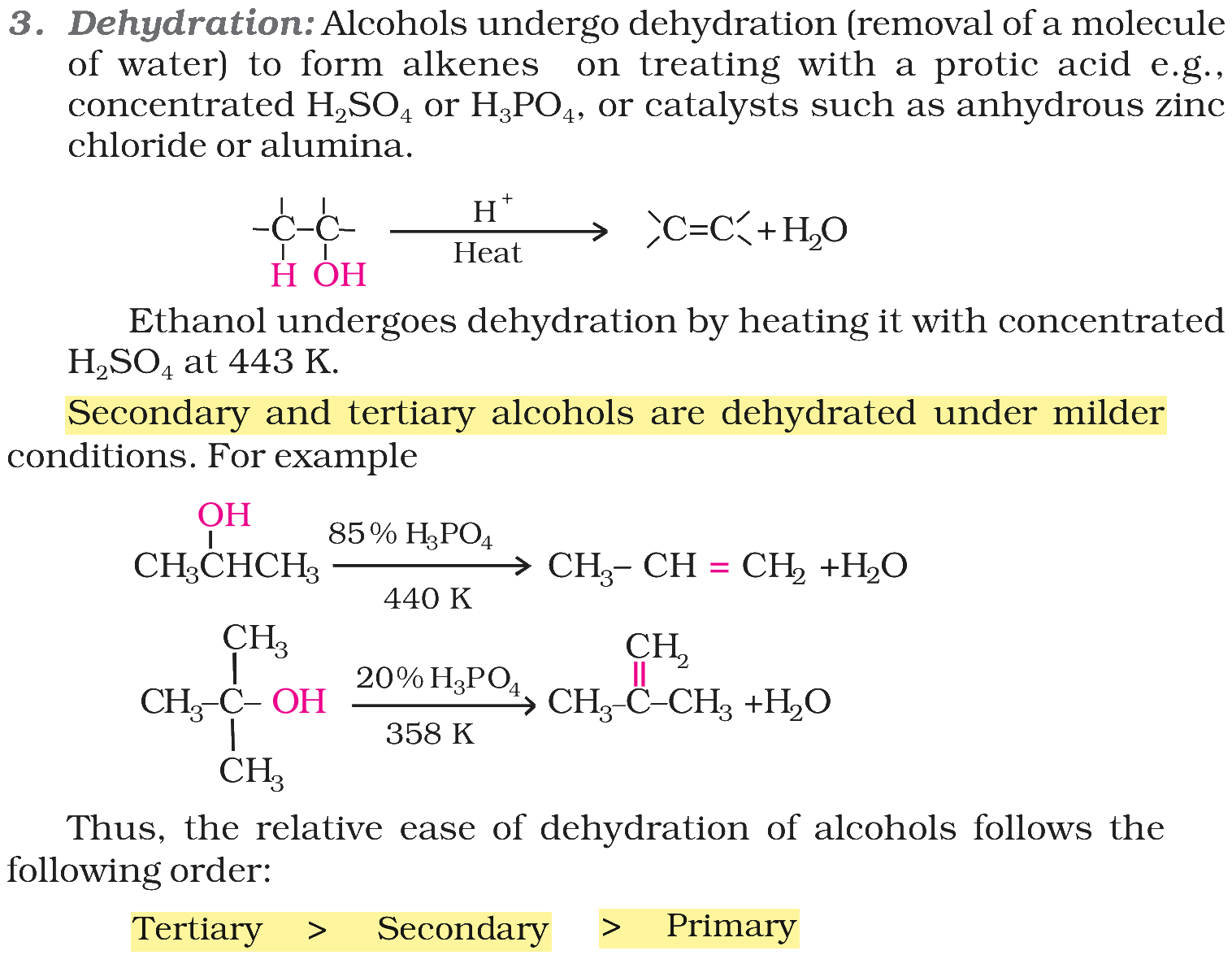
Alcohols lose a molecule of water (dehydration) to form alkenes when heated with a protic acid such as concentrated \( \ce{H2SO4} \) or \( \ce{H3PO4} \). The acid protonates the –OH group, water leaves to give a carbocation, and the carbocation loses a proton from the next carbon to form the C=C bond:
\( \displaystyle \ce{(CH3)3C-OH + H+ -> (CH3)3C-OH2+} \)
\( \displaystyle \ce{(CH3)3C-OH2+ -> (CH3)3C+ + H2O} \)
\( \displaystyle \ce{(CH3)3C+ -> (CH3)2C=CH2 + H+} \)
The net reaction, for tert-butyl alcohol:
\( \displaystyle \ce{(CH3)3C-OH} \xrightarrow[\text{heat}]{\ce{H3PO4}} \ce{(CH3)2C=CH2 + H2O} \)
The slow step is the formation of the carbocation. A tertiary carbocation is the most stable, so a tertiary alcohol dehydrates most easily and at 443 K gives the alkene.
Why the other options are incorrect
Option (1) Ether is formed — Incorrect. Ethers form by an SN2 attack of a second alcohol molecule; this works for primary alcohols in excess at a lower temperature (ethanol at 413 K). A tertiary alcohol forms a carbocation that loses a proton, so it gives an alkene, not an ether.
Option (3) Mixture of alkene and alcohol is formed — Incorrect. Under these conditions the alcohol is converted into the alkene; no new alcohol is formed.
Option (4) No reaction takes place — Incorrect. Tertiary alcohols are the easiest of all alcohols to dehydrate.
NCERT (2026-27 edition):
Dehydration