
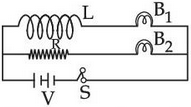
In the circuit two identical bulbs \( B_1 \) and \( B_2 \) are connected on closing switch S:
Which of the following statement is correct?
Answer & explanation
Correct answer: option 3
The correct answer is Option (3) → \( B_2 \) lights up earlier and finally \( B_1 \) shines brighter than \( B_2 \)
In the figure the battery with the switch feeds three branches in parallel: the inductor L in series with bulb \( B_1 \), the resistor R in series with bulb \( B_2 \), and the battery itself. The two bulbs are identical, so the brightness of each depends only on the current in its branch. An ideal inductor and battery are assumed.
Just after closing S. The inductor opposes a sudden change of current by a back emf (self induction), so the current in the \( B_1 \) branch grows slowly from zero. The \( B_2 \) branch has only a resistance, so its current is \( V/(R+R_B) \) at once. Hence \( B_2 \) lights up earlier.
Steady state. The current no longer changes, so there is no back emf and the inductor (of negligible resistance) acts as a plain wire. With \( R_B \) the resistance of a bulb:
\( \displaystyle I_1 = \frac{V}{R_B},\qquad I_2 = \frac{V}{R_B+R} \)
The extra resistor R makes \( I_2 \lt I_1 \), so \( B_1 \) finally shines brighter than \( B_2 \).