
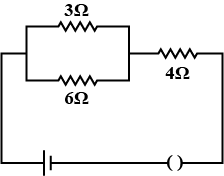
If the current flowing through the \( 3\,\Omega \) resistor in the given circuit is 0.8 A, what is the potential drop across the \( 4\,\Omega \) resistor?
Answer & explanation
Correct answer: option 2
The correct answer is Option (2) → 4.8 V
Resistors in parallel have the same potential difference across them, and a resistor in series with a combination carries the whole current through it. From the figure, the \( 3\,\Omega \) and \( 6\,\Omega \) resistors are in parallel, and this pair is in series with the \( 4\,\Omega \) resistor.
The potential difference across the parallel pair is:
\( \begin{aligned} V_{\mathrm{p}} &= I_3R_3 \\ &= 0.8\,\mathrm{A}\times3\,\Omega \\ &= 2.4\,\mathrm{V} \end{aligned} \)
The current in the \( 6\,\Omega \) resistor is:
\( \begin{aligned} I_6 &= \frac{V_{\mathrm{p}}}{R_6} \\ &= \frac{2.4\,\mathrm{V}}{6\,\Omega} \\ &= 0.4\,\mathrm{A} \end{aligned} \)
The total current, which flows through the \( 4\,\Omega \) resistor, is:
\( \begin{aligned} I &= I_3+I_6 \\ &= 0.8\,\mathrm{A}+0.4\,\mathrm{A} \\ &= 1.2\,\mathrm{A} \end{aligned} \)
The potential drop across the \( 4\,\Omega \) resistor is:
\( \begin{aligned} V_4 &= IR_4 \\ &= 1.2\,\mathrm{A}\times4\,\Omega \\ &= 4.8\,\mathrm{V} \end{aligned} \)