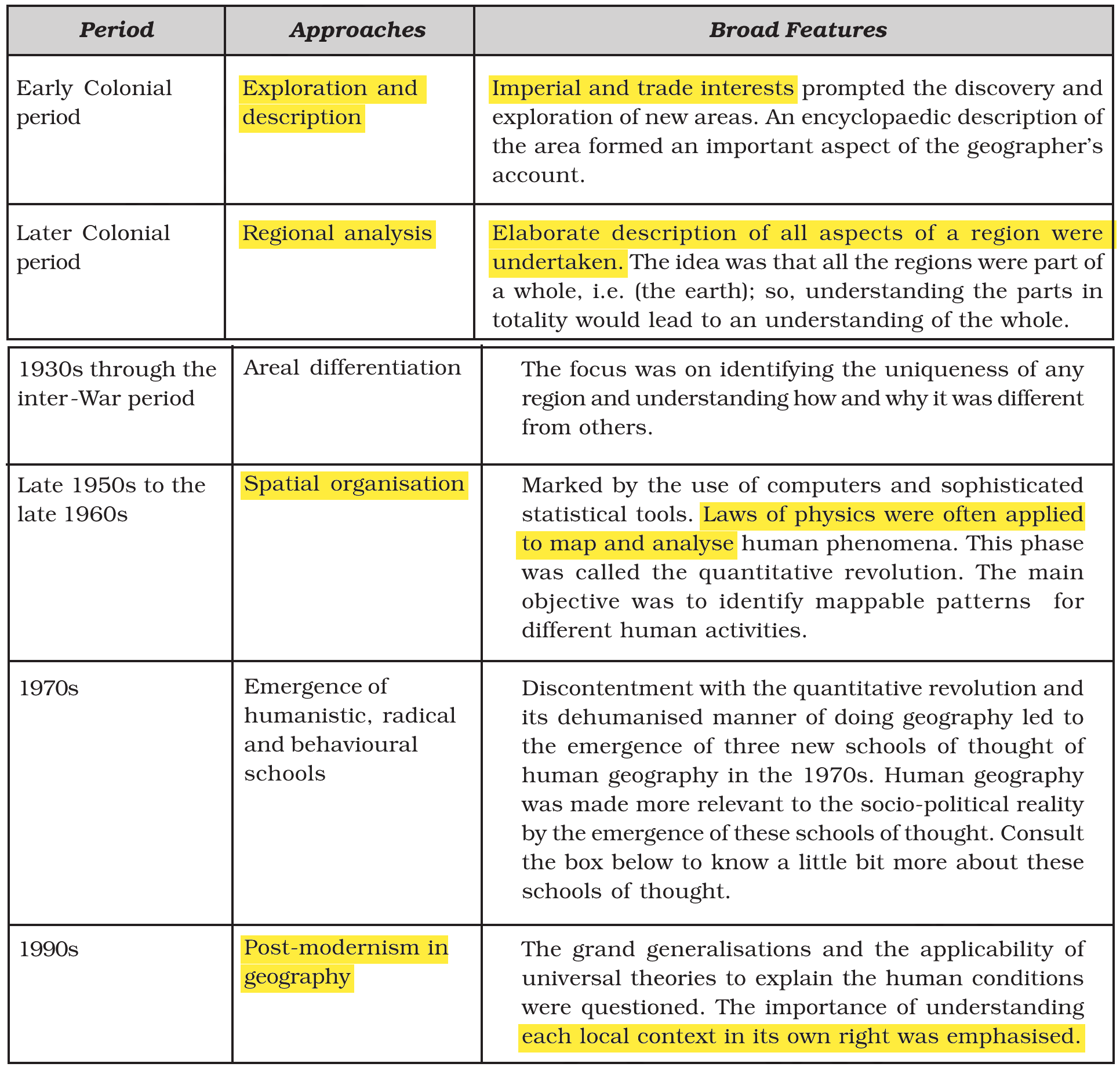
Match List-I with List-II
| List-I | List-II | ||
| Approach to Human Geography | Broad Feature | ||
| (A) | Exploration and description | (I) | Imperial and trade interests. |
| (B) | Spatial Organisation | (II) | Elaborate description of all aspects of a region were undertaken. |
| (C) | Regional Analysis | (III) | Laws of physics were often applied to map and analyse. |
| (D) | Post Modernism | (IV) | Understanding each local context in its own right was emphasised. |
Choose the correct answer from the options given below:
Answer & explanation
Correct answer: option 2
The correct answer is Option (2) → (A)-(I), (B)-(III), (C)-(II), (D)-(IV)
(A) Exploration and description — this matches (I) Imperial and trade interests. In the early colonial period, empires and traders wanted new lands, so new areas were discovered and described.
(B) Spatial Organisation — this matches (III) Laws of physics were often applied to map and analyse. In the late 1950s and the 1960s, computers and statistical tools were used. This phase was called the quantitative revolution.
(C) Regional Analysis — this matches (II) Elaborate description of all aspects of a region were undertaken. In the later colonial period, each region was studied in detail as a part of the whole earth.
(D) Post Modernism — this matches (IV) Understanding each local context in its own right was emphasised. In the 1990s, grand universal theories were questioned, and each place was studied on its own terms.
NCERT (2026-27): Fundamentals of Human Geography — Chapter 1: Human Geography: Nature and Scope, Table 1.1: Broad Stages and Thrust of Human Geography
|