
CUETMOCK
  • Pricing
  • Mentors
Log inStart freeStart free mocks→

First test, then trust

Try a free CUET mock test.

Join 5,00,000+ students who rehearsed exam day on the exact NTA screen before sitting CUET. On the web and on Android.

Start free mocks →Get the Android app
CUETMOCK

India's #1 CUET Mock Test Platform. Original NCERT-based questions on the exact NTA exam screen — trusted by 5,00,000+ students since CUET 2022.

Get it onGoogle PlayScan to download the CUETMOCK app

Mock tests

  • CUET mock test series
  • Browse all papers
  • Commerce mocks
  • Humanities (Arts) mocks
  • Science mocks
  • Languages & GAT mocks
  • Free practice questions
  • Pricing

Resources

  • CUET exam guide
  • CUET syllabus
  • Universities accepting CUET
  • Expert blogs
  • News & notifications
  • Webinars & counselling
  • CUET score calculator
  • How we estimate your rank
  • FAQs

Company

  • About us
  • Our leadership & team
  • Our toppers
  • Mentors
  • For schools
  • Contact us
  • Terms
  • Privacy
  • Refund policy

Talk to us

+91 7696 6630 56info@cuetmock.comWhatsApp us

Our other platforms

  • JEE Mock — For IIT-JEE aspirants
  • NEET Mock — For NEET aspirants

Newsletter

Exam updates, study material and offers — no spam.

© 2026 NYC Ventures Pvt. Ltd.

701-702, Royal Business Park, Zirakpur, Punjab - 140603

  • Terms of use
  • Privacy policy
  • Refund policy
  • Contact us

iCUETMOCK is an independent preparation platform, not affiliated with the National Testing Agency (NTA). Always check exam details on the official NTA website.

  • Home
  • Mock tests
  • CUET guide
  • Pricing
  • Log in
Home/Practice questions/Physics
PhysicsElectromagnetic Induction

Event 1 : South pole is moved towards the coil. Event 2 : North pole…

Case : Read the passage and answer the question(s).

Consider a coil C1 connected to galvanometer as shown. A magnet is placed next to the coil with its North pole facing near the coil and South facing away from the coil. The magnet is then moved towards the coil.
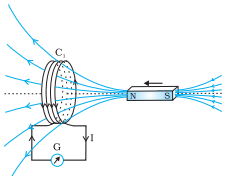
In context to this, answer the following question.

Event 1 : South pole is moved towards the coil.

Event 2 : North pole is moved away from the coil.

Answer & explanation+

Correct answer: option 4

Current developed when South pole is moved towards the coil is opposite in direction to that developed when North pole is moved towards the coil. Similarly, current developed when South pole is moved towards the coil is same in direction to that developed when North pole is moved away from the coil.

Advertisement

Practise more on Electromagnetic Induction

Chapter-wise mocks on the real NTA exam screen, with solutions and your rank. Your first mocks are free.

Start free mocks →

Advertisement

Next questions

  1. Identify the feature of coordination highlighted in the given situation: A manager plans the Diwali collection in June. The manager then ma…Business Studies · Nature and significance of Management
  2. Select the most appropriate option to fill in the blank. Can you please stop _________ it’s me who keeps messing up the work?English · Fill Blanks
  3. सूची-I को सूची-II से सुमेलित कीजिए : सूची-I शब्द सूची-II पर्यायवाची (A). असुर (I). केशरी (B). सोना (II). आदित्य (C). शेर (III). राक्षस (D).…Hindi · Synonyms
  4. The integral ∫displaystyledx/(√(1/2-5x-x^2)) is equal to:Maths. Section B1 · Indefinite Integration
  5. Which of the following countries the North-Eastern states do not share boundaries with?Political Science · Politics in India Since Independence: Regional Aspirations
  6. आधिकारिक पत्र-लेखन में सम्मिलित नहीं है -Hindi · पत्र लेखन
  7. The speed of a train is 108 km/h. The distance covered by the train in 11 seconds will be:General Aptitude Test · Numerical Ability
  8. The distance of plane r·(6imath-3jmath-2k)+1=0 from origin is:Maths. Section B1 · Three-dimensional Geometry
  9. The resemblance in bone structure found in the forelimbs of various vertebrates exemplifies which of the following?Biology · Evolution
  10. Hybridisation state of central metal ion in [Co(NH3)4(en)]3+ will beChemistry · Inorganic: Coordination Compounds