Hybridisation state of central metal ion in [Co(NH3)4(en)]3+ will be
Answer & explanation
Correct answer: option 3
The correct answer is Option (3) → d2sp3
In \( \ce{[Co(NH3)4(en)]^{3+}} \) there are 4 \( \ce{NH3} \) (unidentate) + 1 en (didentate), so the coordination number is 6 and the complex is octahedral.
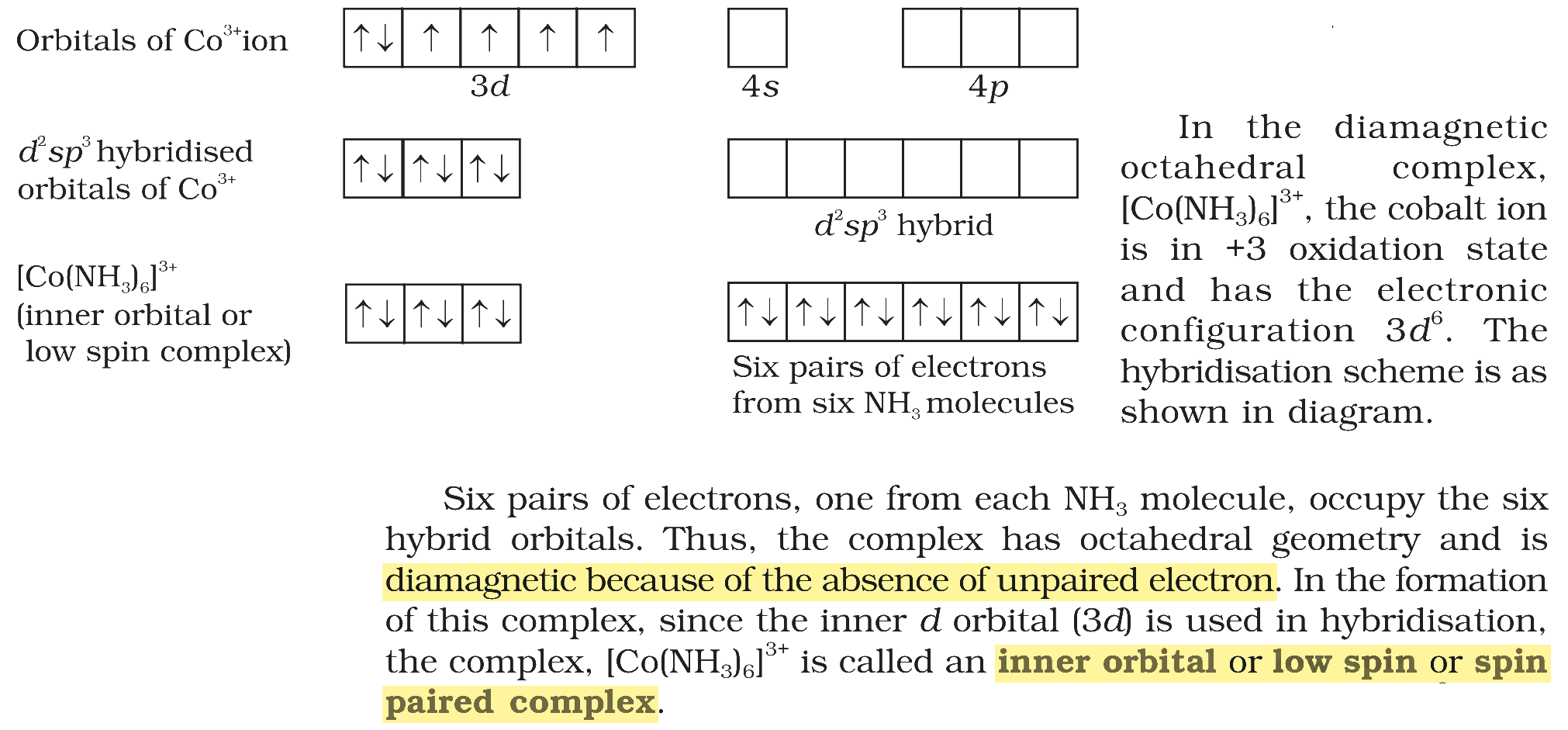
Co (Z = 27) is [Ar] 3d74s2, so Co3+ is 3d6. \( \ce{NH3} \) and en are strong field ligands, so, as in \( \ce{[Co(NH3)6]^{3+}} \), the six 3d electrons pair up in three 3d orbitals, leaving two inner 3d orbitals empty. These combine with the 4s and three 4p orbitals:
two 3d + one 4s + three 4p → six d2sp3 hybrid orbitals (inner orbital, low spin, diamagnetic)
Why the other options are incorrect
Option (1) sp3 — Incorrect. One 4s + three 4p orbitals give only four hybrid orbitals, arranged tetrahedrally (as in \( \ce{[NiCl4]^{2-}} \)); six donor atoms need six hybrid orbitals.
Option (2) dsp2 — Incorrect. One inner 3d + one 4s + two 4p orbitals give four hybrid orbitals in a square plane (as in \( \ce{[Ni(CN)4]^{2-}} \)); it also fits only coordination number 4, not 6.
Option (4) sp3d2 — Incorrect. The outer orbital (4d) octahedral hybridisation of high spin complexes with weak field ligands, such as \( \ce{[CoF6]^{3-}} \).
NCERT (2026-27 edition):
Valence Bond Theory – …