
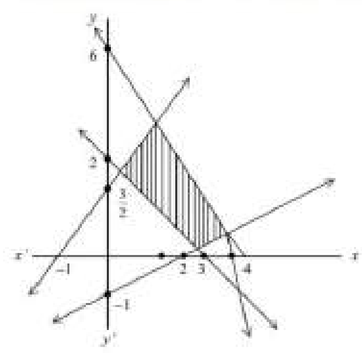
Consider the following feasible region. Which of the following constraints represents the feasible region?
A. \(2x + 3y \le 6\)
B. \(x - 2y \le 2\)
C. \(3x + 2y \le 12\)
D. \(3x - 2y \le -3\)
E. \(x - 2y \ge -1\)
Choose the correct answer from the options given below:
Answer & explanation
Correct answer: option 3
The correct answer is Option (3) → B and C only
The boundary lines in the figure can be read from their intercepts:
through (3, 0) and (0, 2): \(2x + 3y = 6\)
through (2, 0) and (0, −1): \(x - 2y = 2\)
through (4, 0) and (0, 6): \(3x + 2y = 12\)
through (−1, 0) and \(\left(0, \frac{3}{2}\right)\): \(3x - 2y = -3\)
The point (2, 1) lies inside the shaded region. Putting it into each line finds the side of each line on which the region lies:
\(2(2) + 3(1) = 7 \ge 6\)
\(2 - 2(1) = 0 \le 2\)
\(3(2) + 2(1) = 8 \le 12\)
\(3(2) - 2(1) = 4 \ge -3\)
So the shaded region is \(2x + 3y \ge 6\), \(x - 2y \le 2\), \(3x + 2y \le 12\) and \(3x - 2y \ge -3\); the line \(x - 2y = -1\) is not one of its boundaries.
Checking the statements
(A) \(2x + 3y \le 6\) — Incorrect. The region is on the other side of this line; (2, 1) gives 7, which is more than 6.
(B) \(x - 2y \le 2\) — Correct. (2, 1) gives 0, which is \(\le 2\).
(C) \(3x + 2y \le 12\) — Correct. (2, 1) gives 8, which is \(\le 12\).
(D) \(3x - 2y \le -3\) — Incorrect. The region is on the other side of this line; (2, 1) gives 4, which is more than −3.
(E) \(x - 2y \ge -1\) — Incorrect. The corner \(\left(\frac{3}{2}, \frac{15}{4}\right)\) of the region gives \(\frac{3}{2} - \frac{15}{2} = -6\), which is less than −1.