
A + B means 'A is daughter of B'
A - B means 'A is wife of B'
A × B means 'A is husband of B'
A ÷ B means 'A is father of B'
If K - S ÷ J × B + C - Q,
Choose the correct answer from the options given below:
(A) K is the father-in-law of B.
(B) J is the son-in-law of Q.
(C) S is the father of B.
(D) B is the daughter of C.
Answer & explanation
Correct answer: option 2
The correct answer is Option (2) → (B) and (D) only
In a coded relation, each symbol stands for one relation. The expression is broken into pairs of letters joined by a symbol, and each pair is read as “the letter on the left is the … of the letter on the right”.
The codes given in the question:
A + B means A is the daughter of B
A − B means A is the wife of B
A × B means A is the husband of B
A ÷ B means A is the father of B
The expression K − S ÷ J × B + C − Q breaks into five pairs:
K − S — − means “is the wife of”. So K is the wife of S, and K is female.
S ÷ J — ÷ means “is the father of”. So S is the father of J, and K is J’s mother.
J × B — × means “is the husband of”. So J is the husband of B.
B + C — + means “is the daughter of”. So B is the daughter of C.
C − Q — − means “is the wife of”. So C is the wife of Q, and Q is B’s father.
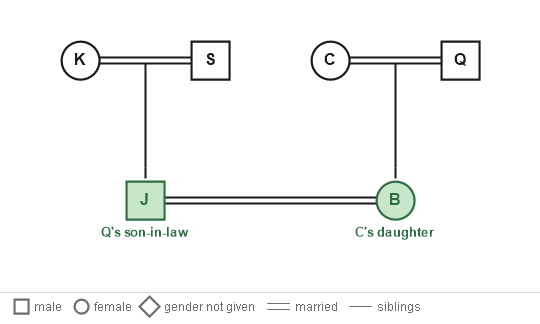
(A) K is the father-in-law of B. Incorrect. K is the mother of B’s husband J, but K is a woman (the wife of S), so K is B’s mother-in-law, not father-in-law.
(B) J is the son-in-law of Q. Correct. J is married to B, and B is the daughter of Q, so J is Q’s son-in-law.
(C) S is the father of B. Incorrect. S is the father of J, and B is J’s wife, so S is B’s father-in-law; B’s father is Q.
(D) B is the daughter of C. Correct. This is the pair B + C read directly.