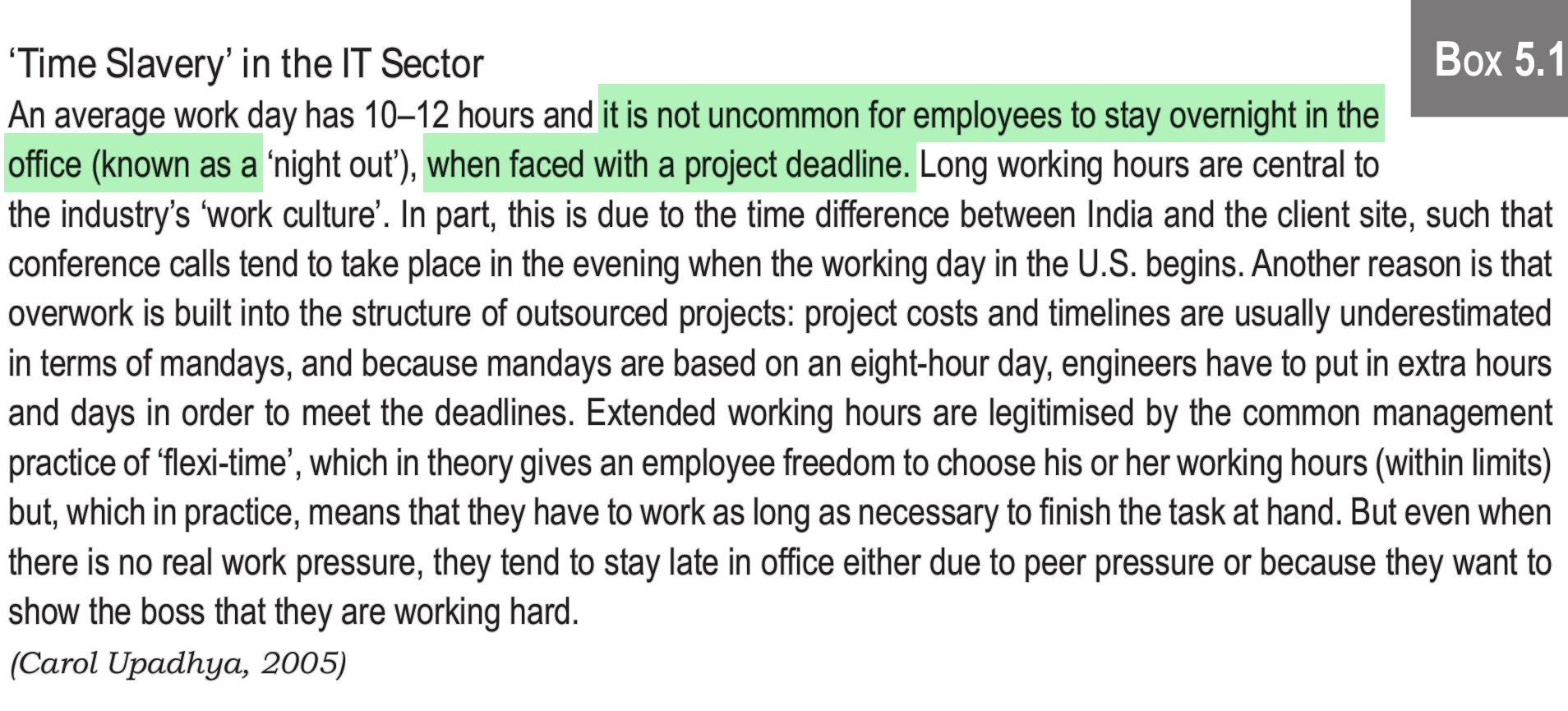
In IT and advertising sectors, it is not uncommon for employees to stay overnight in the office when faced with a project deadline. What phenomenon does this example indicate?
Answer & explanation
Correct answer: option 1
The correct answer is Option (1) → Night Out
Option (1) Night Out — Correct. In the IT sector an average work day has 10-12 hours, and it is not uncommon for employees to stay overnight in the office when faced with a project deadline; this is known as a ‘night out’. Long hours are built into the industry’s work culture, described as ‘time slavery’. The example in the question is a night out.
Option (2) Unorganised workforce — Incorrect. The unorganised or informal sector has small units, no unions and little protection of wages or working conditions. IT and advertising firms are large, organised employers; staying late for a deadline does not make their staff an unorganised workforce.
Option (3) Virtual work — Incorrect. Virtual work is work done from any place over the internet, without being present in the office. The employees in the question do the opposite: they stay in the office through the night.
Option (4) Alienation — Incorrect. Alienation is Marx’s term for the situation where people do not enjoy work and see it only as something they must do to survive, often because they produce only one small part of a product. The question describes long working hours, a specific practice, not the worker’s feeling about work.
Note: The concept in Option (3), ‘virtual work’, is not in NCERT (2025-26); it has been explained here for the benefit of the students.
NCERT: Social Change and Development in India — Chapter 5: Change and Development in Industrial Society (2025-26)
Box 5.1 ‘Time Slavery’ in the IT Sector |