Observe the image and answer the following question.
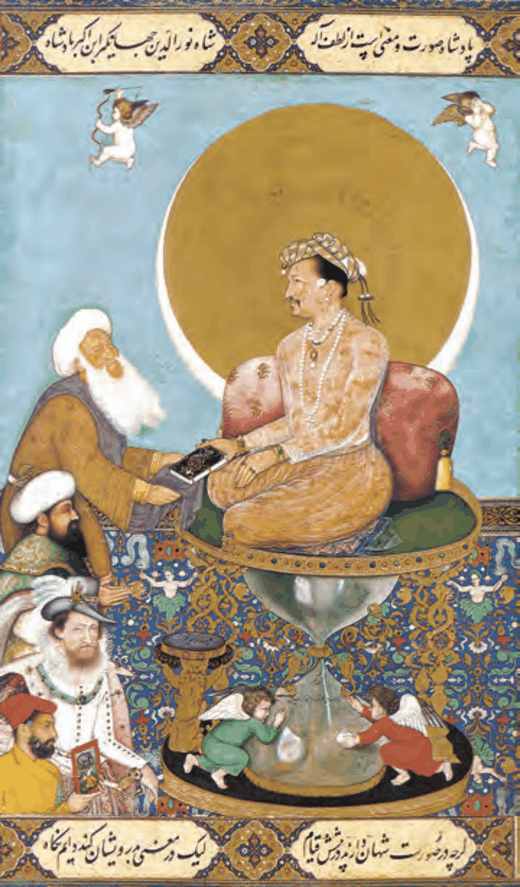
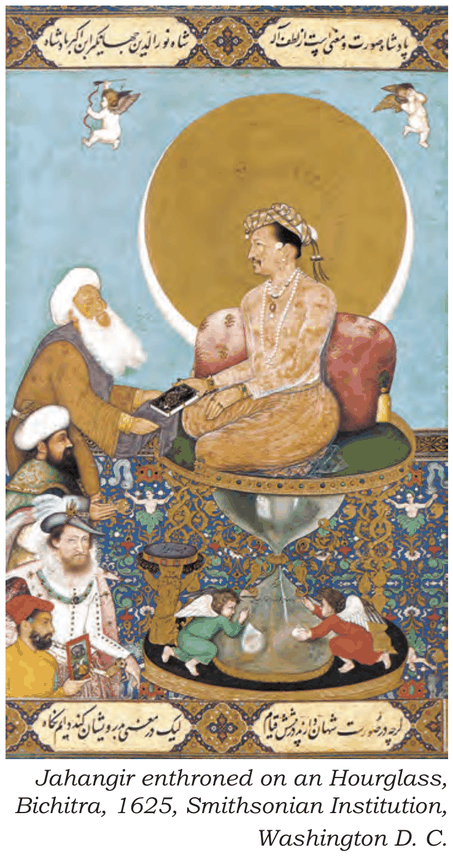
This Mughal painting carries lines of Persian calligraphy at the top and bottom. What do these lines say?
Answer & explanation
Correct answer: option 3
The correct answer is Option (3) → That the Shahs of this world may stand before him, as Jahangir prefers the dervishes
Option (1) That the Shah of Persia came to the emperor in a dream as a good omen — Incorrect. This is the subject of Jahangir’s Dream by Abul Hasan, in which Jahangir embraces Shah Abbas. It is a painted dream, not the verse on this painting.
Option (2) That a mule was brought by the Turks from Ethiopia for the emperor — Incorrect. Jahangir wrote these words in Persian on the Zebra painting by Ustad Mansur. They do not belong to this painting.
Option (3) That the Shahs of this world may stand before him, as Jahangir prefers the dervishes — Correct. The painting is Jahangir enthroned on an Hourglass by Bichitra. Its verse says the Shahs may stand before him, as Jahangir prefers to have the dervishes.
Option (4) That the Ottoman Sultan and King James I bring gifts for the mighty emperor — Incorrect. Figures that resemble the Ottoman Sultan and King James I are painted portraits standing with gifts. The calligraphy does not say this.
Note: This topic was not named in the CUET 2026 syllabus, but it was part of the NCERT chapter. In 2025 and 2026, NTA also asked questions on topics in NCERT that the CUET syllabus did not name. So our mocks have questions from every part of the NCERT chapter, to give you enough practice. Read the whole chapter, not only the sub-topics named in the syllabus.
NCERT (2026-27): “In the painting, Jahangir enthroned on an Hourglass (1625), symbolism is creatively applied by the court painter, Bichitra, who can be seen on the emperor’s right hand corner holding a painting in his hand, which would be his offering to the mighty emperor. Persian calligraphy adorns the top and bottom, which in verse says that the Shahs of this world may stand before him as Jahangir prefers to have the dervishes. Portrait that resemble the Ottoman Sultan, King James I of England also stands on the right hand with gifts for the mighty emperor.”
|