CUETMOCK
  • Pricing
  • Mentors
Log inStart freeStart free mocks→

First test, then trust

Try a free CUET mock test.

Join 5,00,000+ students who rehearsed exam day on the exact NTA screen before sitting CUET. On the web and on Android.

Start free mocks →Get the Android app
CUETMOCK

India's #1 CUET Mock Test Platform. Original NCERT-based questions on the exact NTA exam screen — trusted by 5,00,000+ students since CUET 2022.

Get it onGoogle PlayScan to download the CUETMOCK app

Mock tests

  • CUET mock test series
  • Browse all papers
  • Commerce mocks
  • Humanities (Arts) mocks
  • Science mocks
  • Languages & GAT mocks
  • Free practice questions
  • Pricing

Resources

  • CUET exam guide
  • CUET syllabus
  • Universities accepting CUET
  • Expert blogs
  • News & notifications
  • Webinars & counselling
  • CUET score calculator
  • How we estimate your rank
  • FAQs

Company

  • About us
  • Our leadership & team
  • Our toppers
  • Mentors
  • For schools
  • Contact us
  • Terms
  • Privacy
  • Refund policy

Talk to us

+91 7696 6630 56info@cuetmock.comWhatsApp us

Our other platforms

  • JEE Mock — For IIT-JEE aspirants
  • NEET Mock — For NEET aspirants

Newsletter

Exam updates, study material and offers — no spam.

© 2026 NYC Ventures Pvt. Ltd.

701-702, Royal Business Park, Zirakpur, Punjab - 140603

  • Terms of use
  • Privacy policy
  • Refund policy
  • Contact us

iCUETMOCK is an independent preparation platform, not affiliated with the National Testing Agency (NTA). Always check exam details on the official NTA website.

  • Home
  • Mock tests
  • CUET guide
  • Pricing
  • Log in
Home/Practice questions/Chemistry
ChemistryOrganic: Aldehydes, Ketones and Carboxylic Acids

Which of the following reaction will not produce ketones?

Which of the following reaction will not produce ketones?

Answer & explanation+

Correct answer: option 4

The correct answer is Option (4) → Stephen's reaction

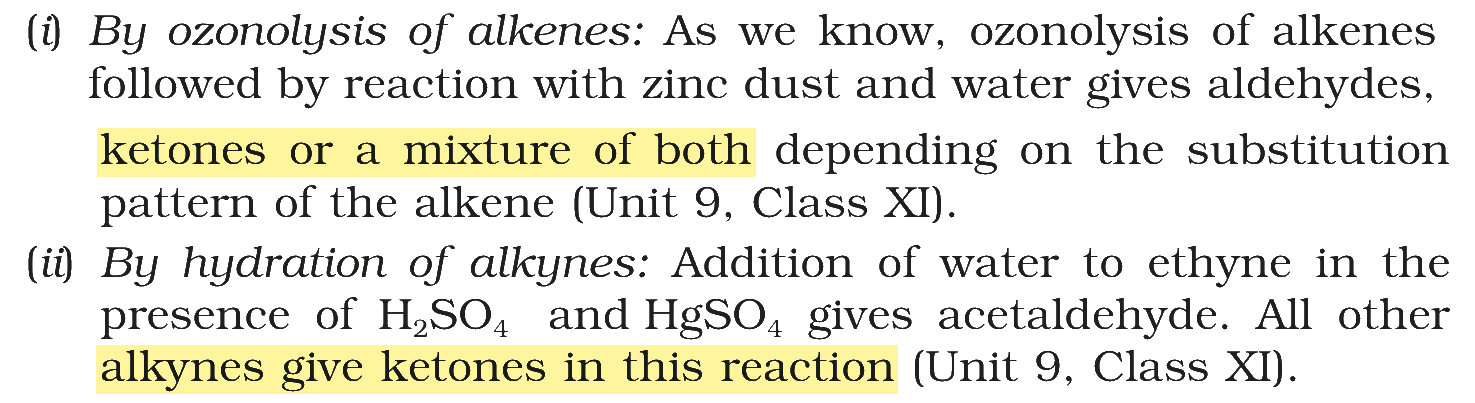
Ketones are prepared by several routes: ozonolysis of suitably substituted alkenes, hydration of alkynes other than ethyne, and the reaction of nitriles with Grignard reagents. The Stephen reaction belongs to the methods for aldehydes.

  • Option (1) Hydration of alkynes — Produces a ketone. With dilute \( \ce{H2SO4} \) and \( \ce{HgSO4} \), ethyne gives acetaldehyde, but all other alkynes give ketones.

        \( \ce{CH3-C#CH + H2O} \xrightarrow[\text{dil. }\ce{H2SO4}]{\ce{HgSO4}} \ce{CH3COCH3} \)

  • Option (2) Ozonolysis of substituted alkenes — Produces a ketone. Ozonolysis followed by Zn/water puts a C=O on each carbon of the double bond. A carbon that carries two alkyl groups becomes a ketone.

        \( \ce{(CH3)2C=CH2} \xrightarrow[\text{(ii) Zn/}\ce{H2O}]{\text{(i) }\ce{O3}} \ce{CH3COCH3 + HCHO} \)

  • Option (3) Treating nitrile with a Grignard reagent — Produces a ketone. The Grignard reagent adds to the C≡N group, and hydrolysis of the imine salt gives a ketone.

        \( \ce{CH3CN + C6H5MgBr} \xrightarrow{\text{ether}} \ce{C6H5C(CH3)=NMgBr} \xrightarrow{\ce{H3O+}} \ce{C6H5COCH3} \)

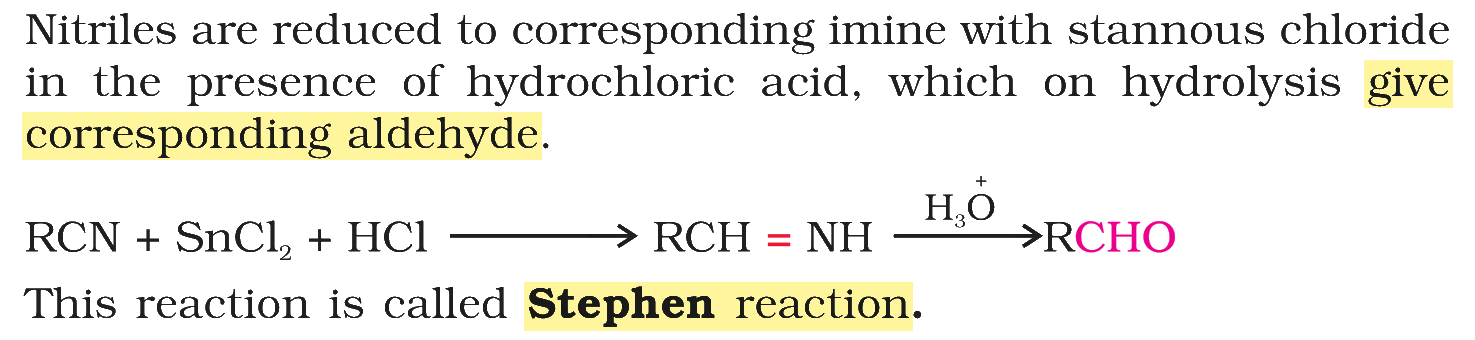
  • Option (4) Stephen's reaction — Does not produce a ketone. In the Stephen reaction a nitrile is reduced by stannous chloride and hydrochloric acid to an imine, and hydrolysis of the imine gives an aldehyde. The carbon of –CHO keeps one hydrogen, so no ketone can form.

        \( \ce{RCN + SnCl2 + HCl -> RCH=NH} \xrightarrow{\ce{H3O+}} \ce{RCHO} \)

NCERT (2026-27 edition):
From Hydrocarbons
Textbook extract

From Nitriles and Esters

Textbook extract

From Nitriles

Textbook extract

Note: The same/similar question has been asked in different years by NTA as per the details given below:

20262025202420232022
–––12-06 S3
30-05 S1
22-05 S3
–

Advertisement

Practise more on Organic: Aldehydes, Ketones and Carboxylic Acids

Chapter-wise mocks on the real NTA exam screen, with solutions and your rank. Your first mocks are free.

Start free mocks →

Advertisement

Next questions

  1. Which of the following areas received greater attention under liberalisation in and after 1991?Economics · Indian Economic Development: Liberalisation, Privatisation and Globalisation - An Appraisal
  2. Travelling from north to south, which of the following is the correct sequence of mountain ranges in India?General Aptitude Test · General Knowledge
  3. The position vector of three consecutive vertices of a parallelogram ABCD are A(4i + 2j - 6k), B(5i - 3j + k) and C(12i + 4j + 5k). The pos…Maths. Section B1 · Vectors
  4. The economic reforms of 1991 aimed at liberalising Indian business and industry from all unnecessary controls and restrictions, and signall…Business Studies · Business Environment
  5. The given pie chart shows the percentage distribution of 450 employees in an organisation. Study the pie chart and answer the questions tha…General Aptitude Test · Quantitative Reasoning
  6. The volume of the cylinder isGeneral Aptitude Test · Quantitative Reasoning
  7. 'कोमल' शब्द का विलोम है:Hindi · Comprehension - (Poetry / Literary)
  8. If A is an invertible matrix of order 2; then det(A^-1) is equal to:Maths. Section A · Determinants (Section A)
  9. Pick the correct statements: (A) One can change one's caste(B) Caste is determined by birth(C) Membership in a caste involves flexible rule…Sociology · Indian Society: Continuity and Change
  10. Match the description in List I with the regions mentioned in List II correctly: List- I (Description) List- II (Region) (A) Ruled by Nawab…Political Science · Politics in India Since Independence: Challenges of nation Building