Inheritance and variation
Read the following passage carefully and answer the given questions.
Mendel’s approach of using mathematics to explain biological phenomena was totally new and unacceptable to many of the biologists of his time. Finally, though Mendel’s work suggested that factors (genes) were discrete units, he could not provide any physical proof for the existence of factors or say what they were made of. In the dihybrid cross, the phenotypes round, yellow; wrinkled, yellow; round, green and wrinkled, green appeared in the ratio 9:3:3:1. Such a ratio was observed for several pairs of characters that Mendel studied. The important things to remember are that chromosomes as well as genes occur in pairs. Morgan and his group also found that even when genes were grouped on the same chromosome, some genes were very tightly linked while others were loosely linked. In a number of other insects and mammals including man, XY type of sex determination is seen where both male and female have same number of chromosomes. Grasshopper is an example of XO type of sex determination in which the males have only one X-chromosome besides the autosomes, whereas females have a pair of X-chromosomes.
Identify the stage of cell division when the two chromosome pairs can align at the metaphase plate independently of each other.
Answer & explanation
Correct answer: option 4
The correct answer is Option (4) → Anaphase of meiosis I
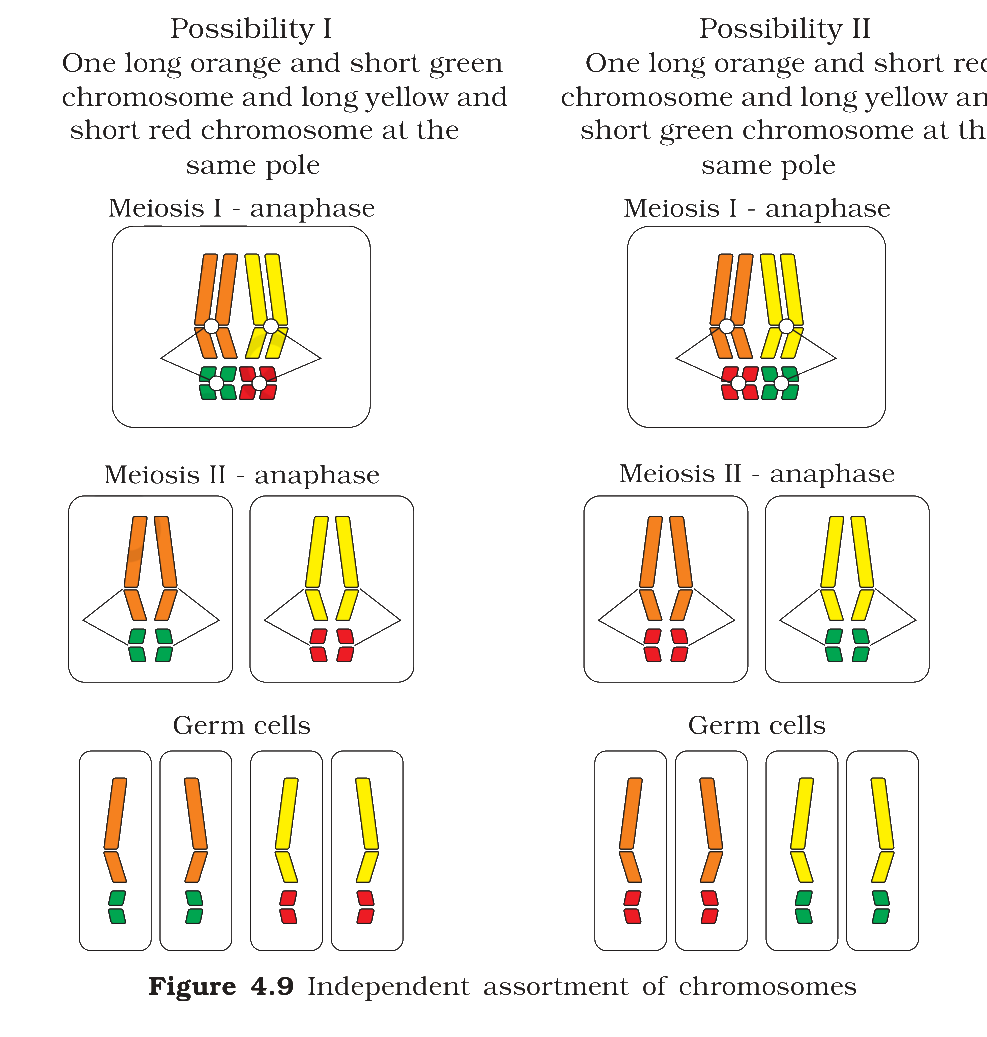
The chromosomal theory of inheritance explains Mendel’s law of independent assortment by the behaviour of chromosomes in meiosis I. Each pair of homologous chromosomes takes its place at the metaphase plate on its own, without regard to the other pairs. At anaphase of meiosis I the members of each pair separate, and the pairs separate independently of each other. So a chromosome of one pair may go to a pole with either chromosome of the other pair, and the gametes get all combinations in equal numbers.
(1) Metaphase of meiosis II — Incorrect. In meiosis II the homologous chromosomes have already separated. Single chromosomes line up, so there are no pairs to sort.
(2) Metaphase of meiosis I — Incorrect. At metaphase I the pairs only take their positions on the plate. The pairs actually separate, and so sort out independently, at anaphase I.
(3) Anaphase of meiosis II — Incorrect. At anaphase II the two sister chromatids of each chromosome separate. This does not sort chromosome pairs.
(4) Anaphase of meiosis I — Correct. This is the stage at which the two chromosome pairs sort independently of each other.
Note: The passage is taken from NCERT. NTA has put lines of the NCERT text together to make it. Most CUET (UG) questions come straight from NCERT, so study the book line by line, including figures and their titles.
NCERT Extract:
Chromosomal Theory of Inheritance – …