Read the passage and answer the questions:
"The mid-first millennium BCE saw the emergence of thinkers such as Mahavira and Gautama Buddha in India. Many tried to understand the mysteries of existence and the relationship between human beings and cosmic order. This was also the time when new kingdoms and cities were developing and social and economic life was changing in the Ganga Valley."
Match List I with List II:
| List I | List II | ||
| (A) | Mahavamsa | (I) | Philosophical Matters |
| (B) | Sutta Pitaka | (II) | Buddha's Teachings |
| (C) | Vinaya Pitaka | (III) | Rules and Regulations for a Sangh |
| (D) | Abhidhamma Pitaka | (IV) | Regional History of Buddhism |
Choose the correct answer from the options given below:
Answer & explanation
Correct answer: option 4
The correct answer is Option (4) → A-IV, B-II, C-III, D-I
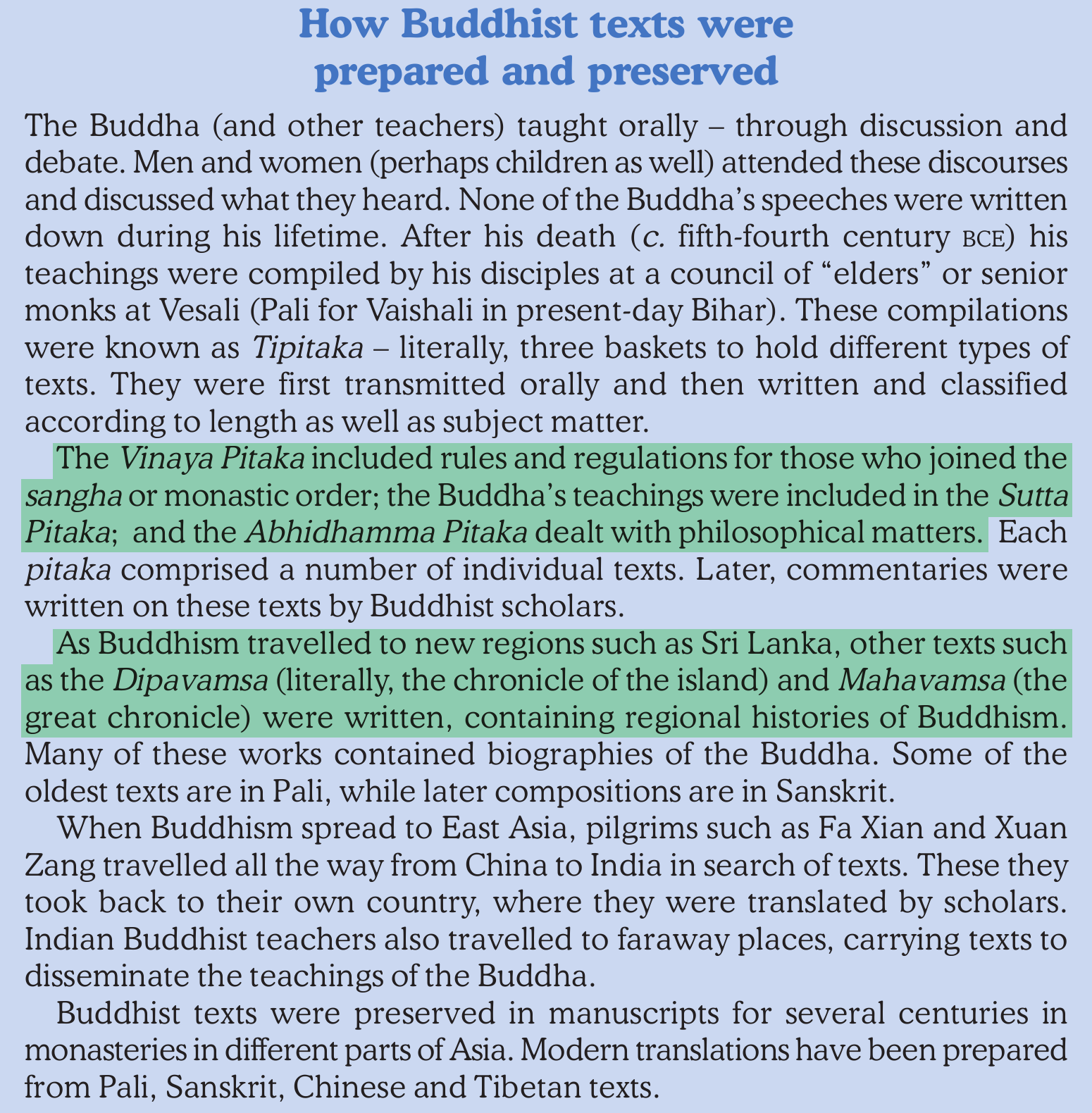
(A) Mahavamsa — this matches (IV) Regional History of Buddhism. As Buddhism travelled to new regions such as Sri Lanka, texts such as the Dipavamsa and the Mahavamsa (‘the great chronicle’) were written, containing regional histories of Buddhism.
(B) Sutta Pitaka — this matches (II) Buddha’s Teachings. The Buddha’s teachings were compiled by his disciples after his death and placed in the Sutta Pitaka.
(C) Vinaya Pitaka — this matches (III) Rules and Regulations for a Sangh. The Vinaya Pitaka included the rules and regulations for those who joined the sangha, the monastic order.
(D) Abhidhamma Pitaka — this matches (I) Philosophical Matters. The Abhidhamma Pitaka dealt with philosophical matters. Together the three pitakas, or ‘baskets’, made up the Tipitaka.
NCERT: Themes in Indian History Part I — Chapter 4: Thinkers, Beliefs and Buildings (2026-27)
|