
What is the IUPAC name of the given compound?
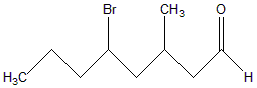
Answer & explanation
Correct answer: option 1
The correct answer is Option (1) → 5-Bromo-3-methyloctanal
An aliphatic aldehyde takes the name of the parent alkane with the ending –e changed to –al. The longest chain is numbered from the aldehyde carbon, which is always C1, and the substituents are written in alphabetical order with their numbers.
The compound written out in a line:
\( \displaystyle \ce{CH3CH2CH2CH(Br)CH2CH(CH3)CH2CHO} \)
Longest chain: from the –CHO carbon to the \( \ce{CH3} \) at the far end there are 8 carbons, so the parent is octanal.
Numbering: –CHO is C1. The carbon carrying \( \ce{CH3} \) is C3, and the carbon carrying Br is C5.
Order of prefixes: bromo comes before methyl in the alphabet.
So the name is 5-bromo-3-methyloctanal.
Why the other options are incorrect
Option (2) 4-Bromo-6-methyloctanal — Incorrect. These numbers come from counting from the \( \ce{CH3} \) end of the chain. In an aldehyde the numbering must start at the –CHO carbon, so C4 and C6 become C5 and C3.
Option (3) 4-Bromo-6-methyloctanaldehyde — Incorrect. The numbering is reversed as in Option (2), and the IUPAC suffix for an open-chain aldehyde is –al, not “–aldehyde”.
NCERT (2026-27 edition):
(b) IUPAC names – “The IUPAC names of open chain aliphatic aldehydes and ketones are derived from the names of the corresponding alkanes by replacing the ending –e with –al and –one respectively. In case of aldehydes the longest carbon chain is numbered starting from the carbon of the aldehyde group while in case of ketones the numbering begins from the end nearer to the carbonyl group. The substituents are prefixed in alphabetical order along with numerals indicating their positions in the carbon chain.”