Match List-I with List-II:
| List-I Books/Articles | List-II Author | ||
| (A) | Mohenjodaro and the Indus Civilisation , 1931 | (I) | R.E.M. Wheeler |
| (B) | “Harappa 1946”, Ancient India , 1947 | (II) | John Marshall |
| (C) | “The Mythical Massacre at Mohenjodaro”, Expediton , 1964 | (III) | Vasant Shinde |
| (D) | An Ancient Harappan Genome Lacks Ancestry from Steppe Pastoralists or Iranian Farmers, Cell , 2019 | (IV) | G.F. Dales |
Choose the correct answer from the options given below:
Answer & explanation
Correct answer: option 3
The correct answer is Option (3) → (A)-(II), (B)-(I), (C)-(IV), (D)-(III)
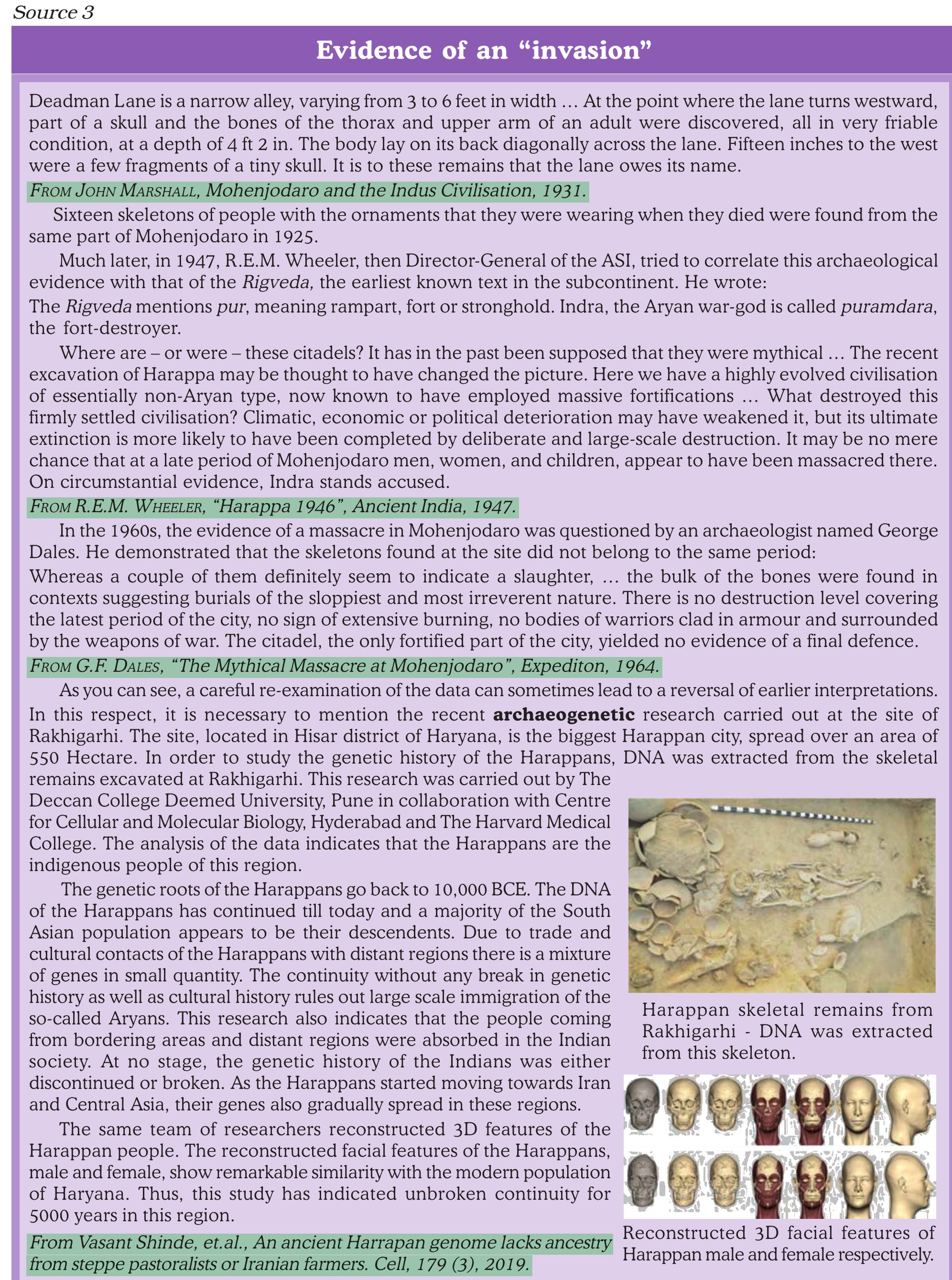
(A) Mohenjodaro and the Indus Civilisation, 1931 — this matches (II) John Marshall. The ‘Deadman Lane’ account of skeletons found in a narrow alley of Mohenjodaro is quoted from John Marshall’s book of 1931.
(B) “Harappa 1946”, Ancient India, 1947 — this matches (I) R.E.M. Wheeler. Wheeler, then Director-General of the ASI, tried to link the skeletons with the Rigveda and wrote that “Indra stands accused” of destroying the Harappan cities.
(C) “The Mythical Massacre at Mohenjodaro”, Expediton, 1964 — this matches (IV) G.F. Dales. In the 1960s George Dales questioned the massacre theory, showing that the skeletons did not belong to the same period.
(D) An Ancient Harappan Genome Lacks Ancestry from Steppe Pastoralists or Iranian Farmers, Cell, 2019 — this matches (III) Vasant Shinde. It reports the archaeogenetic research on the skeletal remains of Rakhigarhi, carried out by Vasant Shinde and his team.
NCERT: Themes in Indian History Part I — Chapter 1: Bricks, Beads and Bones (2026-27)
|