CUETMOCK
  • Pricing
  • Mentors
Log inStart freeStart free mocks→

First test, then trust

Try a free CUET mock test.

Join 5,00,000+ students who rehearsed exam day on the exact NTA screen before sitting CUET. On the web and on Android.

Start free mocks →Get the Android app
CUETMOCK

India's #1 CUET Mock Test Platform. Original NCERT-based questions on the exact NTA exam screen — trusted by 5,00,000+ students since CUET 2022.

Get it onGoogle PlayScan to download the CUETMOCK app

Mock tests

  • CUET mock test series
  • Browse all papers
  • Commerce mocks
  • Humanities (Arts) mocks
  • Science mocks
  • Languages & GAT mocks
  • Free practice questions
  • Pricing

Resources

  • CUET exam guide
  • CUET syllabus
  • Universities accepting CUET
  • Expert blogs
  • News & notifications
  • Webinars & counselling
  • CUET score calculator
  • How we estimate your rank
  • FAQs

Company

  • About us
  • Our leadership & team
  • Our toppers
  • Mentors
  • For schools
  • Contact us
  • Terms
  • Privacy
  • Refund policy

Talk to us

+91 7696 6630 56info@cuetmock.comWhatsApp us

Our other platforms

  • JEE Mock — For IIT-JEE aspirants
  • NEET Mock — For NEET aspirants

Newsletter

Exam updates, study material and offers — no spam.

© 2026 NYC Ventures Pvt. Ltd.

701-702, Royal Business Park, Zirakpur, Punjab - 140603

  • Terms of use
  • Privacy policy
  • Refund policy
  • Contact us

iCUETMOCK is an independent preparation platform, not affiliated with the National Testing Agency (NTA). Always check exam details on the official NTA website.

  • Home
  • Mock tests
  • CUET guide
  • Pricing
  • Log in
Home/Practice questions/Chemistry
ChemistryOrganic: Aldehydes, Ketones and Carboxylic Acids

Which of the following reaction will not produce ketones?

Which of the following reaction will not produce ketones?

Answer & explanation+

Correct answer: option 4

The correct answer is Option (4) → Stephen's reaction

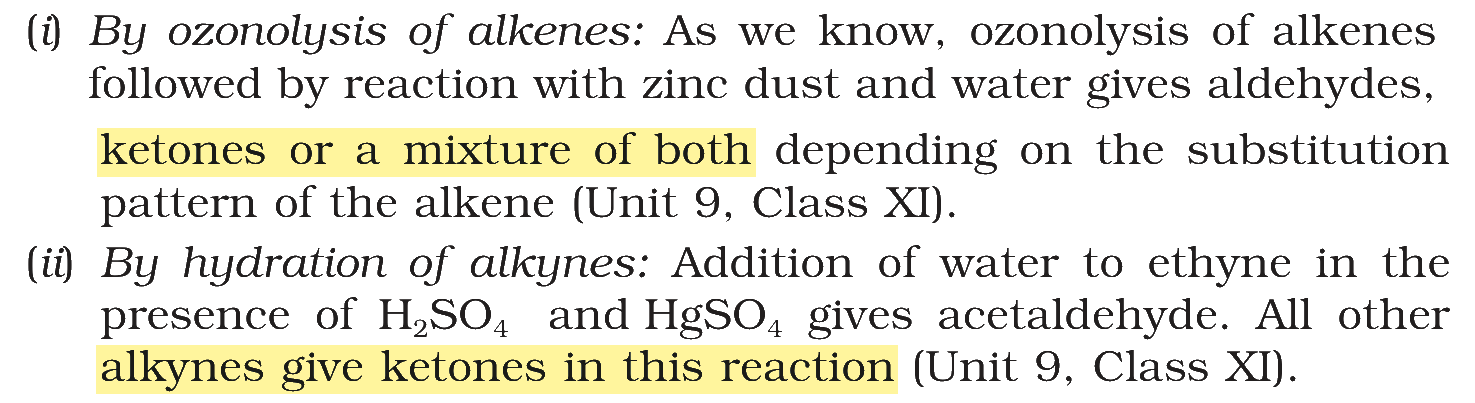
Ketones are prepared by several routes: ozonolysis of suitably substituted alkenes, hydration of alkynes other than ethyne, and the reaction of nitriles with Grignard reagents. The Stephen reaction belongs to the methods for aldehydes.

  • Option (1) Hydration of alkynes — Produces a ketone. With dilute \( \ce{H2SO4} \) and \( \ce{HgSO4} \), ethyne gives acetaldehyde, but all other alkynes give ketones.

        \( \ce{CH3-C#CH + H2O} \xrightarrow[\text{dil. }\ce{H2SO4}]{\ce{HgSO4}} \ce{CH3COCH3} \)

  • Option (2) Ozonolysis of substituted alkenes — Produces a ketone. Ozonolysis followed by Zn/water puts a C=O on each carbon of the double bond. A carbon that carries two alkyl groups becomes a ketone.

        \( \ce{(CH3)2C=CH2} \xrightarrow[\text{(ii) Zn/}\ce{H2O}]{\text{(i) }\ce{O3}} \ce{CH3COCH3 + HCHO} \)

  • Option (3) Treating nitrile with a Grignard reagent — Produces a ketone. The Grignard reagent adds to the C≡N group, and hydrolysis of the imine salt gives a ketone.

        \( \ce{CH3CN + C6H5MgBr} \xrightarrow{\text{ether}} \ce{C6H5C(CH3)=NMgBr} \xrightarrow{\ce{H3O+}} \ce{C6H5COCH3} \)

  • Option (4) Stephen's reaction — Does not produce a ketone. In the Stephen reaction a nitrile is reduced by stannous chloride and hydrochloric acid to an imine, and hydrolysis of the imine gives an aldehyde. The carbon of –CHO keeps one hydrogen, so no ketone can form.

        \( \ce{RCN + SnCl2 + HCl -> RCH=NH} \xrightarrow{\ce{H3O+}} \ce{RCHO} \)

NCERT (2026-27 edition):
From Hydrocarbons
Textbook extract

From Nitriles and Esters

Textbook extract

From Nitriles

Textbook extract

Note: The same/similar question has been asked in different years by NTA as per the details given below:

20262025202420232022
–––12-06 S3
30-05 S1
22-05 S3
–

Advertisement

Practise more on Organic: Aldehydes, Ketones and Carboxylic Acids

Chapter-wise mocks on the real NTA exam screen, with solutions and your rank. Your first mocks are free.

Start free mocks →

Advertisement

Next questions

  1. The legal provisions against violence and humiliation to Dalits and Adivasis strengthened by:Sociology · Indian Society: Patterns of Social Inequality and Exclusion
  2. In this question a statement is given which is followed by two assumptions numbered I and II. You have to consider the statement and the fo…General Aptitude Test · Verbal Reasoning
  3. How does Aarav most likely feel when Dadi answers “Enough”?English · Comprehension - (Narrative / Factual)
  4. Point the evidence NOT considered as a proof of agricultural technology of Harappan culture:History · Ancient India: Bricks, Beads and Bones
  5. What will be the quick assets of the company?Accountancy Part B · Accounting Ratios
  6. In Freud's theory, which defence mechanism is shown when a person totally refuses to accept reality?Psychology · Self and Personality
  7. Select the option that can be used as a one-word substitute for the given group of words. The study of human mind and behaviourEnglish · One Word
  8. Find the value of cot θ.tan(90 - θ) - sec (90 - θ) cosec θ + (sin2 25° + sin2 65° ) + sqrt 3 (tan 30° tan 35° tan 55°).General Aptitude Test · Quantitative Reasoning
  9. Select the Venn diagram that best represents the relationship between the following classes. Males, Fathers, AccountantsGeneral Aptitude Test · Verbal Reasoning
  10. If the value of nominal GDP is 5500 and of real GDP is 2200, what is the value of GDP Deflator?Economics · Macro Economics: National Income Accounting