Read the passage and answer the following questions.
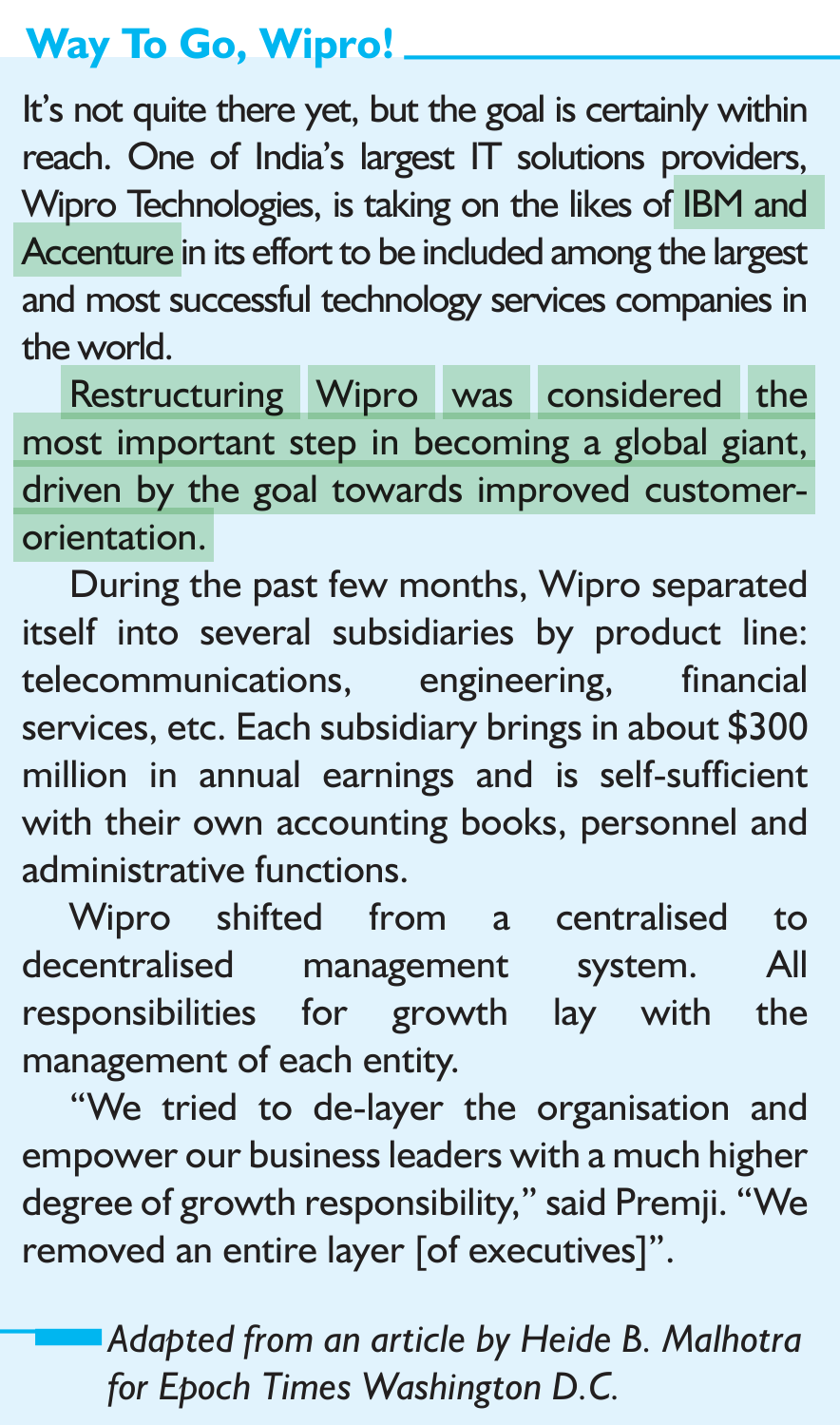
Wipro Technologies, one of India's largest IT solutions providers, restructured its organization in its bid to compete globally with giants like IBM and Accenture. This restructuring aimed to improve customer orientation and operational efficiency, critical to Wipro's ambition of becoming a global technology leader.
The company transitioned from a centralized management system to a decentralized structure, dividing its operations into several self-sufficient subsidiaries focused on specific product lines, such as telecommunications, engineering, and financial services. Each subsidiary operates independently, managing its personnel, accounting, and administrative functions. This decentralization empowered business leaders to take greater responsibility for growth and eliminated an entire layer of executives to streamline operations.
Azim Premji, Wipro's then-chairman, emphasized the importance of this shift, noting that it gave leaders more autonomy and enhanced decision-making at the operational level. This organizational change helped Wipro achieve specialization and allowed better alignment of resources with customer needs.
Despite the advantages of decentralization, including flexibility, faster decision-making, and enhanced accountability, it also posed challenges, such as coordination among subsidiaries and maintaining consistency in strategic objectives. Wipro addressed these challenges by clearly defining roles and responsibilities across its new structure.
What was the primary objective behind Wipro's organizational restructuring?
Answer & explanation
Correct answer: option 2
The correct answer is Option (2) → To improve customer orientation and global competitiveness
Option (1) To reduce operational costs — Incorrect. The passage talks about operational efficiency, but cutting cost is not given as the main aim.
Option (2) To improve customer orientation and global competitiveness — Correct. The passage says Wipro restructured “in its bid to compete globally with giants like IBM and Accenture”. It also says the aim was to improve customer orientation. Customer orientation means putting the customer first. Restructuring was the key step to become a global giant.
Option (3) To increase the number of employees — Incorrect. Wipro did the opposite. It removed a whole layer of executives.
Option (4) To focus on local markets — Incorrect. Wipro wanted to compete in the world market, not only in local markets.
Note: The passage is based on the NCERT box ‘Way To Go, Wipro!’ in the chapter Organising; NTA has added some lines to it. NCERT (2026-27 Edition): “Wipro organised itself in a manner that allowed customer orientation to dominate over other goals and diversified on the basis of product lines. It also modified the relationships within the management hierarchy to suit the goals.” “Divisional Structure … In a divisional structure, the organisation structure comprises of separate business units or divisions. Each unit has a divisional manager responsible for performance and who has authority over the unit. Generally, manpower is grouped on the basis of different products manufactured. …”
|