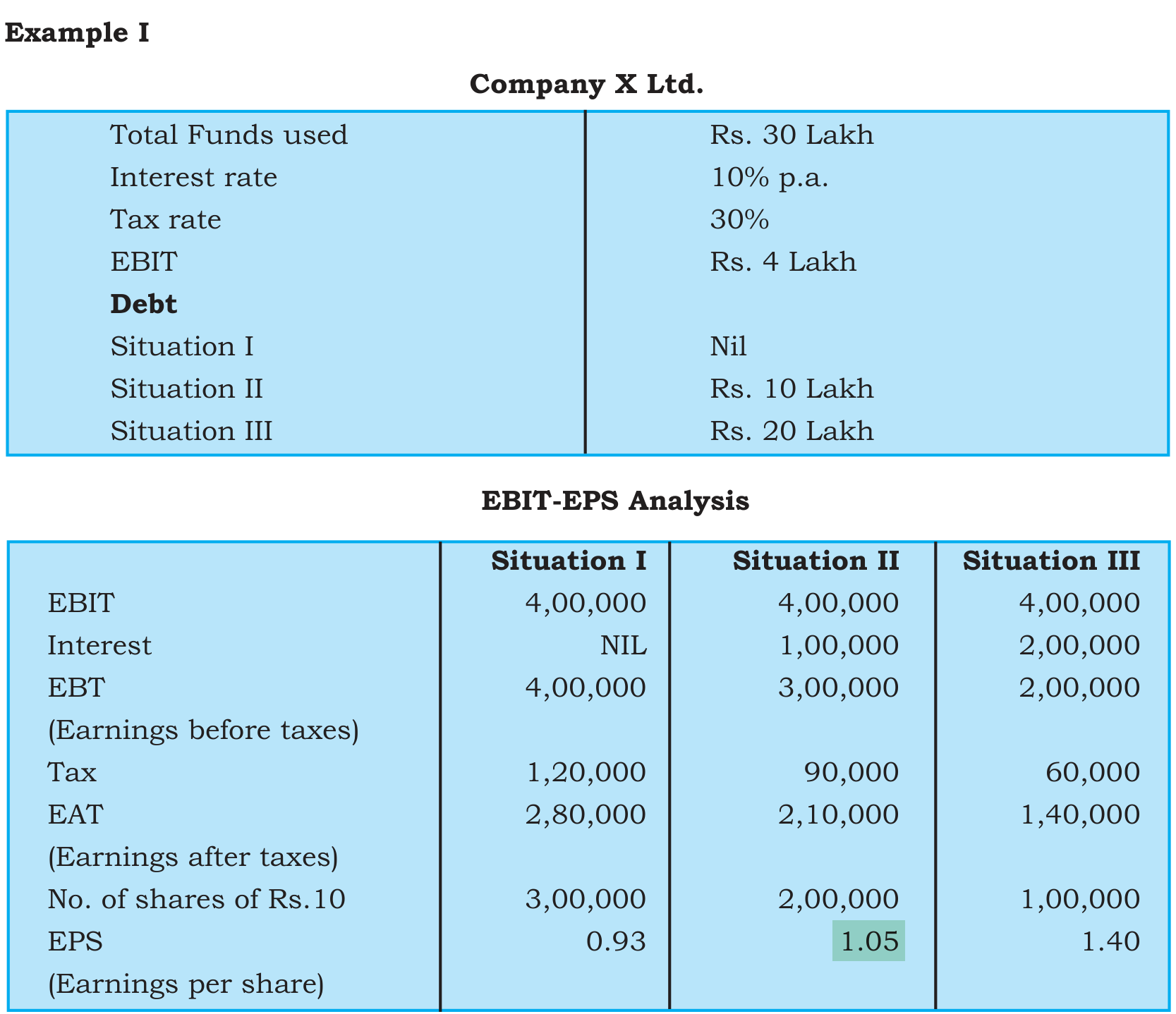
Answer the questions on the basis of the information given below.
Company X
TOTAL FUND USED = 30 LAKHS
| Face value of share | ₹10/- |
| Interest rate on Debt | 10% |
| Tax rate | 30% |
| EBIT | 4 Lakhs |
| Situation I (Debt) | Nil |
| Situation II (Debt) | 10 Lakhs |
Choose the correct answer from the options given below:
The Earning Per Share (EPS) for situation II is:
Answer & explanation
Correct answer: option 2
The correct answer is Option (2) → 1.05
Formula: EPS = EAT ÷ Number of equity shares
So: Find the interest, tax and EAT first, then the number of shares.
Values: Debt = ₹10 lakh at 10%, so equity = ₹30 lakh − ₹10 lakh = ₹20 lakh. EBIT = ₹4,00,000; interest = 10% of ₹10,00,000 = ₹1,00,000; EBT = ₹3,00,000; tax (30%) = ₹90,000; EAT = ₹2,10,000. Shares = ₹20,00,000 ÷ ₹10 = 2,00,000
Working: EPS = ₹2,10,000 ÷ 2,00,000 = ₹1.05
Note: This case is based on the trading-on-equity example of Company X in NCERT Business Studies Part II, Chapter 9 (Financial Management). NCERT (2026-27 Edition): “Capital Structure … Three situations are considered. There is no debt in situation-I i.e. (unlevered business). Debt of Rs. 10 lakh and 20 lakh are assumed in situations-II and III, respectively. All debt is at 10% p.a.” “The company earns Rs. 0.93 per share if it is unlevered. With debt of Rs. 10 lakh its EPS is Rs. 1.05. With a still higher debt of Rs. 20 lakh, its, EPS rises to Rs. 1.40. …”
|