
Read the following information carefully & answer the question given below:
I) 'P+Q' means 'P is mother of Q'
II) 'P-Q' means 'Q is sister of P'
III) 'P×Q' means 'P is the brother of Q'
IV) 'P÷Q' means 'Q is the father of P'
Which of the following means R is nephew of T?
A) R×J÷T
B) R×T÷J×K
C) R-M+T-J
D) T-K+R×M
Choose the correct answer from the options given below:
Answer & explanation
Correct answer: option 4
The correct answer is Option (4) → Only (D)
In a coded relation, each symbol stands for one relation. Each expression is broken into pairs of letters joined by a symbol, and each pair is read with the meaning the question gives for that symbol. R is the nephew of T only if R is male and is a child of T’s brother or sister.
The codes given in the question:
P + Q means P is the mother of Q
P − Q means Q is the sister of P
P × Q means P is the brother of Q
P ÷ Q means Q is the father of P
(A) R × J ÷ T
R × J — × means “is the brother of”, so R is the brother of J.
J ÷ T — ÷ means the right letter is the father of the left, so T is the father of J.
R is J’s brother, so R is T’s son, not his nephew.
(B) R × T ÷ J × K
R × T — R is the brother of T. This pair alone settles it: R is T’s brother.
T ÷ J makes J the father of T (and of R), and J × K makes J the brother of K, so R is K’s nephew, not T’s.
(C) R − M + T − J
R − M — − means the right letter is the sister of the left, so M is the sister of R.
M + T — + means “is the mother of”, so M is the mother of T.
T − J — J is the sister of T.
R is the brother or sister of T’s mother, so R is T’s uncle or aunt; it is T who is R’s nephew or niece.
(D) T − K + R × M
T − K — K is the sister of T.
K + R — K is the mother of R.
R × M — R is the brother of M. This is the pair that tells us R is male.
R is the son of T’s sister, so R is T’s nephew.
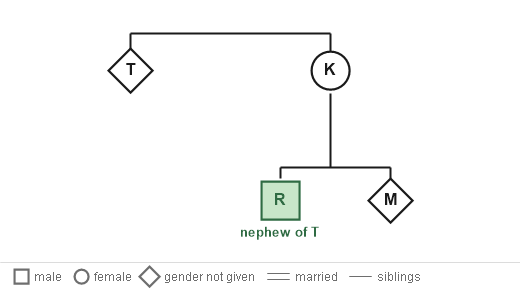
Tip: The symbols mean only what the question defines for them. Here − is read the other way round (“Q is the sister of P”), and so is ÷; in another paper the same signs may stand for other relations, so read the codes afresh every time.
Note: NTA dropped this question in its Final Answer Key. The original NTA paper printed expression (D) as R-M×J÷T and Option (4) as (B) and (C). That expression contradicts itself (R-M makes M a sister, while M×J makes M a brother), and none of the printed expressions makes R the nephew of T, so no option was correct. For the benefit of students and to ensure a single answer, expression (D) has been changed to T-K+R×M and Option (4) to Only (D).