Read the passage carefully and answer the questions based on the passage:
Species diversity on earth is not uniformly distributed. It is generally highest in the tropics and decreases towards the poles. Earth’s fossil history reveals the incidences of mass extinctions in the past. Earth’s rich biodiversity is vital for the very survival of mankind. It is believed that communities with high diversity tend to be less variable and more productive. The reasons of conserving biodiversity are narrowly utilitarian, broadly utilitarian and ethical. Biodiversity conservation may be in situ as well as ex-situ.
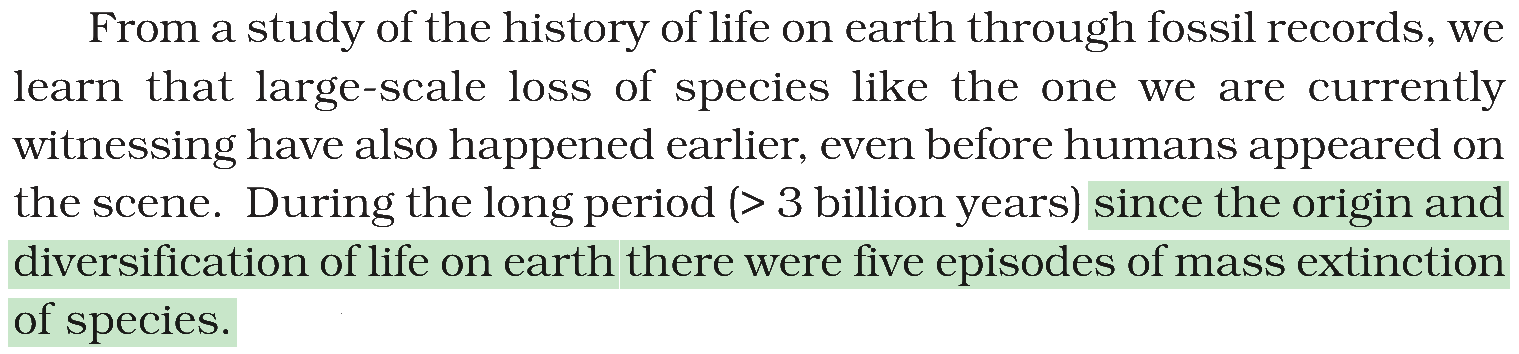
How many episodes of mass extinction of species have occurred since the origin and diversification of life on earth?
Answer & explanation
Correct answer: option 3
The correct answer is Option (3) → Five
The passage says the fossil history of the earth shows mass extinctions in the past. A mass extinction is the loss of a very large number of species in a short geological time. In more than 3 billion years of life on earth there have been five such episodes. The loss going on now is called the ‘Sixth Extinction’. It is 100 to 1,000 times faster than in pre-human times, and human activities cause it.
Option (3) Five — Correct. Since the origin and diversification of life on earth there have been five episodes of mass extinction. The present loss of species, mostly due to humans, is often called the sixth.
Note 1: The passage is taken from NCERT. NTA has put lines of the NCERT text together to make it. Most CUET (UG) questions come straight from NCERT, so study the book line by line, including figures and their titles.
Note 2: A similar question was also asked in CUET (UG) 2023 on 10-06-2023 (Slot 3).
NCERT Extract:
Loss of Biodiversity –