
In the context of humans, which one of the following groups will have 46 chromosomes:
Answer & explanation
Correct answer: option 3
The correct answer is Option (3) → Oogonia and spermatogonia
In humans, the chromosome number is diploid (2n = 46) in somatic cells and germ cells before meiosis, and haploid (n = 23) in gametes (sperm and egg) and certain cells produced during meiosis.
Spermatogonia and secondary spermatocytes:
- Spermatogonia are diploid (46 chromosomes). Secondary spermatocytes are haploid (23 chromosomes) because they are produced after meiosis I. Not both have 46 chromosomes.
Spermatids and ovum:
- Spermatids are haploid (23 chromosomes) because they are produced after meiosis II. Ovum (egg) is haploid (23 chromosomes). Both are haploid.
Oogonia and spermatogonia:
- Oogonia (female germ cells before meiosis) are diploid (46 chromosomes). Spermatogonia (male germ cells before meiosis) are diploid (46 chromosomes). Both have 46 chromosomes.
Sperm and second polar body:
- Sperm is haploid (23 chromosomes). Second polar body is haploid (23 chromosomes) because it is a byproduct of meiosis in oogenesis. Both are haploid.
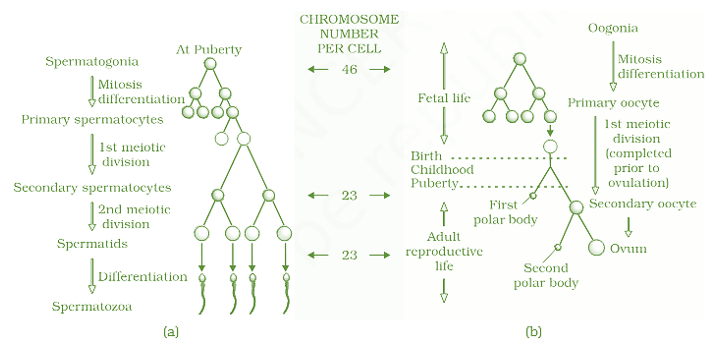
Schematic representation of (a) Spermatogenesis; (b) Oogenesis