CUETMOCK
  • Pricing
  • Mentors
Log inStart freeStart free mocks→

First test, then trust

Try a free CUET mock test.

Join 5,00,000+ students who rehearsed exam day on the exact NTA screen before sitting CUET. On the web and on Android.

Start free mocks →Get the Android app
CUETMOCK

India's #1 CUET Mock Test Platform. Original NCERT-based questions on the exact NTA exam screen — trusted by 5,00,000+ students since CUET 2022.

Get it onGoogle PlayScan to download the CUETMOCK app

Mock tests

  • CUET mock test series
  • Browse all papers
  • Commerce mocks
  • Humanities (Arts) mocks
  • Science mocks
  • Languages & GAT mocks
  • Free practice questions
  • Pricing

Resources

  • CUET exam guide
  • CUET syllabus
  • Universities accepting CUET
  • Expert blogs
  • News & notifications
  • Webinars & counselling
  • CUET score calculator
  • How we estimate your rank
  • FAQs

Company

  • About us
  • Our leadership & team
  • Our toppers
  • Mentors
  • For schools
  • Contact us
  • Terms
  • Privacy
  • Refund policy

Talk to us

+91 7696 6630 56info@cuetmock.comWhatsApp us

Our other platforms

  • JEE Mock — For IIT-JEE aspirants
  • NEET Mock — For NEET aspirants

Newsletter

Exam updates, study material and offers — no spam.

© 2026 NYC Ventures Pvt. Ltd.

701-702, Royal Business Park, Zirakpur, Punjab - 140603

  • Terms of use
  • Privacy policy
  • Refund policy
  • Contact us

iCUETMOCK is an independent preparation platform, not affiliated with the National Testing Agency (NTA). Always check exam details on the official NTA website.

  • Home
  • Mock tests
  • CUET guide
  • Pricing
  • Log in
Home/Practice questions/History
HistoryAncient India: Bricks, Beads and Bones

Match List-I with List-II:List-IEarly India ArchaeologyList-IIMajor P…

Match List-I with List-II:

List-I
Early India Archaeology
List-II
Major Periods
(A) Neolithic Age(I) 1000 BCE
(B) Harappan Civilisation(II) 10,000 BP
(C) Early Iron(III) 600-400 BCE
(D) Early Historic(IV) 2600 BCE

Choose the correct answer from the options given below:

Answer & explanation+

Correct answer: option 4

The correct answer is Option (4) → (A) - (II), (B) - (IV), (C) - (I), (D) - (III)

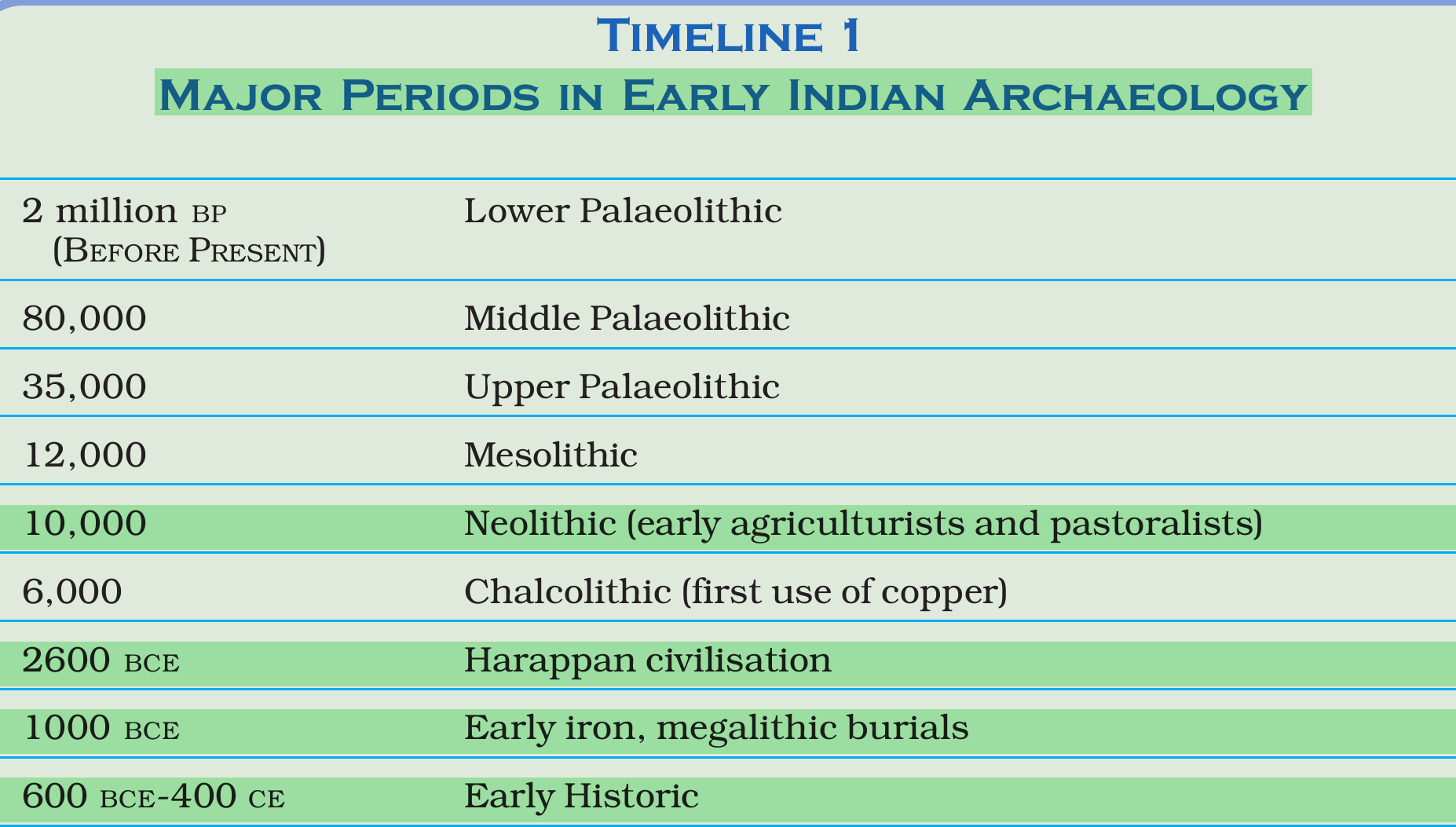
(A) Neolithic Age — this matches (II) 10,000 BP. The Neolithic, the age of the early agriculturists and pastoralists, begins about 10,000 years Before Present.

(B) Harappan Civilisation — this matches (IV) 2600 BCE. The timeline places the Harappan civilisation at 2600 BCE, the start of its mature phase.

(C) Early Iron — this matches (I) 1000 BCE. At 1000 BCE the timeline has the early iron age, along with the megalithic burials.

(D) Early Historic — this matches (III) 600-400 BCE. The Early Historic period is the last entry of the timeline, from 600 BCE to 400 CE.

Note: It seems that there is a mistake in the original NTA paper, which prints item (III) as ‘600-400 BCE’ when it should read ‘600 BCE-400 CE’, as in the NCERT timeline. Item (III) is still the only one that fits the Early Historic period, so the answer is not affected.


NCERT: Themes in Indian History Part I — Chapter 1: Bricks, Beads and Bones (2025-26)

NCERT extract

Advertisement

Practise more on Ancient India: Bricks, Beads and Bones

Chapter-wise mocks on the real NTA exam screen, with solutions and your rank. Your first mocks are free.

Start free mocks →

Advertisement

Next questions

  1. Identify the incorrect statement regarding price flooring:Economics · Micro Economics: Market Equilibrium
  2. Which of the following defect in solid is a vacancy defect as well as interstitial defect?Chemistry · Physical: Solid State
  3. Three of the following are details contained in the contract note issued by the broker. Identify the odd one out.Business Studies · Financial Markets
  4. Which of the following statements is NOT correct in respect of planning?Business Studies · Planning
  5. Three partners A, B and C shared the profit in a business in the ratio 6 : 9 : 10 respectively. If A, B and C invested the money for 12 mon…Applied Maths. Section B2 · Numbers, Quantification and Numerical Applications
  6. The structure of the group has evolved and is accepted by group members. The group moves towards achieving the group goal. Which of the fol…Psychology · Social Influence and Group Processes
  7. In which year was the State Reorganisation Act passed?Political Science · Politics in India Since Independence: Challenges of nation Building
  8. The standard reduction potential of Ag^+/Ag electrode is +0.80 V. Choose the correct statement based on this information.Chemistry · Physical: Electro Chemistry
  9. Civil Rights Movement in USA in 1950s and 1960s was related to which of the following?Sociology · Social Change and Development in India: Social Movements
  10. Most tributaries of the Ganga join it from the north. Which of the following joins it from the south, as a right-bank tributary?General Aptitude Test · General Knowledge