Which of the following statements is not correct with reference to a catalyst?
Answer & explanation
Correct answer: option 4
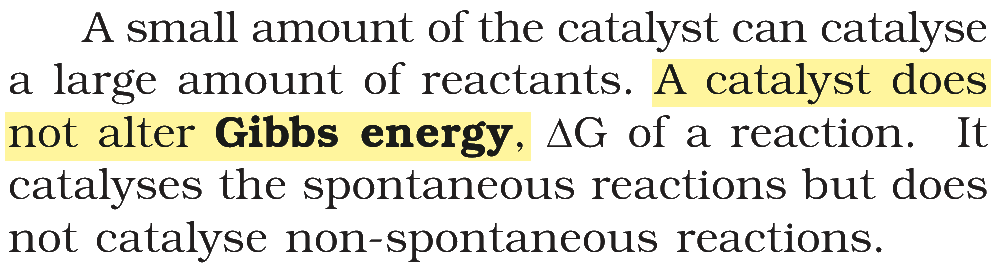
The correct answer is Option (4) → It alters the Gibbs free energy for a reaction.
A catalyst forms temporary bonds with the reactants and opens an alternative pathway of lower activation energy, so the reaction goes faster. It is given back unchanged at the end, so it does not change the energies of the reactants and products. The Gibbs energy change, \( \Delta G \), depends only on these initial and final states, so a catalyst does not alter \( \Delta G \). For the same reason it cannot make a non-spontaneous reaction go.
Option (1) It decreases the activation energy of a reaction. — Correct about a catalyst. A lower energy barrier lets a larger fraction of molecules react, so the rate rises.
Option (2) It provides an alternative reaction pathway. — Correct about a catalyst. The lower activation energy belongs to this new pathway through an intermediate with the catalyst.
Option (3) It catalyzes the forward and backward reaction to the same extent. — Correct about a catalyst. The barrier is lowered equally in both directions, so the equilibrium constant stays the same and equilibrium is only reached sooner.
Option (4) It alters the Gibbs free energy for a reaction. — Not correct about a catalyst. \( \Delta G \) depends only on the initial and final states, which the catalyst does not change, so a catalyst does not alter the Gibbs energy of a reaction.
NCERT (2026-27 edition):
Effect of Catalyst – …