
CUETMOCK
  • Pricing
  • Mentors
Log inStart freeStart free mocks→

First test, then trust

Try a free CUET mock test.

Join 5,00,000+ students who rehearsed exam day on the exact NTA screen before sitting CUET. On the web and on Android.

Start free mocks →Get the Android app
CUETMOCK

India's #1 CUET Mock Test Platform. Original NCERT-based questions on the exact NTA exam screen — trusted by 5,00,000+ students since CUET 2022.

Get it onGoogle PlayScan to download the CUETMOCK app

Mock tests

  • CUET mock test series
  • Browse all papers
  • Commerce mocks
  • Humanities (Arts) mocks
  • Science mocks
  • Languages & GAT mocks
  • Free practice questions
  • Pricing

Resources

  • CUET exam guide
  • CUET syllabus
  • Universities accepting CUET
  • Expert blogs
  • News & notifications
  • Webinars & counselling
  • CUET score calculator
  • How we estimate your rank
  • FAQs

Company

  • About us
  • Our leadership & team
  • Our toppers
  • Mentors
  • For schools
  • Contact us
  • Terms
  • Privacy
  • Refund policy

Talk to us

+91 7696 6630 56info@cuetmock.comWhatsApp us

Our other platforms

  • JEE Mock — For IIT-JEE aspirants
  • NEET Mock — For NEET aspirants

Newsletter

Exam updates, study material and offers — no spam.

© 2026 NYC Ventures Pvt. Ltd.

701-702, Royal Business Park, Zirakpur, Punjab - 140603

  • Terms of use
  • Privacy policy
  • Refund policy
  • Contact us

iCUETMOCK is an independent preparation platform, not affiliated with the National Testing Agency (NTA). Always check exam details on the official NTA website.

  • Home
  • Mock tests
  • CUET guide
  • Pricing
  • Log in
Home/Practice questions/Maths. Section A
Maths. Section ALinear Programming (Section A)

For the problem max Z=ax+by,\ x ≥ 0,\ y ≥ 0 , which of the following…

For the problem max \(Z=ax+by,\ x \ge 0,\ y \ge 0\), which of the following is NOT a valid constraint to make it a linear programming problem?

Answer & explanation+

Correct answer: option 4

The correct answer is Option (4) → \(x^2+y \le 50\)

In a linear programming problem the objective function and every constraint must be linear, that is, of the first degree in x and y.

    \(x \le 5,\ y \le 10\): first degree, valid
    \(2x+3y \le 60\): first degree, valid
    \(x+2y \le 40\): first degree, valid
    \(x^2+y \le 50\): contains \(x^2\), not linear

So \(x^2+y \le 50\) cannot be a constraint of a linear programming problem.

NCERT (2026-27 edition):
Linear Programming Problem and its Mathematical Formulation
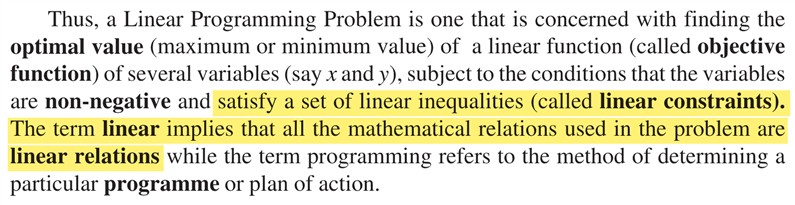
NCERT extract

Advertisement

Practise more on Linear Programming (Section A)

Chapter-wise mocks on the real NTA exam screen, with solutions and your rank. Your first mocks are free.

Start free mocks →

Advertisement

Next questions

  1. If A= […] , then the sum of the elements of the matrix AA^T is:Applied Maths. Section B2 · Algebra
  2. India's first open-sea Marine Fish Farming project has been launched in Jan 2026 at which sea/channel/bay/strait/gulf?General Aptitude Test · Current Affairs
  3. If a + b = 9, 2/3 ab = 12, then find the value of a2 + b2+ 4.General Aptitude Test · Quantitative Reasoning
  4. The price of sugar decreased by 30% due to this a family used 32 kg more sugar so as expenditure decreased by 16% only. Find current consum…General Aptitude Test · Numerical Ability
  5. Time taken by sunlight to pass through a window of thickness 8 mm and refractive index (3/2) is:Physics · Ray Optics
  6. Select the most appropriate option to fill in the blank. The sudden death of our uncle was ______________ for all of us.English · Fill Blanks
  7. The speed of sound will be fastest in _____.General Aptitude Test · General Knowledge
  8. In a class of 60 where girls are twice to that of boys. Annu , a girl 20th from the top. If there are 12 girls ahead of her then, how many…General Aptitude Test · Verbal Reasoning
  9. According to species-area relationships, the relation between species richness and area for a wide variety of taxa (angiosperms, birds, bat…Biology · Biodiversity and Conservation
  10. What is co-evolution?Biology · Organisms and Populations