CUETMOCK
  • Pricing
  • Mentors
Log inStart freeStart free mocks→

First test, then trust

Try a free CUET mock test.

Join 5,00,000+ students who rehearsed exam day on the exact NTA screen before sitting CUET. On the web and on Android.

Start free mocks →Get the Android app
CUETMOCK

India's #1 CUET Mock Test Platform. Original NCERT-based questions on the exact NTA exam screen — trusted by 5,00,000+ students since CUET 2022.

Get it onGoogle PlayScan to download the CUETMOCK app

Mock tests

  • CUET mock test series
  • Browse all papers
  • Commerce mocks
  • Humanities (Arts) mocks
  • Science mocks
  • Languages & GAT mocks
  • Free practice questions
  • Pricing

Resources

  • CUET exam guide
  • CUET syllabus
  • Universities accepting CUET
  • Expert blogs
  • News & notifications
  • Webinars & counselling
  • CUET score calculator
  • How we estimate your rank
  • FAQs

Company

  • About us
  • Our leadership & team
  • Our toppers
  • Mentors
  • For schools
  • Contact us
  • Terms
  • Privacy
  • Refund policy

Talk to us

+91 7696 6630 56info@cuetmock.comWhatsApp us

Our other platforms

  • JEE Mock — For IIT-JEE aspirants
  • NEET Mock — For NEET aspirants

Newsletter

Exam updates, study material and offers — no spam.

© 2026 NYC Ventures Pvt. Ltd.

701-702, Royal Business Park, Zirakpur, Punjab - 140603

  • Terms of use
  • Privacy policy
  • Refund policy
  • Contact us

iCUETMOCK is an independent preparation platform, not affiliated with the National Testing Agency (NTA). Always check exam details on the official NTA website.

  • Home
  • Mock tests
  • CUET guide
  • Pricing
  • Log in
Home/Practice questions/Accountancy Part A
Accountancy Part AAccounting for Shares

Select the correct statements related to shares and share capital:(A)…

Select the correct statements related to shares and share capital:

(A) Authorized Share Capital and Nominal Share Capital are different from each other.

(B) Equity shares cannot be redeemed during the lifetime of the company.

(C) Preference shares are not the real owner of the company.

(D) Equity shares cannot be issued to the public at a discount.

Choose the correct statements from the options given below:

Answer & explanation+

Correct answer: option 2

The correct answer is Option (2) → (B), (C) and (D) only

The statements cover the names of share capital, redemption, ownership and the issue of shares at a discount.

(A) Authorized Share Capital and Nominal Share Capital are different from each other. Incorrect. They are two names for the same capital: the amount stated in the Memorandum of Association, also called Nominal or Registered capital. A statement that sets them against each other is false.

(B) Equity shares cannot be redeemed during the lifetime of the company. Correct. Redemption is a feature of preference shares; equity capital goes back to its holders only when the company is wound up (apart from a buy-back, which is not redemption).

(C) Preference shares are not the real owner of the company. Correct. Control and the residual profit sit with the equity shareholders, while preference holders get a fixed dividend with priority and have limited voting rights.

(D) Equity shares cannot be issued to the public at a discount. Correct. Shares are normally sold at par or above; an issue below face value is barred except in the special cases the law allows.

NCERT (2026-27 edition):
Categories of Share Capital – “From accounting point of view the share capital of the company can be classified as follows: Authorised Capital: Authorised capital is the amount of share capital which a company is authorised to issue by its Memorandum of Association. The company cannot raise more than the amount of capital as specified in the Memorandum of Association. It is also called Nominal or Registered capital.”

NCERT (2026-27 edition):
Distinction between Shares and Debentures – “… Repayment: Normally, the amount of shares is not returned during the life of the company, whereas, generally, the debentures are issued for a specified period and repayable on the expiry of that period.”

NCERT (2026-27 edition):
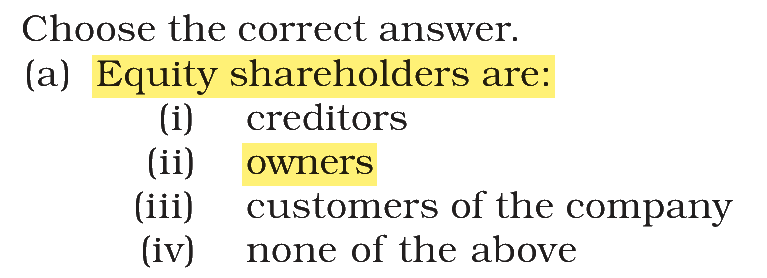
Test your Understanding – II

Extract from the NCERT textbook

NCERT (2026-27 edition):
Answers to Test your Understanding

Extract from the NCERT textbook

NCERT (2026-27 edition):
Issue of Shares at a Discount – “… As a general rule, a company cannot ordinarily issue shares at a discount. It can do so only in cases such as ‘reissue of forfeited shares’ (to be discussed later) and issue of sweat equity shares.”

Advertisement

Practise more on Accounting for Shares

Chapter-wise mocks on the real NTA exam screen, with solutions and your rank. Your first mocks are free.

Start free mocks →

Advertisement

Next questions

  1. In Jahanara's biography, she has shown her devotion to which Sufi saint?History · Medieval India: Bhakti Sufi Traditions
  2. A long straight wire AB carries current 10 A. A proton (P) travels with a speed 2×10^6 mathrmm s^-1 , parallel to the wire, at a distance 2…Physics · Moving Charges and Magnetism
  3. Which of the following is NOT true about dairy farming:Geography · Fundamentals of Human Geography: Primary Activities
  4. At which place National Remote Sensing Centre (NRSC) is located?Geography · India-People and Economy: Transport and Communcation
  5. What were some of the consequences faced by journalists during the Emergency? 1) They received government awards and recognition for coveri…Political Science · Politics in India Since Independence: Crisis of democratic Order
  6. If x + 1/x= 8, then find the value of 5x/(x^2+1-6x).General Aptitude Test · Quantitative Reasoning
  7. Capital Employed in a partnership firm is ₹50,00,000. Its average profit is ₹6,00,000. The normal rate of return in similar type of busines…Accountancy Part A · Admission of a Partner
  8. When tourists go home happy they normally tend to:English · Comprehension - (Narrative / Factual)
  9. “PPC is concave to the origin”. Which of the following options explain the reason behind the same?Economics · Micro Economics: Introduction
  10. "कुर्सी पर मास्टर जी बैठे हैं" इस वाक्य में निम्नलिखित में से कौन-सा कारक होगा?Hindi · व्याकरण - सकारक