
CUETMOCK
  • Pricing
  • Mentors
Log inStart freeStart free mocks→

First test, then trust

Try a free CUET mock test.

Join 5,00,000+ students who rehearsed exam day on the exact NTA screen before sitting CUET. On the web and on Android.

Start free mocks →Get the Android app
CUETMOCK

India's #1 CUET Mock Test Platform. Original NCERT-based questions on the exact NTA exam screen — trusted by 5,00,000+ students since CUET 2022.

Get it onGoogle PlayScan to download the CUETMOCK app

Mock tests

  • CUET mock test series
  • Commerce mocks
  • Humanities (Arts) mocks
  • Science mocks
  • Languages & GAT mocks
  • Free practice questions
  • Pricing

Resources

  • CUET exam guide
  • CUET syllabus
  • Universities accepting CUET
  • Expert blogs
  • News & notifications
  • Webinars & counselling
  • CUET score calculator
  • How we estimate your rank
  • FAQs

Company

  • About us
  • Our leadership & team
  • Our toppers
  • Mentors
  • For schools
  • Contact us
  • Terms
  • Privacy
  • Refund policy

Talk to us

+91 7696 6630 56info@cuetmock.comWhatsApp us

Our other platforms

  • JEE Mock — For IIT-JEE aspirants
  • NEET Mock — For NEET aspirants

Newsletter

Exam updates, study material and offers — no spam.

© 2026 NYC Ventures Pvt. Ltd.

701-702, Royal Business Park, Zirakpur, Punjab - 140603

  • Terms of use
  • Privacy policy
  • Refund policy
  • Contact us

iCUETMOCK is an independent preparation platform, not affiliated with the National Testing Agency (NTA). Always check exam details on the official NTA website.

  • Home
  • Mock tests
  • CUET guide
  • Pricing
  • Log in
Home/Practice questions/Chemistry
ChemistryPhysical: Chemical Kinetics

For a reaction, the activation energies of the forward and the backwa…

Most chemical reactions are accelerated by an increase in temperature. The temperature dependence of the rate of a chemical reaction is explained by the Arrhenius equation

\[k = A\,e^{-E_a/RT}\]

where \(A\) is the Arrhenius factor (also called the frequency factor or pre-exponential factor) and \(E_a\) is the activation energy, expressed in J mol−1. A plot of ln \(k\) against \(1/T\) is a straight line with slope \(-E_a/R\). The rate constants \(k_1\) and \(k_2\) of a reaction at temperatures \(T_1\) and \(T_2\) are related as

\[\log\frac{k_2}{k_1} = \frac{E_a}{2.303R}\left[\frac{T_2 - T_1}{T_1T_2}\right]\]

For a chemical reaction, a rise in temperature by 10 K nearly doubles the rate constant, because the fraction of molecules having energy equal to or greater than the activation energy increases.

For a reaction, the activation energies of the forward and the backward reactions are equal. Which of the following is true for this reaction?

Answer & explanation+

Correct answer: option 3

The correct answer is Option (3) → Energy is neither absorbed nor released in the reaction.

On a plot of potential energy against reaction coordinate, the reactants (A), the activated complex (C) and the products (B) each sit at a fixed energy. Both the forward and the backward reaction pass through the same activated complex C.

  • Forward reaction: Ea(forward) = energy of C − energy of A.

  • Backward reaction: Ea(backward) = energy of C − energy of B.

  • Equal barriers: Ea(forward) = Ea(backward), so energy of A = energy of B.

  • Enthalpy change: ΔH = energy of B − energy of A = Ea(forward) − Ea(backward) = 0.

The reactants and products have the same energy, so no energy is absorbed or released in the reaction.

Why the other options are incorrect

Option (1) Energy is released in the reaction. — Incorrect. Energy is released only when the products lie below the reactants (as A and B are drawn in Fig. 3.7); then Ea(backward) is larger than Ea(forward).

Option (2) Energy is absorbed in the reaction. — Incorrect. Energy is absorbed only when the products lie above the reactants; then Ea(forward) is larger than Ea(backward).

Option (4) The activation energy of the reaction is zero. — Incorrect. Equal does not mean zero. The reactants still need energy to form the activated complex C, which lies above both A and B; that energy is the activation energy.

NCERT (2026-27 edition):
3.4 Temperature Dependence of the Rate of a Reaction – “The energy required to form this intermediate, called activated complex (C), is known as activation energy (Ea). Fig. 3.7 is obtained by plotting potential energy vs reaction coordinate. Reaction coordinate represents the profile of energy change when reactants change into products. Some energy is released when the complex decomposes to form products. So, the final enthalpy of the reaction depends upon the nature of reactants and products.”
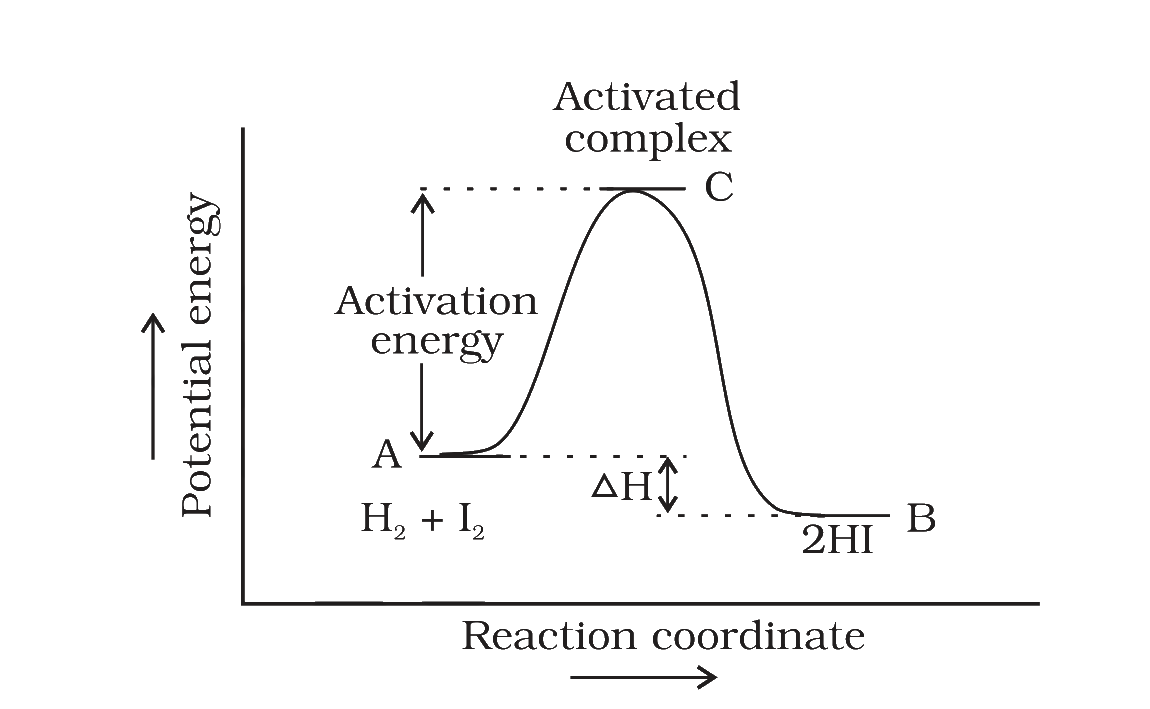
Fig. 3.7

Fig. 3.7: Diagram showing plot of potential energy vs reaction coordinate

Advertisement

Practise more on Physical: Chemical Kinetics

Chapter-wise mocks on the real NTA exam screen, with solutions and your rank. Your first mocks are free.

Start free mocks →

Advertisement

Next questions

  1. An Electromagnetic Wave of frequency v = 3.0 MHz passes from vacuum into a dielectric medium with permittivity ε = 4.0. ThemPhysics · Electromagnetic Waves
  2. Arrange the stages of a crime in a correct order: (A) Commission of Crime (Actus Reus)(B) Intention (Mens Rea)(C) Preparation(D) Attempt Ch…Legal Studies · Judiciary
  3. The Paradox of Thrift means :Economics · Macro Economics: Determination of Income and Employment
  4. Which of the following is a cushion of fatty tissue covered by skin and pubic hair ?Biology · Human Reproduction
  5. Select the option in which the numbers share the same relationship as that shared by the given pair of numbers. 2197 : 1331General Aptitude Test · General Ability
  6. Who among the following women offered financial support for the preservation of the ancient site of Sanchi?History · Ancient India: Thinkers, Beliefs and Buildings
  7. A can finish a work in 16 days and B can do the same work in half the time taken by A. Then, working together, what part of the same work c…General Aptitude Test · Numerical Ability
  8. In a ΔABC, right-angled at B, AB = 5 cm and (AC - BC) = 1 cm. The value sec C + cot A of is?General Aptitude Test · Quantitative Reasoning
  9. Choose from the given options one that is closest in meaning to "unscrupulous"English · Synonyms
  10. If 8r/(r^2-8r+1)=1/14, then the value of (r +1/r) is __________.General Aptitude Test · Quantitative Reasoning