
CUETMOCK
  • Pricing
  • Mentors
Log inStart freeStart free mocks→

First test, then trust

Try a free CUET mock test.

Join 5,00,000+ students who rehearsed exam day on the exact NTA screen before sitting CUET. On the web and on Android.

Start free mocks →Get the Android app
CUETMOCK

India's #1 CUET Mock Test Platform. Original NCERT-based questions on the exact NTA exam screen — trusted by 5,00,000+ students since CUET 2022.

Get it onGoogle PlayScan to download the CUETMOCK app

Mock tests

  • CUET mock test series
  • Browse all papers
  • Commerce mocks
  • Humanities (Arts) mocks
  • Science mocks
  • Languages & GAT mocks
  • Free practice questions
  • Pricing

Resources

  • CUET exam guide
  • CUET syllabus
  • Universities accepting CUET
  • Expert blogs
  • News & notifications
  • Webinars & counselling
  • CUET score calculator
  • How we estimate your rank
  • FAQs

Company

  • About us
  • Our leadership & team
  • Our toppers
  • Mentors
  • For schools
  • Contact us
  • Terms
  • Privacy
  • Refund policy

Talk to us

+91 7696 6630 56info@cuetmock.comWhatsApp us

Our other platforms

  • JEE Mock — For IIT-JEE aspirants
  • NEET Mock — For NEET aspirants

Newsletter

Exam updates, study material and offers — no spam.

© 2026 NYC Ventures Pvt. Ltd.

701-702, Royal Business Park, Zirakpur, Punjab - 140603

  • Terms of use
  • Privacy policy
  • Refund policy
  • Contact us

iCUETMOCK is an independent preparation platform, not affiliated with the National Testing Agency (NTA). Always check exam details on the official NTA website.

  • Home
  • Mock tests
  • CUET guide
  • Pricing
  • Log in
Home/Practice questions/Chemistry
ChemistryPhysical: Electro Chemistry

The factor(s) governing the flow of electricity through an electrolyt…

The factor(s) governing the flow of electricity through an electrolytic solution is/are

(A). The nature of inter ionic attraction.
(B). Temperature
(C). Solvation of ions.
(D). The nature of solvent and its viscosity.

Choose the correct answer from the options given below:

Answer & explanation+

Correct answer: option 3

The correct answer is Option (3) → (A), (B), (C) and (D)

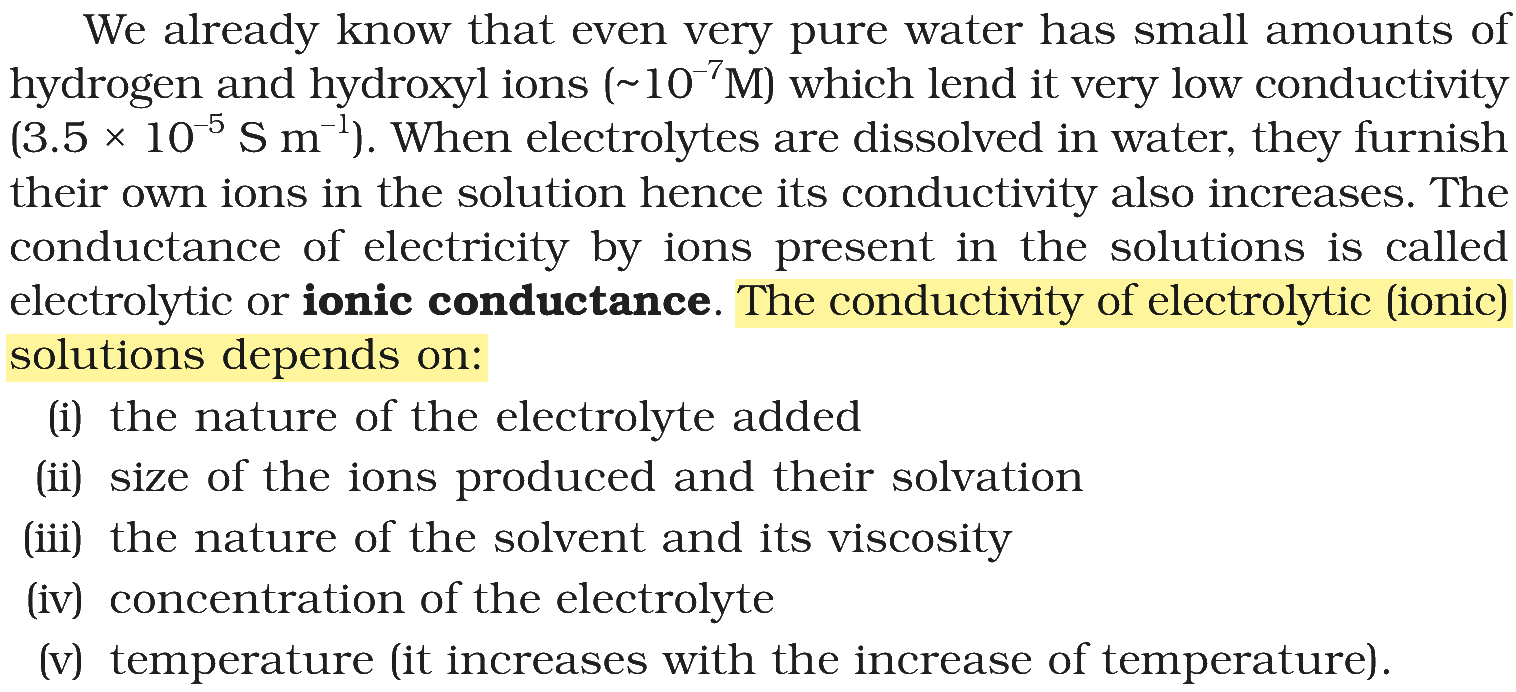
An electrolytic solution conducts electricity by the movement of ions. Anything that changes the number of ions or how freely they move changes the conductance: the nature and concentration of the electrolyte, the size and solvation of its ions, the solvent and its viscosity, and the temperature.

  • (A) The nature of inter ionic attraction. — Correct. Oppositely charged ions attract and hold one another back. The stronger these interionic attractions (higher concentration, higher ionic charges), the more slowly the ions move; this is why the molar conductivity of a strong electrolyte falls as its concentration rises.

  • (B) Temperature — Correct. Conductivity increases with temperature, because the viscosity of the solvent falls and the ions move faster (and a weak electrolyte dissociates more).

  • (C) Solvation of ions. — Correct. A solvated ion moves together with its shell of solvent molecules, so a heavily solvated ion is effectively larger and slower. Small \( \ce{Li^{+}} \), which is strongly hydrated, conducts less than the larger \( \ce{Cs^{+}} \) ion in water.

  • (D) The nature of solvent and its viscosity. — Correct. A more viscous solvent resists the motion of the ions; the solvent also decides, through its polarity, how far the electrolyte dissociates.

NCERT (2026-27 edition):
Conductance of Electrolytic Solutions – …
Textbook extract

Advertisement

Practise more on Physical: Electro Chemistry

Chapter-wise mocks on the real NTA exam screen, with solutions and your rank. Your first mocks are free.

Start free mocks →

Advertisement

Next questions

  1. Opioids are drugs, which bind to specific opioid receptors present in our :Biology · Human Health and Disease
  2. Which of the following articles of the Indian Constitution is related to the writ of the High Courts?General Aptitude Test · General Knowledge
  3. For α, β, γ∈ R, let A= […] and B= […] . If tr(A) = tr(B), then find the value of (α^-1+β^-1+γ^-1).Maths. Section B1 · Matrices
  4. Which of the following is a transducer?Physics · Communication
  5. What did Abanindranath Tagore and E. B. Havell criticise about colonial Art Schools?Fine Arts · The Bengal School and Cultural Nationalism
  6. Which of the following is true?Business Studies · Marketing
  7. Which of the following is not correct?Chemistry · Inorganic: Coordination Compounds
  8. For the given 5 values, 15, 18, 21, 27, 39; the three year moving averages are:Applied Maths. Section B2 · Index Numbers and Time Based Data
  9. What became a major portion of court art during the reign of Raj Singh in Kishangarh?Fine Arts · The Rajasthani Schools of Painting
  10. 8 men and 12 women finish a job in 4 days. While 6 men and 14 women in 5 days. In how many days will 20 women finish the job?General Aptitude Test · Numerical Ability