The aqueous solution of which of the following salts is coloured?
Answer & explanation
Correct answer: option 3
The correct answer is Option (3) → \(Co(NO_3)_2\)
A salt solution is coloured when its metal ion has a partly filled d subshell: a d electron absorbs visible light and jumps to a higher d orbital, and the solution shows the complementary colour. The nitrate and sulphate ions are colourless, so the colour depends on the cation.
Oxidation state of Co: in \( \ce{Co(NO3)2} \), x + 2(−1) = 0, so x = +2.
Configuration: Co (Z = 27) is [Ar]3d74s2; losing the two 4s electrons gives \( \ce{Co^2+} \): 3d7.
d subshell: 3d7 is partly filled, so a d–d transition is possible.
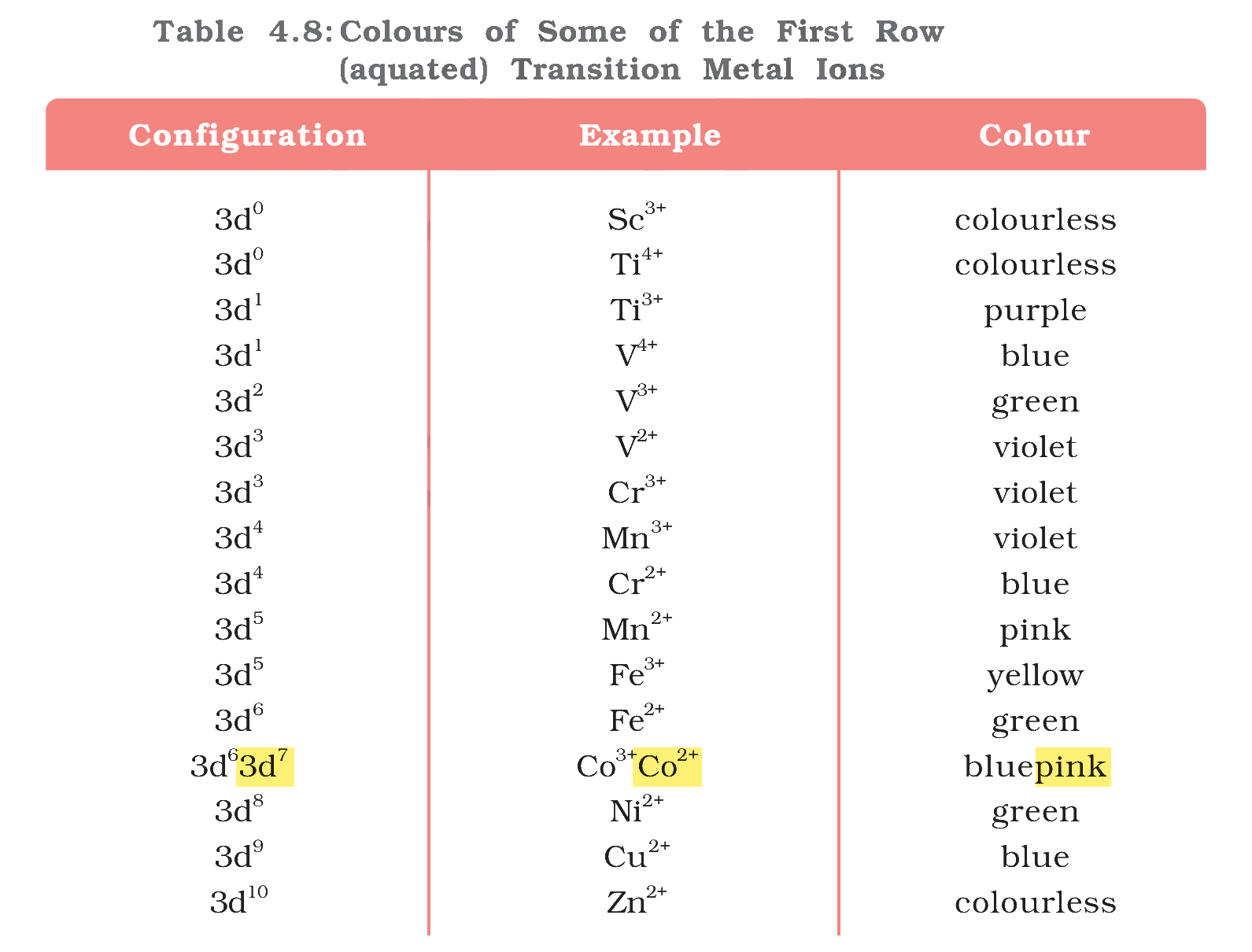
Colour: the aquated \( \ce{Co^2+} \) ion is pink.
Why the other options are incorrect
Option (1) \( \ce{Zn(NO3)2} \) — Incorrect. \( \ce{Zn^2+} \) is 3d10; with a completely filled d subshell no d–d transition is possible, so the solution is colourless.
Option (2) \( \ce{LiNO3} \) — Incorrect. \( \ce{Li^+} \) (1s2) is an s-block ion with no d electrons, so its solution is colourless.
Option (4) Potash alum — Incorrect. Potash alum, \( \ce{KAl(SO4)2.12H2O} \), gives \( \ce{K^+} \), \( \ce{Al^3+} \) and \( \ce{SO4^2-} \) ions in water; neither metal ion has any d electrons, so the solution is colourless.
NCERT (2026-27 edition):
4.3.10 Formation of Coloured Ions – “When an electron from a lower energy d orbital is excited to a higher energy d orbital, the energy of excitation corresponds to the frequency of light absorbed (Unit 5). … The colour observed corresponds to the complementary colour of the light absorbed. … In aqueous solutions where water molecules are the ligands, the colours of the ions observed are listed in Table 4.8.”