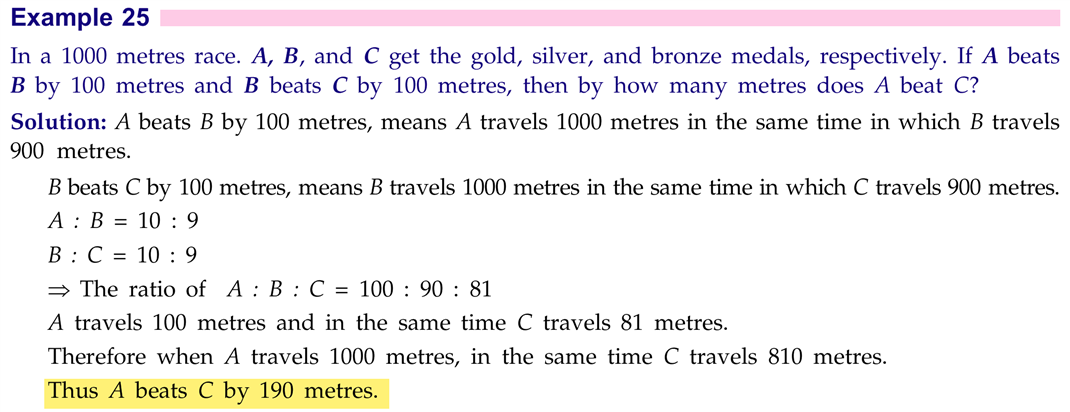
In a 10 km race, A, B and C each running at uniform speed get the gold, silver and bronze medals respectively. If A beats B by 1 km and B beats C by 1 km, then by how many meters does A beat C?
Answer & explanation
Correct answer: option 3
The correct answer is Option (3) → 1900 m
With uniform speeds, the distances covered in the same time are in the ratio of the speeds.
A beats B by 1 km: while A runs 10 km, B runs 9 km.
B beats C by 1 km: while B runs 10 km, C runs 9 km, so while B runs 9 km, C runs
\( \displaystyle \frac{9}{10}\times 9=8.1\ \text{km} \)
So while A runs 10 km, C runs 8.1 km, and A beats C by
\( \displaystyle 10-8.1=1.9\ \text{km}=1900\ \text{m} \)
Why the other options are incorrect
Option (1) 2000 m — Incorrect. 2000 m simply adds the two margins; but when A finishes, B has run only 9 km, not 10 km, so C is behind B by less than 1 km at that moment.
Option (2) 10000 m — Incorrect. 10000 m is the length of the whole race.
Option (4) 8100 m — Incorrect. 8100 m is the distance C has run when A finishes, not the margin.
CBSE Applied Mathematics (Class XII):
Races and Games