Select the incorrect statement from the following:
Answer & explanation
Correct answer: option 3
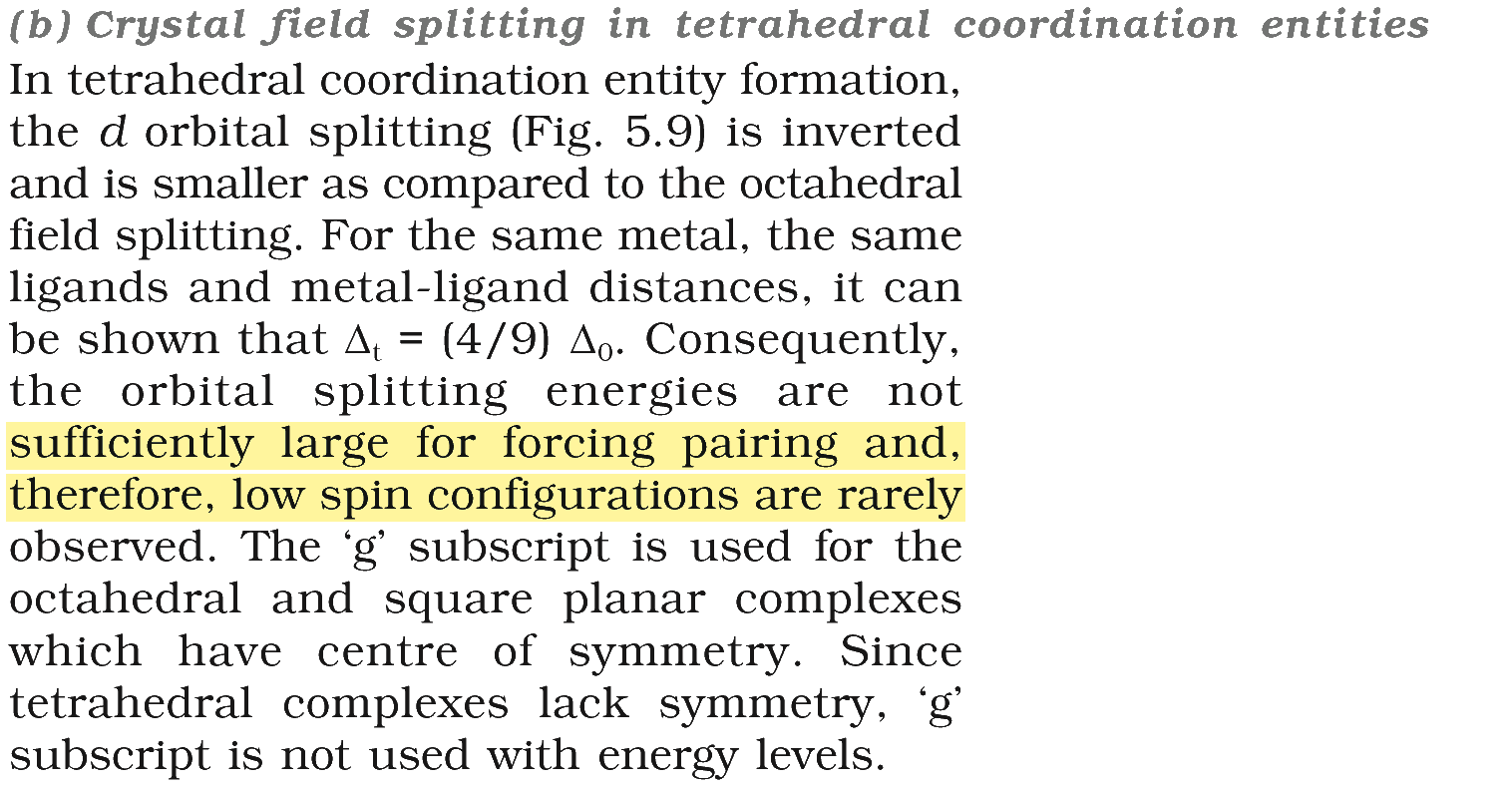
The correct answer is Option (3) → Tetrahedral complexes are commonly low spin complexes.
In crystal field theory the five d orbitals split when ligands approach. The average energy (barycentre) stays the same, so the gain of one set balances the loss of the other:
Octahedral: eg (2 orbitals) up by (3/5)Δo, t2g (3 orbitals) down by (2/5)Δo.
\( \displaystyle 2\times\frac{3}{5}\Delta_o-3\times\frac{2}{5}\Delta_o=0 \)
Tetrahedral: the order is reversed; e (2 orbitals) down by (3/5)Δt, t2 (3 orbitals) up by (2/5)Δt.
Option (1) In crystal field splitting of octahedral complexes the energy of the each of two eg orbitals will increase by (3/5)Δo and that of each of the three t2g will decrease by (2/5)Δo. — A correct statement of crystal field theory. The eg orbitals point directly at the ligands and are raised; the t2g orbitals point between them and are lowered.
Option (2) In crystal field splitting of tetrahedral complexes the energy of the each of two e orbitals will decrease by (3/5)Δt and that of each of the three t2 will increase by (2/5)Δt. — A correct statement of crystal field theory. In a tetrahedral field the splitting pattern is the inverse of the octahedral one.
Option (3) Tetrahedral complexes are commonly low spin complexes. — The incorrect statement. The tetrahedral splitting is small and almost always less than the pairing energy, so tetrahedral complexes are commonly high spin.
Option (4) The crystal field splitting in octahedral complexes, Δo, depends upon the field produced by the ligand and charge on the metal ion. — A correct statement of crystal field theory. Stronger field ligands and a higher charge on the metal ion both increase Δo.
NCERT (2026-27 edition):
Crystal Field Splitting in Tetrahedral Coordination Entities