
The figure shows a commonly used primary cell.
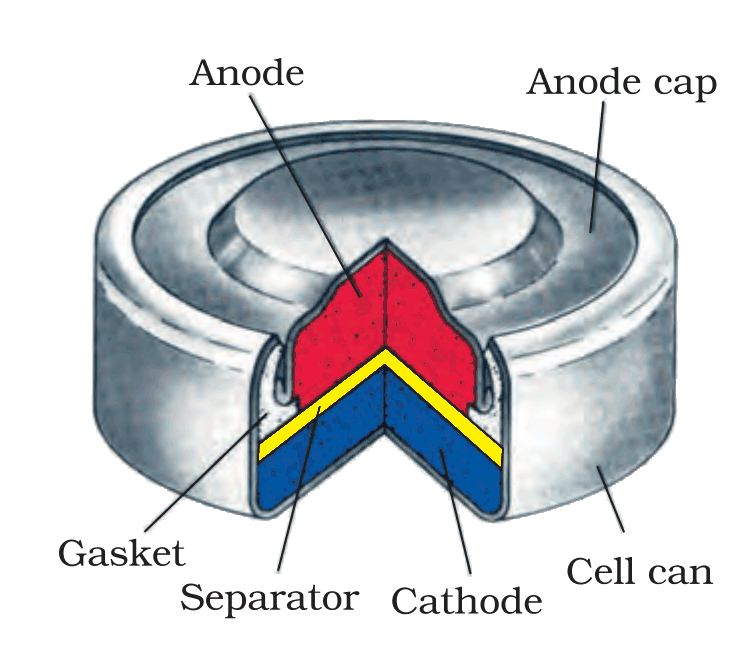
Which reaction takes place at the part labelled ‘Cathode’ while the cell is in use?
Answer & explanation
Correct answer: option 1
The correct answer is Option (1) → \( \ce{HgO + H2O + 2e^- -> Hg(l) + 2OH^-} \)
The button-shaped cell in the figure, with an anode cap, a gasket and a separator between the anode and the cathode, is the mercury cell. Its anode is zinc–mercury amalgam and its cathode is a paste of HgO and carbon. While the cell is in use, mercury(II) oxide is reduced to liquid mercury at the cathode:
Cathode: \( \ce{HgO + H2O + 2e^- -> Hg(l) + 2OH^-} \)
Why the other options are incorrect
Option (2) \( \ce{Zn(Hg) + 2OH^- -> ZnO(s) + H2O + 2e^-} \) — Incorrect. This is the reaction at the anode of the mercury cell, where zinc is oxidised; it does not take place at the cathode.
Option (3) \( \ce{MnO2 + NH4^+ + e^- -> MnO(OH) + NH3} \) — Incorrect. This is the cathode reaction of the dry cell (Leclanche cell), which has a carbon rod in a zinc container, not the button design shown.
Option (4) \( \ce{PbO2(s) + SO4^2-(aq) + 4H^+(aq) + 2e^- -> PbSO4(s) + 2H2O(l)} \) — Incorrect. This is the cathode reaction of the lead storage battery, a secondary cell; the cell shown has no lead dioxide.
NCERT (2026-27 edition):
2.6.1 Primary Batteries – “Mercury cell, (Fig. 2.9) suitable for low current devices like hearing aids, watches, etc. consists of zinc – mercury amalgam as anode and a paste of HgO and carbon as the cathode. The electrolyte is a paste of KOH and ZnO. The electrode reactions for the cell are given below:”
Anode: Zn(Hg) + 2OH– → ZnO(s) + H2O + 2e–
Cathode: HgO + H2O + 2e– → Hg(l) + 2OH–
Fig. 2.9: Commonly used mercury cell. The reducing agent is zinc and the oxidising agent is mercury (II) oxide.