CUETMOCK
  • Pricing
  • Mentors
Log inStart freeStart free mocks→

First test, then trust

Try a free CUET mock test.

Join 5,00,000+ students who rehearsed exam day on the exact NTA screen before sitting CUET. On the web and on Android.

Start free mocks →Get the Android app
CUETMOCK

India's #1 CUET Mock Test Platform. Original NCERT-based questions on the exact NTA exam screen — trusted by 5,00,000+ students since CUET 2022.

Get it onGoogle PlayScan to download the CUETMOCK app

Mock tests

  • CUET mock test series
  • Commerce mocks
  • Humanities (Arts) mocks
  • Science mocks
  • Languages & GAT mocks
  • Free practice questions
  • Pricing

Resources

  • CUET exam guide
  • CUET syllabus
  • Universities accepting CUET
  • Expert blogs
  • News & notifications
  • Webinars & counselling
  • CUET score calculator
  • How we estimate your rank
  • FAQs

Company

  • About us
  • Our leadership & team
  • Our toppers
  • Mentors
  • For schools
  • Contact us
  • Terms
  • Privacy
  • Refund policy

Talk to us

+91 7696 6630 56info@cuetmock.comWhatsApp us

Our other platforms

  • JEE Mock — For IIT-JEE aspirants
  • NEET Mock — For NEET aspirants

Newsletter

Exam updates, study material and offers — no spam.

© 2026 NYC Ventures Pvt. Ltd.

701-702, Royal Business Park, Zirakpur, Punjab - 140603

  • Terms of use
  • Privacy policy
  • Refund policy
  • Contact us

iCUETMOCK is an independent preparation platform, not affiliated with the National Testing Agency (NTA). Always check exam details on the official NTA website.

  • Home
  • Mock tests
  • CUET guide
  • Pricing
  • Log in
Home/Practice questions/Economics
EconomicsMicro Economics: Theory of Consumer behaviour

If the price of a commodity increases by 20%, its demand drops by 20%…

If the price of a commodity increases by 20%, its demand drops by 20%. Then how it will affect the expenditure?

Answer & explanation+

Correct answer: option 3

The correct answer is Option (3) → No change in expenditure.

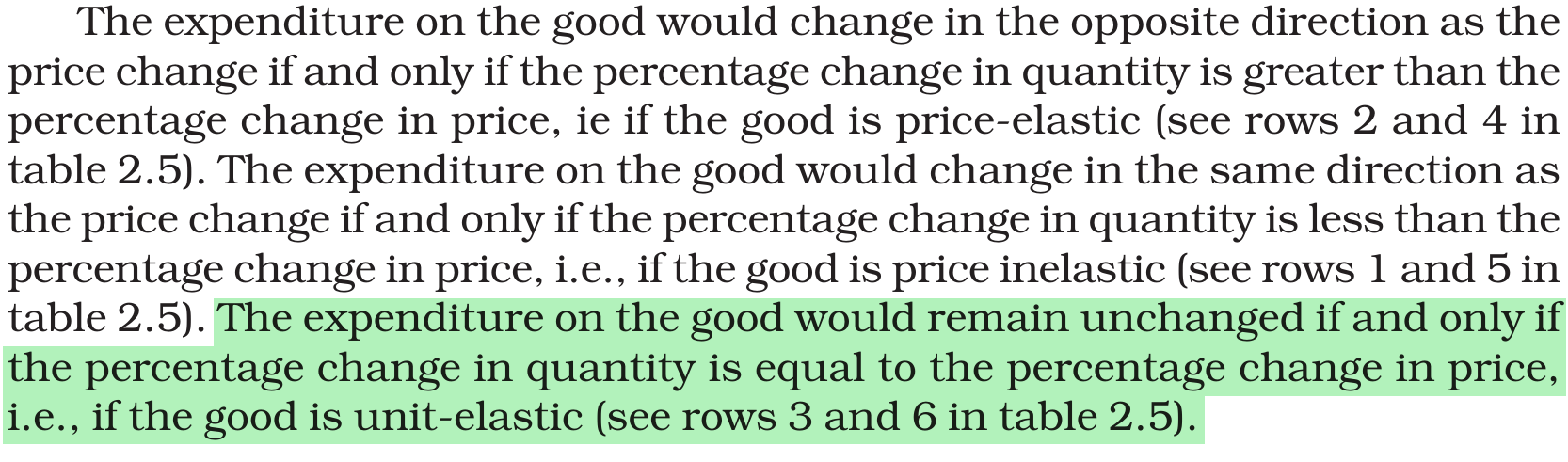
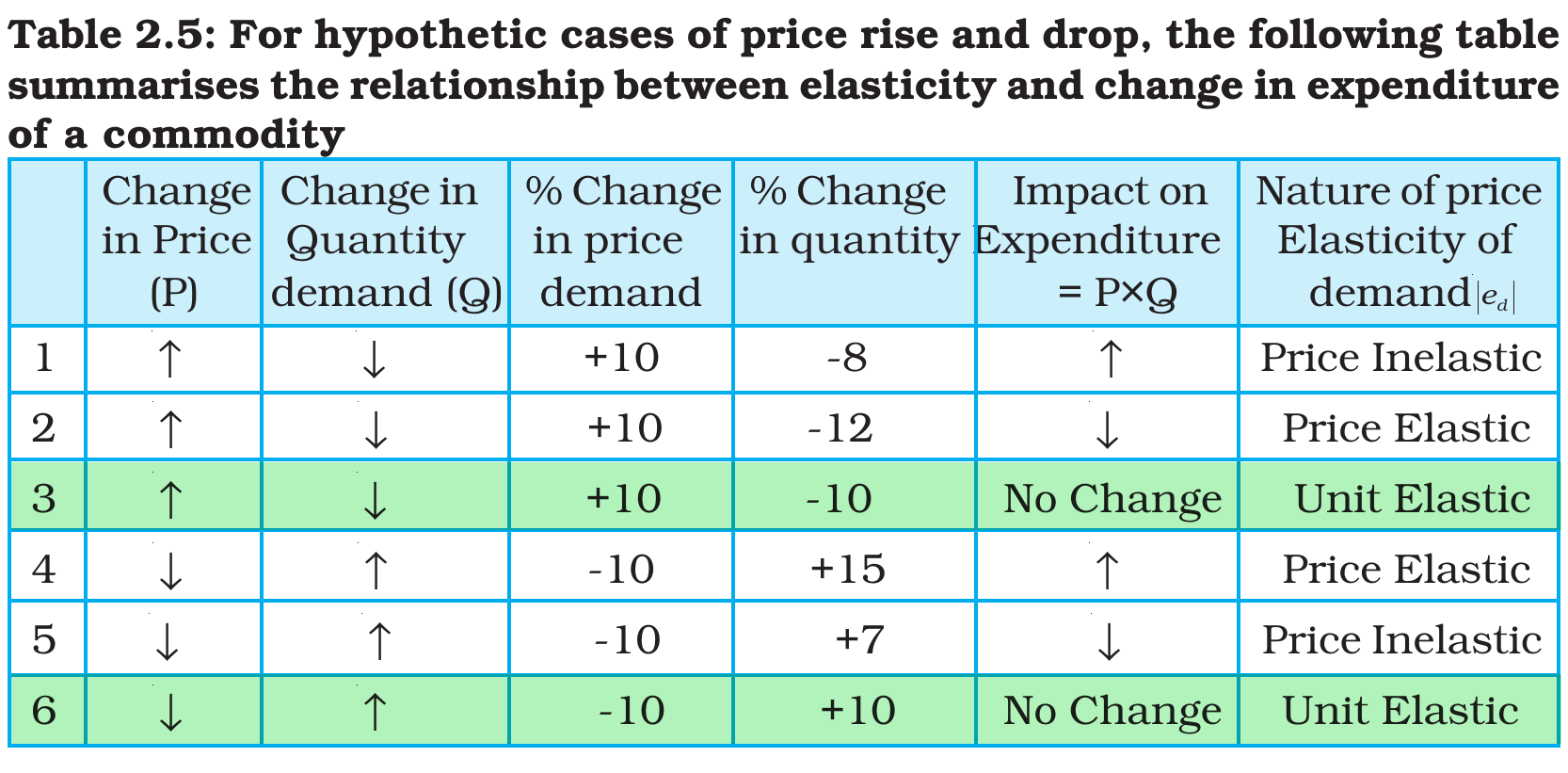
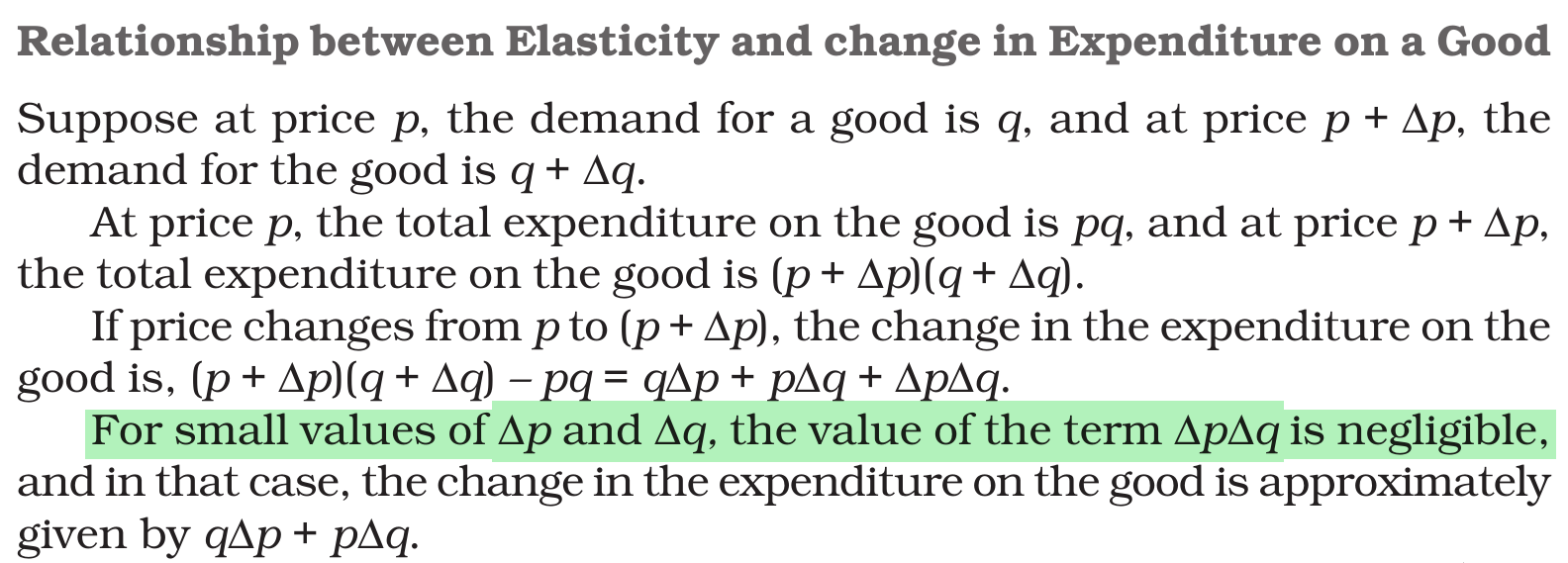
Note: The given answer is as per the official NTA Answer Key. The NCERT rule says that when the percentage fall in quantity equals the percentage rise in price, the expenditure remains unchanged. This gives Option (3). But the rule holds only for small changes. Worked out in full, a 20 per cent change gives a fall of 4 per cent, so one can argue for Option (1), as explained below.

The question says the price rises by 20% and demand falls by 20%. When the two percentages are equal, expenditure does not change.

Expenditure on a good = price × quantity bought.

  • When the price rises, buyers buy less.

  • The result depends on the price elasticity of demand, that is, how much demand reacts to price.

For a rise in price, there are three cases:

  • quantity falls more than the price rises (price-elastic): expenditure goes down;

  • quantity falls less than the price rises (price-inelastic): expenditure goes up;

  • quantity falls by the same percentage as the price rises (unit-elastic): expenditure remains unchanged.

Here elasticity = 20 ÷ 20 = 1, unit elastic, so this is the third case.

The rule is only approximate:

  • The exact change in expenditure is \( q\Delta p + p\Delta q + \Delta p\Delta q \).

  • The rule drops the last term because it is negligible for small changes.

For a 20 per cent change it is not:

New price = 1.20 × old price

New quantity = 0.80 × old quantity

New expenditure = 1.20 × 0.80 = 0.96 × old expenditure, a fall of 4 per cent (0.20 × 0.20 = 0.04, the term the rule leaves out).

NCERT (2026-27): Introductory Microeconomics — Chapter 2: Theory of Consumer Behaviour

NCERT extract

NCERT extract

NCERT extract

Advertisement

Practise more on Micro Economics: Theory of Consumer behaviour

Chapter-wise mocks on the real NTA exam screen, with solutions and your rank. Your first mocks are free.

Start free mocks →

Advertisement

Next questions

  1. Which of the following statements about westernisation are correct?(A) One kind of westernisation emerged through a minority section of Ind…Sociology · Social Change and Development in India: Cultural Change
  2. If x + 1/x = √7, then what is the value of (x^2 + 1) ÷ [ x^4 +(1/(x^2))]?General Aptitude Test · Quantitative Reasoning
  3. Which of the following states launched the 'Mukhyamantri Seekho-Kamao Yojana' (MMSKY) in 2023?General Aptitude Test · Current Affairs
  4. Select the most appropriate ANTONYM of the underlined word in the given sentence. He leaves behind an indelible contribution to the financi…English · Antonyms
  5. In a certain code language, BIRTH is coded as 25129719 and DEVIL is coded as 23851215. How will GLORY be coded in that language?General Aptitude Test · Verbal Reasoning
  6. Who was the Commander of British Forces during the American War of Independence?History · Modern India: Colonialism and the Countryside
  7. Painting grew at the Mughal court under its emperors and princes. Consider the following statements:(A) The tradition of painting started b…Fine Arts · The Mughal School of Miniature Painting
  8. "EcoTech sponsors sustainability events and runs awareness campaigns about the environmental impact of electronic waste and publishes the s…Business Studies · Marketing
  9. 'अभिनव' का विलोम क्या है?Hindi · Antonyms
  10. The public-sector aviation company, Air India, has been acquired by Tata Group. What other airline is operated by Tata Group?General Aptitude Test · Current Affairs